
Table of Contents
INFORMATION REQUIRED IN PROXY STATEMENT
SCHEDULE 14A INFORMATION
Filed by the Registrant x
Filed by a Party other than the Registrant o
Check the appropriate box:
| o Preliminary Proxy Statement |
o Confidential,
for Use of the Commission Only (as permitted by Rule 14a-6(e)(2))
|
|
| x Definitive Proxy Statement | ||
| o Definitive Additional Materials | ||
| o Soliciting Material under Rule 14a-12 | ||
National Vision, Inc.
Payment of Filing Fee (Check the appropriate box):
| x | No fee required. |
o Fee computed on table below per Exchange Act Rules 14a-6(i)(1) and 0-11.
| (1) | Title of each class of securities to which transaction applies: |
| (2) | Aggregate number of securities to which transaction applies: |
| (3) | Per unit price or other underlying value of transaction computed pursuant to Exchange Act Rule 0-11 (set forth the amount on which the filing fee is calculated and state how it was determined): |
| (4) | Proposed maximum aggregate value of transaction: |
| (5) | Total fee paid: |
| o | Fee paid previously with preliminary materials: |
| o | Check box if any part of the fee is offset as provided by Exchange Act Rule 0-11(a)(2) and identify the filing for which the offsetting fee was paid previously. Identify the previous filing by registration statement number, or the Form or Schedule and the date of its filing. |
| (1) | Amount Previously Paid: |
| (2) | Form, Schedule or Registration Statement No.: |
| (3) | Filing Party: |
| (4) | Date Filed: |
Table of Contents

|
NATIONAL VISION, INC.
NOTICE OF ANNUAL MEETING OF SHAREHOLDERS
To the Shareholders:
The Annual Meeting of Shareholders of National Vision, Inc., a Georgia corporation, will be held at the offices of the Company located at 296 Grayson Highway, Lawrenceville, Georgia, on June 29, 2004, at 11:00 a.m.
We are holding this meeting for the following purposes:
| 1. To elect a Board of five Directors to serve until the 2005 Annual Meeting of Shareholders. | |
| 2. To approve the 2004 Equity Incentive Plan. | |
| 3. To transact such other business as may properly come before the meeting or any adjournments of the meeting. |
The Board of Directors has set May 3, 2004 as the record date for this meeting. Accordingly, shareholders as of the close of business on that date are entitled to:
| • | receive this notice of meeting and accompanying materials | |
| • | vote at the meeting and any adjournments of the meeting. |
A proxy statement and a proxy solicited by the Board of Directors are enclosed, along with our annual report. Your vote is important. Please note that you have the option to vote in one of three ways:
| • | Via the Internet (see the website shown on your proxy card) | |
| • | By telephone (within the U.S., call the toll-free number shown on your proxy card) | |
| • | By mail (please sign, date, and return the proxy promptly in the enclosed business reply envelope). |
If you attend the meeting, you may, if you wish, withdraw your proxy and vote in person.
| By order of the Board of Directors, | |
| MITCHELL GOODMAN | |
| Secretary |
Lawrenceville, Georgia
Table of Contents
NATIONAL VISION, INC.
PROXY STATEMENT
General
The Board of Directors (the “Board”) of National Vision, Inc., a Georgia corporation (the “Company”), is soliciting the enclosed proxy for use at the 2004 Annual Meeting of Shareholders (the “Meeting”) to be held on June 29, 2004. Only shareholders of record at the close of business on May 3, 2004, will be entitled to vote at the Meeting. On May 10, 2004, the Company had issued and outstanding 5,239,359 shares of Common Stock (“Common Stock”).
The Company’s principal executive offices are located at 296 Grayson Highway, Lawrenceville, Georgia 30045. The approximate date on which this proxy statement and the accompanying proxy are being first sent to shareholders is May 10, 2004.
Voting
Each of the 5,239,359 shares of Common Stock outstanding as of the record date entitles the holder to notice of, and vote on, each matter to be presented at the Meeting or any adjournments thereof. Each share is entitled to one vote. You have the option to vote via the Internet, by telephone (within the U.S.) or by mail using the enclosed proxy card. If you want to vote via the Internet or by telephone, please read the instructions on the proxy card. Directors are elected by a plurality of the votes cast by the shares entitled to vote. An automated system administered by the Company’s transfer agent tabulates the votes.
Abstentions and “broker non-votes” (that is, proxies from brokers or nominees indicating that such persons have not received instructions from the beneficial owner or other persons entitled to vote shares as to a matter with respect to which the brokers or nominees do not have discretionary power to vote) will be treated as present for purposes of determining the presence of a quorum, but will otherwise have no effect on the election of directors or on any other matter presented at the Meeting. Broker non-votes will be deemed not entitled to vote on the subject matter as to which the non-vote is indicated and will, therefore, have no legal effect on the vote on that particular matter.
Revocability of Proxies
If you want to cancel or change your vote after casting it, you can do any of the following at any time prior to the Meeting: (i) you can deliver a written notice of cancellation to our principal office to the attention of the Secretary of the Company; (ii) you can fill out and mail another proxy card to us with a later date; (iii) if you voted using the Internet, you can log on to the Web site again and follow the prompts; or (iv) if you voted by telephone, you can call the toll-free number again and follow the instructions. Otherwise, you can attend the Meeting and vote in person.
Solicitation
The Company will bear the entire cost of preparing, assembling, printing and mailing this proxy statement, the accompanying proxy and any additional material which may be furnished to shareholders by the Company. Copies of solicitation material will be furnished to brokerage houses, fiduciaries and custodians to forward to beneficial owners of stock held in their name. We will solicit proxies through the mail and through direct communication with certain shareholders or their representatives by officers, directors and employees of the Company, who will receive no additional compensation therefor.
Table of Contents
INFORMATION ABOUT THE BOARD AND ITS COMMITTEES
Compensation of Directors
Non-employee directors of the Company receive an annual retainer of $60,000 and also receive medical and dental benefits. Non-employee directors are also eligible to participate in the restated Non-Employee Director Stock Option Plan. Under this stock option plan, non-employee directors are entitled to automatic grants of options to purchase 10,000 shares upon the date of each annual meeting of shareholders. (The individuals who served as non-employee directors as of the date the Company exited from bankruptcy proceedings each received an initial grant covering 15,000 shares.) All option grants are at exercise prices no less than the “fair market value” of a share of Common Stock on the date of grant. All options vest 50 percent on the second anniversary of the grant date and 25 percent on each of the third and fourth anniversaries of the grant date, or 100 percent upon the death of the director. All current directors of the Company are non-employee directors. As of the Meeting, only 45,000 shares will remain in the Non-Employee Director Stock Option Plan. Directors will also be eligible to receive grants under the proposed 2004 Equity Incentive Plan, which shareholders are being asked to approve at the Meeting (see Proposal Two). If the shareholders approve the 2004 Equity Incentive Plan, the Non-Employee Director Stock Option Plan will be terminated effective May 3, 2004, and the current directors will not receive any options under the terminated plan. If the shareholders do not approve the 2004 Equity Incentive Plan, the five directors will each receive a grant under the Non-Employee Director Stock Option Plan covering 9,000 shares as of the date of the Meeting.
COMMITTEES OF THE BOARD
The Board has three separately designated standing committees: the Audit Committee; the Compensation Committee; and the Nominating Committee. The members of each of these Committees are listed below, along with the number of meetings of each Committee in 2003:
| Audit | Compensation | Nominating | ||
|
Jeffrey A. Snow, Chair
|
B. Robert Floum, Chair | B. Robert Floum | ||
|
B. Robert Floum
|
Marc B. Nelson | Peter T. Socha | ||
|
Peter T. Socha
|
Jeffrey A. Snow | |||
|
23 meetings
|
Four meetings | No meetings |
Audit Committee
The duties and responsibilities of the Audit Committee include the following:
| • | Monitoring the Company’s financial reporting process and internal control system | |
| • | Reviewing the independence and performance of the independent auditors and the internal accounting department | |
| • | Selecting and evaluating the independent auditors | |
| • | Monitoring compliance by the Company with legal, regulatory and ethical requirements. |
The report of the Audit Committee is set forth on page 14.
The listing standards of the American Stock Exchange require that the members of the Audit Committee be independent unless the Board determines that it is in the best interest of the Company to have one non-independent member of the Audit Committee. Each of Mr. Snow and Mr. Floum is independent within the meaning of the listing standards of the American Stock Exchange. As of the date of the mailing of this proxy statement, Mr. Socha is not considered independent under the listing standards, because he served as an employee of the Company within the last three years. Mr. Socha resigned, however, as an employee of the Company in June 2001. Accordingly, he will, as of the date of the Meeting, be considered independent under these listing standards.
2
Table of Contents
The Board has determined that each of Mr. Snow and Mr. Socha is an audit committee financial expert within the meaning of applicable regulations of the Securities and Exchange Commission.
Compensation Committee
The duties and responsibilities of the Compensation Committee include the following:
| • | Establishing salaries, bonuses, and the other compensation for the Company’s officers | |
| • | Making awards under the Company’s Restated Stock Option and Incentive Award Plan. |
The report of the Compensation Committee begins on page 11.
Nominating Committee
The Nominating Committee is responsible for recommending and nominating individuals for election or re-election as directors. The Nominating Committee will consider recommendations for nominees for directorships submitted by shareholders, subject to its procedures and the provisions of the Company’s By-Laws.
The Committee may consider and make recommendations to the Board concerning a nominee for director submitted by a shareholder who has beneficially owned more than 5% of the Company’s outstanding Common Stock for more than one year at the time of the shareholder’s submission of a nominee. Nominations of individuals for election to the Board at any annual meeting of shareholders may be made by any shareholder of the Company entitled to vote for the election of directors at that meeting by complying with the procedures set forth in Article III, Section 3 of the Company’s Bylaws.
This provision of the Company’s By-Laws contains an advance notice procedure for the nomination of candidates for election to the Board. Notice of proposed shareholder nominations for election of directors must be given to the President of the Company not less than 14 days nor more than 50 days prior to the meeting at which directors are to be elected, unless the notice of meeting is given less than 21 days prior to the meeting, in which case the notice of nomination must be submitted not later than the 7th day following the day on which the notice of meeting was mailed to shareholders. The notice of nomination must contain information about each proposed nominee, including age, address, principal occupation, financial standing, plans or ideas for managing the affairs of the Company, the number of shares of stock of the Company beneficially owned by such nominee and such other information as would be required to be disclosed under the Securities Exchange Act of 1934, as amended (the “Exchange Act”) in connection with any acquisition of shares by such nominee or with the solicitation of proxies by such nominee for his election as a director. Information must also be disclosed by and about the shareholder proposing to nominate that person. The chairman of a shareholder meeting may refuse to acknowledge the nomination of any person who does not comply with the foregoing procedure.
The foregoing summary description of the By-Laws is not intended to be complete and is qualified in its entirety by reference to the text of the By-Laws.
Director candidates should at a minimum possess the following qualifications:
| • | High moral character and personal integrity; | |
| • | Demonstrated accomplishment in his or her field; | |
| • | Ability to devote sufficient time to carry out the duties of a director; and | |
| • | Be at least 21 years of age. |
The Board and Committee may also consider any other information relevant in their business judgment to the decision of whether to nominate a particular candidate for a particular Board seat, taking into account the then-current composition of the Board, including without limitation, a candidate’s professional and educational background, reputation, industry knowledge and business experience, and the relevance of that background, reputation, knowledge and experience to the Company and the Board.
3
Table of Contents
The Committee from time to time considers and makes recommendations to the Board regarding what experience, talents, skills and other characteristics the Board as a whole should possess in order to maintain the Board’s effectiveness. Among other matters, the Board and Committee may consider whether there are an appropriate number of financially literate and/or independent directors to effectively staff the Company’s standing Board committees and maintain a majority of independent directors on the Board.
The Board and Committee will evaluate each incumbent director’s continued service on the Board, in light of the Board’s collective requirements, at the time such director’s seat comes up for reelection. When the need for a new director arises (whether because of a newly created Board seat or vacancy), the Committee may proceed by whatever means it deems appropriate to identify a qualified candidate or candidates and may, for example, recommend to the Board the engagement of a director search firm.
The charter of the Nominating Committee is available on our website, www.nationalvision.com. As of the date of the Meeting, the members of the Nominating Committee will be independent under the listing standards of the American Stock Exchange.
MEETINGS OF THE BOARD
During 2003, there were 13 meetings of the Board. All directors attended at least 75% of all meetings of the Board and all committees of the Board of which they were members.
PROPOSAL ONE
ELECTION OF DIRECTORS
The directors of the Company are elected annually to serve until the next annual meeting of shareholders and until their respective successors are elected. The authorized number of directors of the Company is presently fixed at five. All the nominees are currently directors.
Each proxy executed and returned by a shareholder will be voted as specified by the shareholder. If no specification is made, such proxy will be voted for the election of the nominees named below to constitute the entire Board. If any nominee withdraws or for any reason is not able to serve as a director, the proxy will be voted for such other person as may be designated by the Board as a substitute nominee, but in no event will the proxy be voted for more than five nominees. The management of the Company has no reason to believe that any nominee will not serve if elected.
The Board, including all its independent directors, has approved a process whereby security holders can communicate with the Board and individual directors by accessing our website, www.nationalvision.com. and clicking on “Investor Relations.”
We encourage all members of the Board to attend our annual meetings of shareholders. Last year, all members of the Board attended our 2003 annual meeting.
Information Concerning Directors
The following information is provided, as of May 3, 2004, regarding current directors and the nominees for election as directors:
| Name | Age | Positions with the Company | ||||
|
Peter T. Socha
|
45 | Chairman of the Board | ||||
|
B. Robert Floum
|
69 | Director | ||||
|
James W. Krause
|
59 | Director | ||||
|
Marc B. Nelson
|
43 | Director | ||||
|
Jeffrey A. Snow
|
52 | Director | ||||
4
Table of Contents
Mr. Socha joined the Company in October 1999 as Senior Vice President, Strategic Planning. He served as Senior Vice President, Strategic Planning and Managed Care from February 2000 through June 2001. He became a director in February 2000 and was elected as Chairman of the Board in May 2002. In March 2003, he became President and Chief Executive Officer of James River Coal Company, a firm engaged in the mining, processing, and sale of steam coal. Mr. Socha also managed the Chapter 11 reorganization of that company.
Mr. Floum became a director in June 2001. From March 2000 through January 2001, he was acting Chief Operating Officer of Stage Stores. He served as Chief Operating Officer of Jumbo Sports, a sporting goods company, from February 1998 through July 1999.
Mr. Krause joined the Company in April 1994 as President and Chief Executive Officer and a director. He was named Chairman of the Board in June 1995 and retired as an executive of the Company at the beginning of January 2003.
Dr. Nelson is an optometrist licensed in New Jersey and Pennsylvania. Since 1992, he has been the president and sole shareholder of Nelson Eye Associates, P.C., which operates ten optometric clinics in retail optical locations owned by the Company.
Mr. Snow became a director in June 2001. He was President of Hi Fi Buys, Inc. from April 1982 through May 1997. He is currently Chairman of The Capital Network, LLC, a consulting firm.
Executive Officers
The following table sets forth, as of May 3, 2004, certain information regarding the executive officers of the Company:
| Name | Age | Positions with the Company | ||||
|
Reade Fahs
|
43 | President and Chief Executive Officer | ||||
|
J. Bruce Steffey
|
57 | Executive Vice President, Chief Operating Officer | ||||
|
Jeff Busbee
|
43 | Vice President, Human Resources and Corporate Compliance | ||||
|
S. Lynn Butler
|
35 | Vice President, Process Improvement | ||||
|
Paul A. Criscillis, Jr.
|
54 | Senior Vice President, Chief Financial Officer and Treasurer | ||||
|
Mitchell Goodman
|
50 | Senior Vice President, General Counsel and Secretary | ||||
|
Paul Gross
|
40 | Senior Vice President, Marketing and New Ventures | ||||
|
Timothy W. Ranney
|
51 | Vice President, Finance and Assistant Treasurer | ||||
|
Robert E. Schnelle
|
54 | Vice President, Chief Accounting Officer | ||||
|
Robert W. Stein
|
48 | Senior Vice President, Professional and Managed Care Development | ||||
|
Desmond F. Taylor
|
51 | Senior Vice President, Merchandising | ||||
Mr. Fahs joined the Company in April 2002 as President and Chief Operating Officer. He was named Chief Executive Officer in January 2003. From October 1999 until joining the Company, he served first as Chief Executive Officer, then as Executive Director, of First Tuesday, a growth stage company based in the United Kingdom. From 1997 until 1999, he served as a Managing Director of Vision Express, an optical retail company also based in the United Kingdom.
Mr. Steffey joined the Company in September 2002 as Senior Vice President, Retail Operations. From March 1995 to January 2002 he was employed by Zale Corporation, where he served as Senior Vice
5
Table of Contents
Mr. Busbee joined the Company in November 1995 as Director, Human Resources, was appointed a Vice President in February 2000 and assumed his current position in March 2003.
Ms. Butler joined the Company in December 1998 as manager of financial reporting. She became Director of Accounting and Reporting in April 2000 and Principal Accounting Officer in March 2002. She was appointed Vice President in June 2003 and Corporate Controller in August 2003 and assumed her current position in May 2004.
Mr. Criscillis joined the Company in January 2004 as Senior Vice President Chief Financial Officer and Treasurer. He served as Chief Financial Officer for Barry Real Estate Companies from December 2002 through July 2003. He had served as Vice President Chief Financial Officer for Suburban Lodges of America, Inc. from August 1998 through May 2002.
Mr. Goodman joined the Company as General Counsel and Secretary in September 1992 and was named a Vice President in November 1993 and Senior Vice President in May 1998.
Mr. Gross joined the Company in August 2002 as Senior Vice President Marketing, Frames Merchandising, and New Ventures. He assumed his current position in March 2004. He had served as Vice President for PC on Call LLC from August 2000 until shortly before joining the Company. From September 1991 until August 2000 he was employed by LensCrafters as Director of Marketing.
Mr. Ranney joined the Company in September 1998, was named Vice President, Corporate Controller in October 1998, and was named Vice President, Finance and Managed Care Operations in August 2003. He was appointed to his current position in May 2004. From 1991 until joining the Company, he was employed by CVS Corporation, where he served in various positions including Assistant Controller, Store Controller and Director of Financial Systems.
Mr. Schnelle joined the Company in April 2004 and in May was named Vice President, Chief Accounting Officer. Before joining the Company, he served from June 2003 as Vice President of Finance and Accounting at Wesley Hospitality, LLC. From 1999 to 2002 he served as Vice President, Treasurer and Chief Accounting Officer at Suburban Lodges of America, Inc. From May 2002 to May 2003, he consulted for Intown Suites Management, Inc., which had acquired Suburban Lodges of America in May 2002.
Mr. Stein joined the Company as Director of Human Resources in May 1992. In January 1993, he was appointed Vice President, Human Resources, and was appointed Senior Vice President in 1999. He was named Senior Vice President, Professional and Managed Care Development in August 2003.
Mr. Taylor joined the Company in March 2004 as Senior Vice President, Merchandising. From 2002 to March 2004, he served as chief executive officer of the U.S. subsidiary of Optoplast PLC. From 2000 to 2002, he served as Commercial Director, Dollond & Aitchison, a retail optical firm in the United Kingdom. He was previously Store Development Director of Vision Express, a retail optical firm in the United Kingdom, where he was employed from 1993 to 1999.
Each of Messrs. Krause, Socha, Goodman, Ranney, and Stein were executive officers of the Company as of the time the Company filed its petition for protection under Chapter 11 of the Bankruptcy Code.
6
Table of Contents
COMMON STOCK OWNERSHIP OF CERTAIN
Equity Compensation Plan Information
| Number of Securities | ||||||||||||
| Remaining Available | ||||||||||||
| for Future Issuance | ||||||||||||
| Number of Securities | Under Equity | |||||||||||
| to be Issued Upon | Weighted-Average | Compensation Plan | ||||||||||
| Exercise of | Exercise Price of | (Excluding Securities | ||||||||||
| Outstanding Options, | Outstanding Options, | reflected in | ||||||||||
| Warrants and Rights | Warrants and Rights | Column (a)) | ||||||||||
| Plan Category | (a) | (b) | (c) | |||||||||
|
Equity compensation plans approved by security
holders(1)
|
509,450 | (2) | $ | 0.62 | 141,236 | (3) | ||||||
|
Equity compensation plans not approved by
security holders
|
N/A | N/A | N/A | |||||||||
| (1) | A total of 720,000 shares, inclusive of options previously granted, are reserved for issuance under the Company’s Restated Stock Option and Incentive Award Plan (the “Employee Plan”) and 180,000 shares, inclusive of options previously granted, are reserved for issuance under the Company’s Restated Non-Employee Director Stock Option Plan (the “Directors Plan”). All information in this table is as of January 3, 2004. |
| (2) | Options covering 374,450 shares of common stock have been issued under the Employee Plan and options covering 135,000 shares of common stock have been issued under the Directors Plan. |
| (3) | The Company has awarded its President 84,400 shares of restricted stock under the Employee Plan in April 2002 and awarded a total of 168,000 shares of restricted stock to officers, including the named executive officers, in July 2003. The Company cancelled 23,625 of these restricted shares in connection with the termination of employment of certain of these officers. In April 2003, the Company issued 14,272 shares of common stock in partial settlement of performance shares under the Employee Plan. For determining the number of shares available for future issuance 6,267 shares were deducted in accordance with the Employee Plan as of January 3, 2004. |
Security Ownership of Certain Beneficial Owners
The Company is not aware of any person who, on May 3, 2004, was the beneficial owner of five percent (5%) or more of outstanding shares of Common Stock, except as set forth below.
| Amount and Nature of | Percent | |||||||
| Beneficial Ownership | of Class | |||||||
|
Northeast Investors Trust(a)
|
349,784 | 6.7 | ||||||
|
American Express Financial Corporation(b)
|
292,419 | 5.6 | ||||||
|
Horace S. Boone(c)
|
281,200 | 5.4 | ||||||
| (a) | This information is derived solely from a Schedule 13G filed on February 12, 2003. The address of this shareholder is 50 Congress Street, Boston, Massachusetts 02109. |
| (b) | This information is derived solely from a Schedule 13G filed on February 9, 2004. The address of this shareholder is 50606 AXP Financial Center, Minneapolis, Minnesota 55474. |
| (c) | This information is derived solely from a Schedule 13G filed on February 5, 2004. The address of this shareholder is c/o Ingalls and Snyder, 61 Broadway 31st Floor, New York, New York 10006. |
7
Table of Contents
Security Ownership of Board and Management
The following table sets forth information, as of May 3, 2004, concerning beneficial ownership by all directors, by each of the executive officers named in the Summary Compensation Table below, and by all directors and executive officers as a group.
| Number of Shares | Percent of | |||||||
| Beneficially | Outstanding | |||||||
| Name and Address of Beneficial Owner(1) | Owned | Common Stock | ||||||
|
Reade Fahs
|
225,680 | (a) | 4.2 | |||||
|
Jeffrey A. Snow
|
62,500 | (b) | 1.2 | |||||
|
B. Robert Floum
|
20,000 | (b) | * | |||||
|
James W. Krause
|
17,026 | (c) | * | |||||
|
Peter T. Socha
|
12,500 | (d) | * | |||||
|
Marc B. Nelson
|
6,500 | (e) | * | |||||
|
Paul Gross
|
19,851 | (f) | * | |||||
|
Mitchell Goodman
|
17,267 | (g) | * | |||||
|
J. Bruce Steffey
|
16,851 | (f) | * | |||||
|
Angus C. Morrison
|
1,334 | * | ||||||
|
All directors and executive officers as a group
(seventeen persons)
|
439,552 | 8.1 | ||||||
| * | Represents less than one percent of the outstanding Common Stock. |
| (1) | The address of the persons named is 296 Grayson Highway, Lawrenceville, GA 30045. |
| (a) | Includes 110,400 shares that Mr. Fahs has the right to acquire under the employee stock option plan of the Company. |
| (b) | Includes 12,500 shares that this individual has the right to acquire under the directors stock option plan of the Company. |
| (c) | Includes 11,250 shares that Mr. Krause has the right to acquire from the Company. |
| (d) | Represents 12,500 shares that Mr. Socha has the right to acquire under the directors stock option plan of the Company. |
| (e) | Includes 5,000 shares that Dr. Nelson has the right to acquire under the directors stock option plan of the Company. |
| (f) | Includes 3,000 shares that this individual has the right to acquire under the employee stock option plan of the Company. |
| (g) | Includes 2,250 shares that Mr. Goodman has the right to acquire under the employee stock option plan of the Company. |
SECTION 16(a) BENEFICIAL OWNERSHIP REPORTING COMPLIANCE
Section 16(a) of the Exchange Act requires the Company’s directors, executive officers and holders of more than ten percent (10%) of our common stock to file with the Securities and Exchange Commission initial reports of ownership and reports of changes in ownership of Common Stock and other equity securities of the Company. The Company believes that, during 2003, its officers, directors and holders of more than ten percent (10%) of Common Stock complied with all Section 16(a) filing requirements, except that the Company did not timely file a Form 4, relating to a grant of stock options under the directors stock option plan, for each of Messrs. Socha, Snow, Krause, Floum, and Nelson. A Form 4 was not timely filed for four related transactions by Mr. Socha. A Form 3 filed for Mr. Busbee did not reflect a prior acquisition of stock by Mr. Busbee. In making these statements, the Company has relied upon the written representations of its directors and officers and upon copies of reports furnished to the Company.
8
Table of Contents
COMPENSATION OF EXECUTIVE OFFICERS
The following table discloses compensation received from the Company by the Company’s Chief Executive Officer and the Company’s four most highly compensated officers other than the Chief Executive Officer (all such individuals, collectively, the “named executive officers”).
Summary Compensation Table
| Long Term Compensation | |||||||||||||||||||||||||||||||||
| Awards | Payouts | ||||||||||||||||||||||||||||||||
| Annual Compensation | Restricted | Securities | |||||||||||||||||||||||||||||||
| Stock | Underlying | ||||||||||||||||||||||||||||||||
| Fiscal | Other Annual | Award(s) | Options/ | LTIP | All Other | ||||||||||||||||||||||||||||
| Name and Principal Position | Year | Salary($) | Bonus($) | Compensation($) | ($) | SARs(#) | Payouts($) | Compensation($) | |||||||||||||||||||||||||
|
Reade Fahs
|
2003 | 300,000 | 69,000 | 43,000 | (1) | 22,300 | (2) | — | 44,000 | (3) | |||||||||||||||||||||||
| President and | 2002 | 198,000 | 103,000 | 54,000 | (4) | 63,400 | (5) | 165,600 | 10,000 | (6) | |||||||||||||||||||||||
| Chief Executive | 2001 | — | — | — | — | — | — | — | |||||||||||||||||||||||||
| Officer | |||||||||||||||||||||||||||||||||
|
J. Bruce Steffey
|
2003 | 217,000 | 38,000 | 9,000 | (7) | 11,000 | (8) | — | — | — | |||||||||||||||||||||||
| Executive Vice President | 2002 | 40,000 | 32,000 | 31,000 | (4) | — | 9,000 | — | — | ||||||||||||||||||||||||
| and Chief Operating Officer | 2001 | — | — | — | — | — | — | — | |||||||||||||||||||||||||
|
Mitchell Goodman
|
2003 | 198,000 | 34,000 | — | 11,000 | (8) | — | 9,000 | (9) | — | |||||||||||||||||||||||
| Senior Vice President, | 2002 | 190,000 | 22,000 | 15,000 | (10) | — | 10,000 | (6) | |||||||||||||||||||||||||
| General Counsel and | 2001 | 177,000 | 71,000 | 102,000 | (10) | — | 9,000 | — | — | ||||||||||||||||||||||||
| Secretary | |||||||||||||||||||||||||||||||||
|
Angus C. Morrison
|
2003 | 199,000 | 35,000 | — | 11,000 | (8) | — | 9,000 | * | — | |||||||||||||||||||||||
| Senior Vice President, | 2002 | 191,000 | 22,000 | — | — | — | 10,000 | (6) | — | ||||||||||||||||||||||||
| Chief Financial Officer | 2001 | 184,000 | 66,000 | 98,000 | (10) | — | 9,000 | — | — | ||||||||||||||||||||||||
| and Treasurer | |||||||||||||||||||||||||||||||||
|
Paul Gross
|
2003 | 164,000 | 29,000 | 9,000 | (7) | 11,000 | (8) | — | — | — | |||||||||||||||||||||||
| Senior Vice President, | 2002 | 59,000 | 18,000 | 47,000 | (4) | — | 9,000 | — | — | ||||||||||||||||||||||||
| Marketing and New | 2001 | — | — | — | — | — | — | — | |||||||||||||||||||||||||
| Ventures | |||||||||||||||||||||||||||||||||
| (1) | Amounts reimbursed for the payment of taxes. |
| (2) | Mr. Fahs was granted 26,250 shares of restricted stock on July 11, 2003. The shares vest in one-third increments on each anniversary of the date of grant. Dividends are payable on the restricted stock. At the end of fiscal 2003, Mr. Fahs owned 82,516 shares of restricted stock with a value of $210,000. |
| (3) | Represents cash settlement of $36,000 and issuance of 3,630 shares for achievement of Company goals in 2002-2003 performance period under long-term incentive plan. |
| (4) | Reimbursement of relocation expenses. |
| (5) | Mr. Fahs was granted 84,400 shares of restricted stock on April 11, 2002. The shares vest in one-third increments on each anniversary of the date of grant. Dividends are payable on the restricted stock. |
| (6) | Represents cash settlement of $10,000 and issuance of 1,000 shares for achievement of Company goals in first year under long-term incentive plan. |
| (7) | Represents discretionary award of $7,000 and award of 726 shares under Company’s stock option and incentive award plan for assisting in achievement of Company goals in 2002-2003 performance period under long-term incentive plan. |
| (8) | Executive was granted 13,125 shares of restricted stock on July 11, 2003. The shares vest in one-third increments on each anniversary of the date of grant. Dividends are payable on the restricted stock. |
| (9) | Represents cash settlement of $7,000 and issuance of 726 shares for achievement of Company goals in 2002-2003 performance period under long-term incentive plan. |
9
Table of Contents
| (10) | Amounts payable pursuant to the Key Employee Retention Program approved during the Company’s Chapter 11 Case. For 2002 for Mr. Goodman, this amount represents a special one-time bonus. |
| * | Mr. Morrison resigned as Chief Financial Officer of the Company effective January 2004. In connection with his separation of employment, the Company agreed to pay Mr. Morrison the cash value of his vested equity interests in the Company. |
FISCAL YEAR END OPTION VALUES
The following table provides information regarding the number and value of options held by the named executive officers.
| No. of Securities Underlying | Value of Unexercised | |||||||||||||||
| Unexercised Options at | In-the-Money Options | |||||||||||||||
| Fiscal Year End | at Fiscal Year End($) | |||||||||||||||
| Exercisable | Unexercisable(1) | Exercisable | Unexercisable | |||||||||||||
|
Reade Fahs
|
55,200 | 110,400 | 99,000 | 198,000 | ||||||||||||
|
J. Bruce Steffey
|
3,000 | 6,000 | 6,000 | 12,000 | ||||||||||||
|
Mitchell Goodman
|
2,250 | 6,750 | 5,000 | 14,000 | ||||||||||||
|
Paul Gross
|
3,000 | 6,000 | 5,000 | 9,000 | ||||||||||||
|
Angus C. Morrison
|
2,250 | 6,750 | 5,000 | 14,000 | ||||||||||||
| (1) | Shares represented were not exercisable as of January 3, 2004, and future exercisability is subject to the executive’s remaining employed by the Company through the vesting period. |
Change in Control Arrangements
There are agreements between the Company and the named executive officers which provide severance benefits in the event of termination of employment under certain circumstances following a change in control of the Company (as defined). The circumstances are termination by the Company (other than because of death or disability commencing prior to a threatened change in control (as defined), or for cause (as defined)), or by an officer as the result of a voluntary termination (as defined). Following any such termination, in addition to compensation and benefits already earned, the officer will be entitled to receive a lump sum severance payment equal to up to three times the officer’s annual rate of base salary.
Cause for termination by the Company is the: (i) commission of any act that constitutes, on the part of the officer, (a) fraud, dishonesty, gross negligence, or willful misconduct and (b) that directly results in material injury to the Company, or (ii) officer’s material breach of the agreement, or (iii) officer’s conviction of a felony or crime involving moral turpitude.
Circumstances that would entitle the officer to terminate as a result of voluntary termination following a change in control include, among other things: (i) the assignment to the officer of any duties inconsistent with the officer’s title and status in effect prior to the change in control or threatened change in control; (ii) a reduction by the Company of the officer’s base salary; (iii) the Company’s requiring the officer to be based anywhere other than the Company’s principal executive offices; (iv) the failure by the Company, without the officer’s consent, to pay to the officer any portion of the officer’s then current compensation; (v) the failure by the Company to continue in effect any material compensation plan in which the officer participates immediately prior to the change in control or threatened change in control; or (vi) the failure by the Company to continue to provide the officer with benefits substantially similar to those enjoyed by the officer under any of the Company’s life insurance, medical, or other plans. The term of each agreement is for a rolling three years unless the Company gives notice that it does not wish to extend such term, in which case the term of the agreement would expire three years from the date of the notice.
10
Table of Contents
These agreements are also in place between the Company and the other executive officers who are not the named executive officers.
The Company has implemented a severance plan which, in the case of executive officers, provides for severance payment for one year to the executive following termination of the executive because of (i) a significant, adverse change in the executive’s employment responsibilities; (ii) a reduction in the executive’s base salary; (iii) relocation of more than 50 miles from the Company’s office; or (iv) the failure of the Company to pay current compensation. Payments under the severance plan are to be netted against any payments under the change in control agreement.
REPORT OF THE COMPENSATION COMMITTEE
Overall Goal. The goal of the Compensation Committee is to develop and implement compensation policies that reflect the unusual circumstances of the Company (most notably, the run-off of our WalMart leases) and our business objectives, including our new business ventures. We periodically review our compensation structures to keep our management motivated and focused in light of these circumstances.
We continue to believe that salary should be competitive and geared to the middle of the relevant market; annual incentives should motivate attainment of specific business and operating objectives; and long-term equity awards should directly align the interests of management with the interest of shareholders. We recognize the need to apply these principles in a flexible manner and, in appropriate circumstances, to adjust the scale and mix of compensation.
COMPENSATION COMMITTEE ACTION IN 2003
Salaries. For our other executive officers, we approved small annual adjustments in compensation (typically ranging from 2-4% over levels in 2002). We gave Reade Fahs a larger raise in recognition of his promotion to Chief Executive Officer. Our decision was based on various factors and no specific weight was assigned to any one factor.
Incentive Compensation. We awarded incentive compensation based on the achievement by the Company of financial goals we had previously approved for fiscal 2003.
Long-term Incentives. The performance shares we had awarded in 2001 and 2002 provided for awards of cash and Common Stock in the event that the Company attained defined financial goals in any of three separate fiscal periods: 2002, 2002-2003, and 2002-2004. The Company met the lower end of the goals for the 2002-2003 performance period; we accordingly approved the issuance of the cash and stock awards for this period. We also made discretionary stock and cash awards to two executive officers to acknowledge their contributions to these results. We did not grant any performance shares in 2003.
Restricted Stock Awards. We approved awards of restricted stock (with one-third of the shares vesting on each anniversary of the grant date) to each of Mr. Fahs, the other executive officers, and other members of management. We specifically determined that it is in the best interests of the Company and its shareholders to increase the equity participation by management in the Company. We believe it is important to continue to align the interests of management with the interests of our shareholders. We will continue to explore ways to motivate our executives by providing equity and other awards.
OTHER COMPENSATION COMMITTEE MATTERS
We remain mindful of the potential impact of Section 162(m) of the Internal Revenue Code, which can limit the deductibility of certain compensation expense in excess of $1,000,000 paid to executive officers. Although our compensation levels are well below that amount, we continue to utilize a sub-committee to approve equity awards to our executive officers. Because the members of this sub-committee qualify as “outside directors” under the Internal Revenue Code, the stock options and other performance
11
Table of Contents
The circumstances of the Company are unique and continue to evolve. In that regard, we continue to evaluate the compensation structures of the Company and are particularly focused on the equity compensation of senior management.
| COMPENSATION COMMITTEE | |
| B. Robert Floum (Chairman) | |
| Marc B. Nelson | |
| Jeffrey A. Snow |
12
Table of Contents
PERFORMANCE GRAPH
The Company emerged from Chapter 11 on June 1, 2001. Pursuant to the plan of bankruptcy, all of the Company’s then-outstanding common stock was cancelled and its creditors received newly-issued shares of Common Stock. The Common Stock began trading on the American Stock Exchange on August 27, 2001. The chart below shows the total return to shareholders of the Company, assuming a $100 investment in Common Stock on August 27, 2001, compared to the total return on the American Stock Exchange Composite Index and on a custom composite index composed of all of the companies, other than the Company, trading on The American Stock Exchange that have the same SIC code as the Company’s (SIC Code 5900 — miscellaneous retail). Use of the custom composite index in the chart below does not indicate that the companies in the index are competitors of the Company.
CUMULATIVE TOTAL RETURN
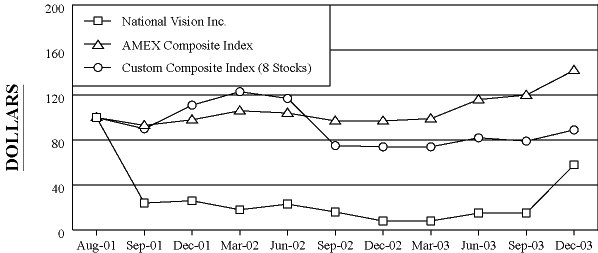
| Aug-01 | Sep-01 | Dec-01 | Mar-02 | Jun-02 | Sep-02 | Dec-02 | Mar-03 | Jun-03 | Sep-03 | Dec-03 | ||||||||||||||||||||||||||||||||||
|
National Vision Inc.
|
$ | 100 | $ | 24 | $ | 26 | $ | 18 | $ | 23 | $ | 16 | $ | 8 | $ | 8 | $ | 15 | $ | 15 | $ | 58 | ||||||||||||||||||||||
|
AMEX Composite Index
|
$ | 100 | $ | 93 | $ | 98 | $ | 106 | $ | 104 | $ | 97 | $ | 97 | $ | 99 | $ | 116 | $ | 120 | $ | 142 | ||||||||||||||||||||||
|
Custom Composite Index (8 Stocks)
|
$ | 100 | $ | 90 | $ | 111 | $ | 123 | $ | 117 | $ | 75 | $ | 74 | $ | 74 | $ | 82 | $ | 79 | $ | 89 | ||||||||||||||||||||||
The 8-Stock Custom Composite Index consists of the following companies with SIC code 5900 (Misc. Retail) that trade on AMEX:
COMPENSATION COMMITTEE INTERLOCKS
Messrs. Floum, Snow, and Nelson served as members of the Compensation Committee in 2003.
CERTAIN TRANSACTIONS
In 2003, Nelson Eye Associates, P.C., which is wholly owned by Marc B. Nelson, a director of the Company, paid the Company approximately $300,000 in occupancy fees related to the sub-occupancy of ten retail optical locations owned by the Company.
13
Table of Contents
REPORT OF THE AUDIT COMMITTEE
In connection with the Company’s Report on Form 10-K for 2003, the Committee met and held discussions with members of management and the Company’s independent accountants, Deloitte & Touche LLP, regarding current audit activities and the plans for and results of selected internal audits. The Company’s independent accountants provided to the Committee the written disclosures and the letter required by Independence Standards Board Standard No. 1 (Independence Discussions with Audit Committees), and the Committee discussed with the independent accountants that firm’s independence.
Management represented to the Committee that the Company’s consolidated financial statements were prepared in accordance with generally accepted accounting principles. The Committee has reviewed and discussed the consolidated financial statements with management and the independent accountants. The Committee discussed with the independent accountants the matters required to be discussed by Statement on Auditing Standards No. 90 as currently in effect. On the basis of these discussions and reviews, the Committee recommended that the Board include the audited consolidated financial statements in the Company’s Annual Report on Form 10-K for the year ended January 3, 2004 for filing with the Securities and Exchange Commission.
Management has the primary responsibility for the Company’s systems of internal controls and the overall financial reporting process. The independent accountants are responsible for performing an independent audit of the Company’s consolidated financial statements in accordance with auditing standards generally accepted in the United States of America and for issuing a report thereon. The Committee’s responsibility is to monitor and oversee these processes. The members of the Audit Committee are not currently certified public accountants, professional auditors or experts in the fields of accounting and auditing and rely, without independent verification, on the information provided to them and on the representations made by management and the independent accountants.
No portion of this Audit Committee Report shall be deemed to be incorporated by reference into any filing under the Securities Act of 1933, as amended (the “Securities Act”), or the Exchange Act, through any general statement incorporating by reference in its entirety the Proxy Statement in which this report appears, except to the extent that the Company specifically incorporates this report or a portion of it by reference. In addition, this report shall not be deemed to be filed under either the Securities Act or the Exchange Act.
| AUDIT COMMITTEE | |
| Jeffrey A. Snow (Chairman) | |
| B. Robert Floum | |
| Peter T. Socha |
Fees of Independent Accountants
Audit Fees. The aggregate fees billed for each of the last two fiscal years for professional services rendered by the Company’s principal accounting firm, Deloitte & Touche LLP (the “Accounting Firm”) for the audit of the Company’s annual financial statements and the review of the financial statements included in the Company’s Forms 10-Q or services that are normally provided by the accountant in connection with statutory and regulatory filings or engagements for those fiscal years were as follows:
| Fiscal 2003 | Fiscal 2002 | |||
|
$459,000*
|
$ | 201,000 | ||
| * | Includes fees billed for the restatement of the Company’s financial statements for fiscal 2001. |
14
Table of Contents
Audit-Related Fees. The aggregate fees billed in each of the last two fiscal years for assurance and related services by the Accounting Firm that were reasonably related to the performance of the audit and reviews of our financial statements and are not reported above were as follows:
| Fiscal 2003 | Fiscal 2002 | |||
|
$105,000
|
$ | 138,000 | ||
These services were for accounting consultation.
Tax Fees. The aggregate fees billed in each of the last two fiscal years for professional services rendered by the Accounting Firm for tax compliance, tax advice, and tax planning were as follows:
| Fiscal 2003 | Fiscal 2002 | |||
|
$113,000
|
$ | 194,000 | ||
All Other Fees. The Accounting Firm did not bill us in the last two fiscal years for any other products and services.
Under the Exchange Act, the Audit Committee must, either directly or through established pre-approval policies, pre-approve all services rendered by the Accounting Firm. The Exchange Act also provides that the Audit Committee can, in the case of certain services that do not represent in excess of five percent of the fees we pay to the Accounting Firm, approve the services after they have been rendered. The Audit Committee did not use this exception to approve any of the services performed by the Accounting Firm. The Audit Committee currently has no pre-approval policies and procedures other than that the Committee itself pre-approves all services provided by the Accounting Firm.
PROPOSAL TWO
APPROVAL OF 2004 EQUITY INCENTIVE PLAN
The Board is proposing for approval by the shareholders the 2004 Equity Incentive Plan (the “2004 Equity Plan”). The following description of the material features of the 2004 Equity Plan is a summary and is qualified in its entirety by reference to the 2004 Equity Plan, a copy of which is attached to this Proxy Statement as Appendix A.
The Board is proposing the 2004 Equity Plan to replace each of the Company’s current Restated Stock Option and Incentive Award Plan, which was originally adopted in 1996 (the “1996 Option Plan”) and the Company’s current Restated Non-Employee Director Stock Option Plan, which was originally adopted in 1993 (the “Directors Plan”) (The 1996 Option Plan and the Directors Plan are referred to collectively as the “Current Plans”.)
The 1996 Option Plan does not expire until February 26, 2006 and the Directors Plan does not expire until April 29, 2007. If the shareholders approve the 2004 Equity Plan, the 1996 Option Plan will be terminated effective June 29, 2004 and the Directors Plan will be terminated effective May 3, 2004. As of May 3, 2004, there are 45,000 shares available for grant under the Directors Plan and 28,253 shares available for grant under the 1996 Option Plan (after giving effect to the grant of options on May 3, 2004 covering 67,000 shares under the 1996 Option Plan).
The objectives of the 2004 Equity Plan are to (i) attract, motivate and retain employees, directors, consultants, advisors and other persons who perform services for the Company by providing compensation opportunities that are competitive with other companies; (ii) provide incentives to those individuals who contribute significantly to the long-term performance and growth of the Company and its affiliates; and (iii) align the long-term financial interests of employees and other individuals who are eligible to participate in the 2004 Equity Plan with those of shareholders. The Board adopted the 2004 Equity Plan on May 3, 2004, subject to the shareholder approval solicited by this proxy statement.
15
Table of Contents
If the 2004 Equity Plan is approved by shareholders and the Current Plans are terminated, the total number of shares available for grant under the 2004 Equity Plan will be 373,253, plus the number of shares subject to outstanding grants under the Current Plans on the date the 2004 Equity Plan is approved by shareholders, which are forfeited or expire on or after such approval date. The 2004 Equity Plan therefore represents an incremental 300,000 shares under the equity incentive plans of the Company.
The shares to be delivered under the 2004 Equity Plan will be made available from authorized but unissued shares of Common Stock, from treasury shares, or from shares purchased in the open market or otherwise. Shares initially issued under the Current Plans that become subject to lapsed or cancelled awards or options will be available for further awards and options under the 2004 Equity Plan.
Description of the 2004 Equity Plan
General. The 2004 Equity Plan will be administered by the Compensation Committee of the Board or such other committee (the “Committee”) consisting of two or more members as may be appointed by the Board to administer the 2004 Equity Plan. If any member of the Committee does not qualify as (i) a “Non-Employee Director” within the meaning of Rule 16b-3 of the Exchange Act and (ii) an “outside director” within the meaning of Section 162(m) of the Internal Revenue Code of 1986, as amended (the “Code”), a subcommittee of the Committee shall be appointed to grant awards to the named executive officers (as defined above under “Compensation of Executive Officers”) and to officers who are subject to Section 16 of the Exchange Act, and each member of such subcommittee shall satisfy the requirements of (i) and (ii) above. References to the Committee in this summary shall include and, as appropriate, apply to any such subcommittee. Subject to the requirement that shareholder approval be obtained for certain amendments, the 2004 Equity Plan may be amended by the Committee in whole or in part, but no such action shall adversely affect any rights or obligations with respect to any awards previously granted under the 2004 Equity Plan, unless the participants affected by such amendment provide their written consent.
Under the 2004 Equity Plan, participants may be granted stock options (qualified and nonqualified), stock appreciation rights (“SARs”), restricted stock, restricted stock units, and performance shares, provided that non-employee directors are not eligible for grants of qualified stock options or performance shares. Not more than 370,000 of the shares reserved under the 2004 Equity Plan may be granted in the form of awards that are other than options or SARs. In addition, except to the extent the Committee determines that an award shall not comply with the performance-based compensation provisions of Section 162(m), the maximum number of shares subject to options and stock appreciation rights that, in the aggregate, may be granted pursuant to awards in any one calendar year to any one participant shall be 100,000 shares, and the maximum number of shares of restricted stock and restricted stock units, and performance shares or units that may be granted, in the aggregate, pursuant to awards in any one calendar year to any one participant shall be 75,000 shares.
Shares awarded or subject to purchase under the 2004 Equity Plan and under the Current Plans that are not delivered or purchased, or revert to the Company as a result of forfeiture or termination, expiration or cancellation of an award, will be available for issuance under the 2004 Equity Plan.
The Committee will determine the individuals to whom awards will be granted, the number of shares subject to an award, and the other terms and conditions of an award. To the extent provided by law, the Committee may delegate to one or more persons the authority to grant awards to individuals who are not named executive officers. As applicable, when used in this description of the 2004 Equity Plan, “Committee” also refers to any such individual to whom the Committee has delegated some of its authority to grant awards. The Committee may provide in the agreements relating to awards under the 2004 Equity Plan for automatic accelerated vesting and other rights upon the occurrence of a change in control or upon the occurrence of other events as may be specified in such agreements.
The Committee expects that future grants to non-employee directors under the 2004 Equity Plan will not exceed in value or in number the 10,000 shares currently awarded each year to non-employee directors under the Directors Plan.
16
Table of Contents
Stock Options. The number of shares subject to a stock option, the type of stock option (i.e., incentive stock option or nonqualified stock option), the exercise price of a stock option (which shall be not less than the fair market value of a share on the date of grant) and the period of exercise (including upon termination of employment) will be determined by the Committee and set forth in an option agreement; provided that no option will be exercisable more than ten years after the date of grant.
Options granted under the 2004 Equity Plan shall be exercisable at such times and be subject to restrictions and conditions as the Committee shall in each instance approve, including conditions related to the employment of or provision of services by a participant. The Committee shall determine and set forth in the option agreement the extent to which options are exercisable after termination of employment. The Committee may provide for deferral of option gains related to an exercise. The option price upon exercise shall be paid to the Company in full, either (a) in cash, (b) cash equivalents approved by the Committee, (c) by tendering (or attesting to the ownership of) previously acquired shares having an aggregate fair market value at the time of exercise equal to the total exercise option price, or (d) by a combination of (a), (b) and (c). The Committee may also allow cashless exercises as permitted under the Federal Reserve Board’s Regulation T, subject to applicable securities law restrictions, or by any other means which the Committee determines to be consistent with the 2004 Equity Plan’s purpose and applicable law.
SARs. SARs granted under the 2004 Equity Plan entitle the grantee to receive an amount payable in shares and/or cash, as determined by the Committee, equal to the excess of the fair market value of a share on the day the SAR is exercised over the specified exercise price, which will not be less than the fair market value of a share on the grant date of the SAR. The exercise period of a SAR may not exceed 10 years. SARs may be granted in tandem with a related stock option or independently. If a SAR is granted in tandem with a stock option, the grantee may exercise the stock option or the SAR, but not both. The Committee shall determine and set forth in the award agreement the extent to which SARs are exercisable after termination of employment.
Restricted Stock/ Restricted Stock Units. Restricted stock awards may be made either alone, in addition to or in tandem with other types of awards permitted under the 2004 Equity Plan and may be current grants of restricted stock or deferred grants. The terms of restricted stock awards, including the restriction period, performance targets applicable to the award and the extent to which the grantee will have the right to receive unvested restricted stock following termination of employment or other events, will be determined by the Committee and be set forth in the agreement relating to such award. The restriction period for restricted stock and restricted stock units that are not subject to performance conditions will be not less than 3 years (but incremental vesting may be provided) and for performance-based awards will not be less than one year. Unless otherwise set forth in an agreement relating to a restricted stock award, the grantee of restricted stock shall have all of the rights of a shareholder of the Company, including the right to vote the shares and the right to receive dividends, provided however that the Committee may require that any dividends on such shares of restricted stock be automatically deferred and reinvested in additional restricted stock or may require that dividends on such shares be paid to the Company to be held for the account of the grantee.
A restricted stock unit is an unsecured promise to transfer an unrestricted share at a specified future date, such as a fixed number of years, retirement or other termination of employment (which date may be later than the vesting date of the award at which time the right to receive the share becomes nonforfeitable). Restricted stock units represent the right to receive a specified number of shares at such times, and subject to such restriction period and other conditions, as the Committee determines. A participant to whom restricted stock units are awarded has no rights as a shareholder with respect to the shares represented by the restricted stock units unless and until shares are actually delivered to the participant in settlement of the award. However, restricted stock units may have dividend equivalent rights if provided for by the Committee.
Performance Shares. Performance shares are awards for a stated potential maximum number of shares, with the actual number and value earned to be determined by reference to the satisfaction of performance targets established by the Committee. The awards are payable in cash or shares, or such
17
Table of Contents
Performance Measures. If awards granted or issued under the 2004 Equity Plan are intended to qualify under the performance-based compensation provisions of Section 162(m) of the Code, the performance measure(s) to be used for purposes of such awards shall be chosen by the Committee from among the following: earnings, earnings per share, consolidated pre-tax earnings, net earnings, operating income, EBIT (earnings before interest and taxes), EBITDA (earnings before interest, taxes, depreciation and amortization), gross margin, revenues, revenue growth, market value added, economic value added, return on equity, return on investment, return on assets, return on net assets, return on capital employed, total shareholder return, profit, economic profit, capitalized economic profit, after-tax profit, pre-tax profit, cash flow measures, cash flow return, sales, sales volume, revenue per employee, stock price, cost, and/or goals related to acquisitions or divestitures. The Committee can establish other performance measures for awards granted to participants that are not named executive officers or for awards granted to named executive officers that are not intended to qualify under the performance-based compensation provisions of Section 162(m) of the Code.
Miscellaneous Provisions. The 2004 Equity Plan prohibits the Company from repricing outstanding awards without first receiving shareholder approval of such repricing.
Federal Income Tax Consequences
The following is a brief summary of the current U.S. federal income tax consequences of awards made under the 2004 Equity Plan. This summary is general in nature and is not intended to cover all tax consequences that may apply to participants and the Company. Further, the provisions of the Code and the regulation and rulings thereunder relating to these matters may change.
Stock Options. A participant will not recognize any income upon the grant or purchase of a stock option. A participant will recognize income taxable as ordinary income (and subject to income tax withholding for Company employees) upon exercise of a non-qualified stock option equal to the excess of the fair market value of the shares purchased over the sum of the exercise price and the amount, if any, paid for the option on an after-tax basis, and the Company will be entitled to a corresponding deduction. A participant will not recognize income (except for purposes of the alternative minimum tax) upon exercise of an incentive stock option provided that the incentive stock option is exercised either while the participant is an employee of the Company or within 3 months (one year if the participant is disabled within the meaning of Section 22(c)(3) of the Code) following the participant’s termination of employment. If shares acquired by such exercise of an incentive stock option are held for the longer of two years from the date the option was granted and one year from the date it was exercised, any gain or loss arising from a subsequent disposition of such shares will be taxed as long-term capital gain or loss, and the Company will not be entitled to any deduction. If, however, such shares are disposed of within the above-described period, then in the year of such disposition the participant will recognize income taxable as ordinary income equal to the excess of (i) the lesser of the amount realized upon such disposition and the fair market value of such shares on the date of exercise over (ii) the exercise price, and the Company will be entitled to a corresponding deduction.
SARs. A participant will not recognize any income upon the grant of a SAR. A participant will recognize income taxable as ordinary income (and, subject to income tax withholding for Company employees) upon exercise of a SAR equal to the fair market value of any shares delivered and the amount of cash paid by the Company upon such exercise, and the Company will be entitled to a corresponding deduction.
Restricted Stock Awards. A participant will not recognize taxable income at the time of the grant of a restricted stock award, and the Company will not be entitled to a tax deduction at such time, unless the participant makes an election under a special Code provision to be taxed at the time such restricted stock award is granted. If such election is not made, the participant will recognize taxable income at the time the restrictions on such restricted stock award lapse in an amount equal to the excess of the fair market
18
Table of Contents
Restricted Stock Units. A participant will not recognize taxable income at the time of the grant of a restricted stock unit and the Company will not be entitled to a tax deduction at such time. When the participant receives shares pursuant to a restricted stock unit, the federal income tax consequences applicable to restricted stock awards, described above, will apply.
Performance Share Awards. A participant will not recognize taxable income upon the grant of a performance share award, and the Company will not be entitled to a tax deduction at such time. Upon the settlement of a performance share award, the participant will recognize compensation taxable as ordinary income (and subject to income tax withholding for Company employees) in an amount equal to the cash paid and the fair market value of the shares delivered to the participant, and the Company will be entitled to a corresponding deduction.
Compliance with Section 162(m). Section 162(m) of the Code denies an income tax deduction to an employer for certain compensation in excess of $1 million per year paid by a publicly traded corporation to the Chief Executive Officer or any of the four most highly compensated executive officers other than the Chief Executive Officer. Compensation realized with respect to stock options awarded under the 2004 Equity Plan, including upon exercise of a non-qualified stock option or upon a disqualifying disposition of an incentive stock option, as described above, will be excluded from this deductibility limit if it satisfies certain requirements, including a requirement that the 2004 Equity Plan be approved by the Company’s current shareholders. In addition, other types of awards under the 2004 Equity Plan may be excluded from this deduction limit if they are conditioned on the achievement of one or more of the performance measures described above, as required by Section 162(m). To satisfy the requirements that apply to “performance-based” compensation, those performance measures must be approved by our current shareholders, and approval of the Plan will also constitute approval of those measures.
2004 Equity Plan Awards
No awards have been granted yet under the 2004 Equity Plan and the grants that will be made under the 2004 Equity Plan are not currently determinable. The Committee will make future awards at its discretion.
19
Table of Contents
The following table sets forth the benefits which would have been received by each of the following for fiscal 2003 if the 2004 Equity Plan had been in effect:
| Name and Position | Dollar Value($)(1) | Number of Units(2) | |||||||
|
Reade Fahs
|
30,000 | 29,880 | |||||||
| President and Chief Executive Officer | |||||||||
|
J. Bruce Steffey
|
13,000 | 13,851 | |||||||
| Executive Vice President and Chief Operating Officer | |||||||||
|
Mitchell Goodman
|
13,000 | 13,851 | |||||||
| Senior Vice President, General Counsel and Secretary | |||||||||
|
Angus C. Morrison
|
11,000 | 13,125 | |||||||
| Senior Vice President, Chief Financial Officer and Treasurer | |||||||||
|
Paul Gross
|
13,000 | 13,851 | |||||||
| Senior Vice President, Marketing and New Ventures | |||||||||
|
Executive Group
|
107,000 | 114,933 | |||||||
|
Non-Executive Director Group
|
0 | (3) | 50,000 | ||||||
|
Non-Executive Officer Employee Group
|
45,000 | 49,379 | |||||||
| (1) | Based on closing stock price as of date of awards. |
| (2) | Awards actually made for fiscal 2003 under the 1996 Option Plan and the Directors Plan. The Company issued shares for achievement of financial goals and also awarded shares of restricted stock to all individuals below except directors. |
| (3) | Directors each received a grant of options covering 10,000 shares; the exercise price of each option was the closing price of Common Stock as of the date of grant. |
Vote Required
The affirmative vote of a majority of votes cast at the Meeting is required for approval of the 2004 Equity Plan.
Recommendation of the Board of Directors
The Board of Directors recommends that shareholders vote FOR approval of the 2004 Equity Plan, including the material terms of the performance measures under which certain awards may be granted. The enclosed proxy will be voted in that manner unless the shareholder executing the proxy specifically votes to the contrary or abstains from voting on this proposal.
The Audit Committee has not yet selected an accounting firm to be the independent public accountants who will audit the accounts of the Company and its subsidiaries for the year 2004. We expect that representatives of the accounting firm we select will be present at the Meeting and will be afforded an opportunity to make a statement if they so desire. Such representatives will be available to respond to appropriate questions.
The Audit Committee of the Board of Directors of the Company has annually considered and recommended to the Board the selection of the Company’s independent public accountants. On the basis of the recommendation of the Audit Committee, the Board of Directors dismissed Arthur Andersen LLP (“Andersen”) as the independent public accountants of the Company and engaged Deloitte & Touche LLP to serve as the Company’s independent accountants for 2002, effective May 15, 2002.
20
Table of Contents
Andersen’s reports on the Company’s consolidated financial statements for the 2001 and 2000 fiscal years did not contain an adverse opinion or disclaimer of opinion, nor were they qualified or modified as to the uncertainty, audit scope or accounting principles, with the exception of their report dated March 30, 2001, covering fiscal 2000, which included an explanatory paragraph regarding the Company’s ability to continue as a going concern. Andersen’s report on the Company’s consolidated financial statements for 2001 was issued on an unqualified basis.
During the Company’s 2001 and 2000 fiscal years and through March 21, 2002 (the date of the Company’s Form 10-K for the fiscal year ended December 29, 2001), there were no disagreements with Andersen on any matter of accounting principles or practices, financial statement disclosure, or auditing scope or procedure which, if not resolved to Andersen’s satisfaction, would have caused them to make reference to the subject matter in connection with their report on the Company’s consolidated financial statements for such years; and there were no reportable events, as listed in Item 304(a)(1)(v) of Regulation S-K.
During the Company’s 2001 and 2000 fiscal years and through March 21, 2002 (the date of the Company’s Form 10-K for the fiscal year ended December 29, 2001), the Company did not consult Deloitte & Touche with respect to the application of accounting principles to a specified transaction, either completed or proposed, or the type of audit opinion that might be rendered on the Company’s consolidated financial statements, or any other matters or reportable events listed in Items 304(a)(2)(i) and (ii) of Regulation S-K.
SHAREHOLDER PROPOSALS FOR 2005 ANNUAL MEETING
All proposals of shareholders must be submitted to the Secretary of the Company no later than January 10, 2005, in order to be considered for inclusion in the Company’s 2005 proxy materials. The Company’s By-Laws require notice to the Board or the President, as the case may be, in advance of any regular shareholders’ meeting, of any shareholder proposals. The By-Laws further require that in connection with such proposals the shareholders provide certain information to the Board or the President, as the case may be. If a shareholder intends to present a proposal (other than a proposal which concerns the nomination and election of directors) for consideration at the 2005 Annual Meeting, the Company must receive notice of such proposal between 90 and 120 days prior to such meeting. The foregoing summary description of the By-Laws is not intended to be complete and is qualified in its entirety by reference to the text of the By-Laws.
OTHER MATTERS
The Board is not aware of any matters to come before the Meeting other than the election of the directors and the proposal to approve the 2004 Equity Plan. As to other matters that may come before the Meeting, the persons named in the enclosed form of proxy will have discretionary authority to vote in accordance with their judgment (x) for the election of a person to the Board if any nominee named herein becomes unable to serve or for good cause will not serve, (y) on matters which the Board did not know would be presented at the Annual Meeting by a reasonable time before the proxy solicitation was made, and (z) on other matters which may properly come before the Annual Meeting and any adjournments or postponements thereof.
21
Table of Contents
VOTING OF PROXIES
On matters coming before the Meeting as to which a choice has been specified by the shareholders on the proxies, the shares will be voted accordingly. If no choice is so specified, the shares will be voted FOR the election of management’s nominees for directors and FOR approval of the 2004 Equity Plan.
| By order of the Board of Directors, | |
| MITCHELL GOODMAN | |
| Secretary |
Dated: May 10, 2004
22
Table of Contents
Appendix A
NATIONAL VISION, INC.
Table of Contents
TABLE OF CONTENT
| Page | ||||||
|
ARTICLE 1 |
||||||
|
GENERAL PROVISIONS |
||||||
|
1.1
|
ESTABLISHMENT AND PURPOSES OF PLAN | 1 | ||||
|
1.2
|
TYPES OF AWARDS | 1 | ||||
|
1.3
|
EFFECTIVE DATE | 1 | ||||
|
ARTICLE 2 |
||||||
|
DEFINITIONS |
||||||
| Definitions | 1 | |||||
|
ARTICLE 3 |
||||||
|
ADMINISTRATION |
||||||
|
3.1
|
GENERAL | 5 | ||||
|
3.2
|
AUTHORITY OF THE COMMITTEE | 5 | ||||
|
3.3
|
DELEGATION OF AUTHORITY | 5 | ||||
|
3.4
|
AWARD AGREEMENTS | 5 | ||||
|
ARTICLE 4 |
||||||
|
SHARES SUBJECT TO THE PLAN |
||||||
|
4.1
|
NUMBER OF SHARES | 5 | ||||
|
4.2
|
INDIVIDUAL LIMITS | 6 | ||||
|
4.3
|
ADJUSTMENT OF SHARES | 6 | ||||
|
ARTICLE 5 |
||||||
|
STOCK OPTIONS |
||||||
|
5.1
|
GRANT OF OPTIONS | 7 | ||||
|
5.2
|
AGREEMENT | 7 | ||||
|
5.3
|
OPTION PRICE | 7 | ||||
|
5.4
|
DURATION OF OPTIONS | 7 | ||||
|
5.5
|
EXERCISE OF OPTIONS | 7 | ||||
|
5.6
|
PAYMENT | 8 | ||||
|
5.7
|
NONTRANSFERABILITY OF OPTIONS | 8 | ||||
|
5.8
|
PURCHASED OPTIONS | 8 | ||||
|
5.9
|
SPECIAL RULES FOR ISOS | 8 | ||||
|
ARTICLE 6 |
||||||
|
STOCK APPRECIATION RIGHTS |
||||||
|
6.1
|
GRANT OF SARS | 8 | ||||
|
6.2
|
TANDEM SARS | 9 | ||||
|
6.3
|
PAYMENT | 9 | ||||
|
6.4
|
EXERCISE OF SARS | 9 | ||||
|
ARTICLE 7 |
||||||
|
RESTRICTED STOCK AND RESTRICTED STOCK UNITS |
||||||
|
7.1
|
GRANT OF RESTRICTED STOCK | 9 | ||||
|
7.2
|
RESTRICTED STOCK AGREEMENT | 9 | ||||
|
7.3
|
NONTRANSFERABILITY | 10 | ||||
|
7.4
|
CERTIFICATES | 10 | ||||
|
7.5
|
DIVIDENDS AND OTHER DISTRIBUTIONS | 10 | ||||
|
7.6
|
RESTRICTED STOCK UNITS (OR RSUS) | 10 | ||||
i
Table of Contents
| Page | ||||||
| ARTICLE 8 | ||||||
|
PERFORMANCE SHARES |
||||||
|
8.1
|
GRANT OF PERFORMANCE SHARES | 11 | ||||
|
8.2
|
VALUE OF PERFORMANCE SHARES | 11 | ||||
|
8.3
|
EARNING OF PERFORMANCE SHARES | 11 | ||||
|
8.4
|
FORM AND TIMING OF PAYMENT OF PERFORMANCE SHARES | 11 | ||||
|
8.5
|
NONTRANSFERABILITY | 11 | ||||
| ARTICLE 9 | ||||||
|
PERFORMANCE MEASURES |
||||||
| Performance Measures | 11 | |||||
| ARTICLE 10 | ||||||
|
BENEFICIARY DESIGNATION |
||||||
|
Beneficiary Designation |
12 | |||||
| ARTICLE 11 | ||||||
|
DEFERRALS |
||||||
|
Deferrals |
12 | |||||
| ARTICLE 12 | ||||||
|
WITHHOLDING |
||||||
| Withholding | 12 | |||||
|
12.1
|
TAX WITHHOLDING | 12 | ||||
|
12.2
|
SHARE WITHHOLDING | 12 | ||||
| ARTICLE 13 | ||||||
|
FOREIGN EMPLOYEES |
||||||
|
Foreign Employees |
13 | |||||
| ARTICLE 14 | ||||||
|
AMENDMENT AND TERMINATION |
||||||
|
14.1
|
AMENDMENT OF PLAN | 13 | ||||
|
14.2
|
AMENDMENT OF AWARD AGREEMENT | 13 | ||||
|
14.3
|
TERMINATION OF PLAN | 13 | ||||
|
14.4
|
CANCELLATION OF AWARDS | 13 | ||||
|
14.5
|
ASSUMPTION OR CANCELLATION OF AWARDS | 14 | ||||
| ARTICLE 15 | ||||||
|
MISCELLANEOUS PROVISIONS |
||||||
|
15.1
|
RESTRICTIONS ON SHARES | 14 | ||||
|
15.2
|
RIGHTS OF A SHAREHOLDER | 14 | ||||
|
15.3
|
NO IMPLIED RIGHTS | 15 | ||||
|
15.4
|
COMPLIANCE WITH LAWS | 15 | ||||
|
15.5
|
SUCCESSORS | 15 | ||||
|
15.6
|
TAX ELECTIONS | 15 | ||||
|
15.7
|
LEGAL CONSTRUCTION | 15 | ||||
ii
Table of Contents
NATIONAL VISION, INC.
ARTICLE 1
GENERAL PROVISIONS
1.1 Establishment and Purposes of Plan. National Vision, Inc., a Georgia corporation (the “Company”), hereby establishes an equity incentive plan to be known as the “National Vision, Inc. 2004 Equity Incentive Plan” (the “Plan”), as set forth in this document. The objectives of the Plan are (i) to provide incentives to those individuals who contribute significantly to the long-term performance and growth of the Company and its affiliates; and (ii) to attract, motivate and retain employees, directors, consultants, advisors and other persons who perform services for the Company by providing compensation opportunities that are competitive with other companies; and (iii) to align the long-term financial interests of employees’ and other Eligible Participants with those of the Company’s shareholders. The Plan is designed to replace the Company’s Restated Stock Option and Incentive Award Plan (the “1996 Employee Plan”) and the Company’s Restated Non-Employee Director Stock Option Plan (the “1997 Director Plan”), and except as described in Section 4.1, no further grants will be made under the 1996 Employee Plan or the 1997 Director Plan after approval of the Plan by the shareholders of the Company.
1.2 Types of Awards. Awards under the Plan may be made to Eligible Participants who are Employees in the form of (i) Incentive Stock Options, (ii) Nonqualified Stock Options, (iii) Stock Appreciation Rights, (iv) Restricted Stock, (v) Restricted Stock Units; (vi) Performance Shares, or any combination of the foregoing. Awards under the Plan may be made to Eligible Participants who are Directors in the form of (i) Nonqualified Stock Options, (ii) Stock Appreciation Rights; (iii) Restricted Stock; and (iv) Restricted Stock Units, or any combination of the foregoing.
1.3 Effective Date. The Plan shall be effective upon approval by the Company’s shareholders (the “Effective Date”).
ARTICLE 2
DEFINITIONS
Except where the context otherwise indicates, the following definitions apply:
2.1 “Agreement” means the written agreement evidencing an Award granted to the Participant under the Plan.
2.2 “Award” means an award granted to a Participant under the Plan that is an Option, Stock Appreciation Right, Restricted Stock, Restricted Stock Unit, Performance Share, or combination of these.
2.3 “Board” means the Board of Directors of the Company.
2.4 “Cause” means, unless provided otherwise in the Agreement, the involuntary termination of a Participant by the Company for any of the following reasons: (a) as a result of an act or acts by the Participant which have been found in an applicable court of law to constitute a felony (other than traffic-related offenses); (b) as a result of an act or acts by Participant which are in the good faith judgment of the Board to be in violation of law or of policies of the Company and which result in demonstrably material injury to the Company; (c) as a result of an act or acts of proven dishonesty by the Participant resulting or intended to result directly or indirectly in significant gain or personal enrichment to the Participant at the expense of the Company or public shareholders of the Company; or (d) upon the willful and continued failure by the Participant to perform his duties with the Company (other than any such failure resulting from incapacity due to mental or physical illness not constituting a Disability), after a demand in writing for substantial performance is delivered by the Board, which demand specifically identifies the manner in which the Board believes that the Participant has not substantially performed his duties. For purposes of the Plan, no act or failure to act by the Participant shall be deemed to be “willful”
1
Table of Contents
2.5 “Change in Control” means any of the following events:
| (a) The acquisition (other than from the Company) by any “Person” [as the term person is used for purposes of Sections 13(d) or 14(d) of the Exchange Act] of beneficial ownership (within the meaning of Rule 13d-3 promulgated under the Exchange Act) of thirty-five percent (35%) or more of either (i) the then outstanding shares of common stock of the Company or (ii) the combined voting power of the then outstanding voting securities of the Company entitled to vote generally in the election of directors; or | |
| (b) Individuals who, as of April 29, 2004, are members of the Board (the “Incumbent Board”), cease for any reason to constitute at least two-thirds of the Board; provided, however, that if the election, or nomination for election by the Company’s shareholders, of any new director was approved by a vote of at least two-thirds of the Incumbent Board, such new director shall, for purposes of this Plan, be considered as a member of the Incumbent Board; or | |
| (c) Consummation of a merger or consolidation involving the Company if the shareholders of the Company immediately before such merger or consolidation do not, as a result of such merger or consolidation, own, directly or indirectly, more than fifty percent (50%) of the combined voting power of the then outstanding voting securities of the corporation resulting from such merger or consolidation in substantially the same proportion as their ownership of the combined voting power of the voting securities of the Company outstanding immediately before such merger or consolidation; or | |
| (d) A complete liquidation or dissolution of the Company or an agreement for the sale or other disposition of all or substantially all of the assets of the Company. | |
| Notwithstanding the foregoing, a Change in Control shall not be deemed to occur pursuant to subsection (a) above, solely because thirty-five percent (35%) or more of the combined voting power of the Company’s then outstanding securities is acquired by (i) a trustee or other fiduciary holding securities under one or more employee benefit plans maintained by the Company or any of its subsidiaries of which the Company directly or indirectly controls more than 50% of the voting securities, or (ii) any corporation which, immediately prior to such acquisition, is owned directly or indirectly by the shareholders of the Company in the same proportion as their ownership of Shares in the Company immediately prior to such acquisition. |
2.6 “Code” means the Internal Revenue Code of 1986, as now in effect or as hereafter amended. All citations to sections of the Code are to such sections as they may from time to time be amended or renumbered.
2.7 “Committee” means the Compensation Committee of the Board or such other committee consisting of two or more members as may be appointed by the Board to administer this Plan pursuant to Article 3. All members shall be independent directors within the meaning of the Listing Standards and any other standards as the Board or the Committee may prescribe from time to time; provided, however, that, (a) if the Committee is comprised of at least three directors, and (b) the Listing Standards permit one member of the Committee not to be independent within the meaning of the Listing Standards, then the Board may appoint a member who is not so independent, further provided, however, that such appointment otherwise complies with the Listing Standards. If any member of the Committee does not qualify as (i) a “Non-Employee Director” within the meaning of Rule 16b-3 under the Exchange Act, and (ii) an “outside director” within the meaning of Section 162(m) of the Code, a subcommittee of the Committee shall be appointed to grant Awards to Named Executive Officers and to officers who are subject to Section 16 of the Act, and each member of such subcommittee shall satisfy the requirements of (i) and
2
Table of Contents
2.8 “Company” means National Vision, Inc., a Georgia corporation, and its successors and assigns.
2.9 “Director” means any individual who is a member of the Board of the Company; provided, however, that any Director who is employed by the Company or any Employer shall not be considered a Director, but instead shall be considered an employee for purposes of the Plan.
2.10 “Disability” means, (i) with respect to a Participant who is eligible to participate in the Employer’s program of long-term disability insurance, if any, a condition with respect to which the Participant is entitled to commence benefits under such program, and (ii) with respect to any Participant (including a Participant who is eligible to participate in the Employer’s program of long-term disability insurance, if any), the inability of the Participant to engage in any substantial gainful activity by reason of any medically determinable physical or mental impairment expected to result in death or to be of continuous duration of six (6) months or more. For a Director, Disability shall mean the inability of the Director to perform his or her usual duties as a Board member by reason of any medically determinable physical or mental impairment expected to result in death or to be of continuous duration of six(6) months or more. The determination of Disability shall be made by the Committee.
2.11 “Effective Date” shall have the meaning ascribed to such term in Section 1.3 hereof.
2.12 “Eligible Participant” means an employee of the Employer (including an officer) as well as any other person, including a Director and a consultant or advisor who provides bona fide services to the Employer, as shall be determined by the Committee.
2.13 “Employer” means the Company and any entity during any period that is a “parent corporation” or a “subsidiary corporation” with respect to the Company within the meaning of Sections 424(e) and 424(f) of the Code. With respect to all purposes of the Plan, including but not limited to, the establishment, amendment, termination, operation and administration of the Plan, the Company shall be authorized to act on behalf of all other entities included within the definition of “Employer.”
2.14 “Exchange Act” means the Securities Exchange Act of 1934, as now in effect or as hereafter amended. All citations to sections of the Exchange Act or rules thereunder are to such sections or rules as they may from time to time be amended or renumbered.
2.15 “Fair Market Value” means the fair market value of a Share, as determined in good faith by the Committee as follows:
| (a) if the Shares are listed on a national securities exchange, Fair Market Value on any date shall be the last sale price reported for the Shares on such exchange on such date or, if no sale was reported on such date, on the last date preceding such date on which a sale was reported; | |
| (b) if the Shares are quoted on the National Association of Securities Dealers Automated Quotation System (“NASDAQ”) or other comparable quotation system and have been designated as a National Market System (“NMS”) security, Fair Market Value on any date shall be the last sale price reported for the Shares on such system on such date or on the last day preceding such date on which a sale was reported; | |
| (c) If the Shares are quoted on the NASDAQ and have not been designated a NMS Security, Fair Market Value on any date shall be the average of the highest bid and lowest asked prices of the Shares on such system on such date; or | |
| (d) if (a), (b) and (c) do not apply, on the basis of the good faith determination of the Committee. |
For purposes of subsection (a) above, if Shares are traded on more than one securities exchange then the following exchange shall be referenced to determine Fair Market Value: (i) the New York Stock
3
Table of Contents
2.16 “Incentive Stock Option” or “ISO” means an Option granted to an Eligible Participant under Article 5 of the Plan which is intended to meet the requirements of Section 422 of the Code.
2.17 “Insider” shall mean an individual who is, on the relevant date, subject to the reporting requirements of Section 16(a) of the Act.
2.18 “Listing Standards” means the listing standards of any exchange or self-regulatory organization which lists or quotes the securities of the Company.
2.19 “Named Executive Officer” means a Participant who is one of the group of “covered employees” as defined in the regulations promulgated or other guidance issued under Section 162(m) of the Code, as determined by the Committee.
2.20 “Nonqualified Stock Option” or “NQSO” means an Option granted to an Eligible Participant under Article 5 of the Plan which is not intended to meet the requirements of Section 422 of the Code.
2.21 “Option” means an Incentive Stock Option or a Nonqualified Stock Option.
2.22 “Option Price” means the price at which a Share may be purchased by a Participant pursuant to an Option.
2.23 “Participant” means an Eligible Participant to whom an Award has been granted.
2.24 “Performance Measures” means the performance measures set forth in Article 9 which are used for performance based Awards to Named Executive Officers.
2.25 “Performance Share” means an Award under Article 8 of the Plan that is valued by reference to a Share, which value may be paid to the Participant by delivery of such property as the Committee shall determine, including without limitation, cash or Shares, or any combination thereof, upon achievement of such performance objectives during the relevant performance period as the Committee shall establish at the time of such Award or thereafter, but not later than the time permitted by Section 162(m) of the Code in the case of a Named Executive Officer, unless the Committee determines that a particular Award will not comply with Section 162(m) of the Code.
2.26 “Permitted Transferee” means any members of the immediate family of the Participant (i.e., spouse, children, and grandchildren), any trusts for the benefit of such family members or any partnerships whose only partners are such family members.
2.27 “Plan” means the National Vision, Inc. 2004 Equity Incentive Plan, as set forth herein and as it may be amended from time to time.
2.28 “Restricted Stock” means an Award of Shares under Article 7 of the Plan, which Shares are issued with such restriction(s) as the Committee, in its sole discretion, may impose, including without limitation, any restriction on the right to retain such Shares, to sell, transfer, pledge or assign such Shares, to vote such Shares, and/or to receive any cash dividends with respect to such Shares, which restrictions may lapse separately or in combination at such time or times, in installments or otherwise, as the Committee may deem appropriate.
2.29 “Restricted Stock Units (or RSUs)” means a right granted under Section 7 of the Plan to receive a number of Shares or a cash payment for each such Share equal to the Fair Market Value of a Share on a specified date.
2.30 “Restriction Period” means the period commencing on the date an Award of Restricted Stock or Restricted Stock Units is granted and ending on such date as the Committee shall determine.
2.31 “Retirement” means termination of employment other than for Cause after a Participant has (i) attained age 65; or (ii) reached the age of 55 years and has completed at least 10 years of service.
4
Table of Contents
2.32 “Share” means one share of common stock of the Company, and as such Share may be adjusted pursuant to the provisions of Section 4.3 of the Plan.
2.33 “Stock Appreciation Right” or “SAR” means an Award granted under Article 6 which provides for an amount payable in Shares and/or cash, as determined by the Committee, equal to the excess of the Fair Market Value of a Share on the day the Stock Appreciation Right is exercised over the specified purchase or exercise price.
ARTICLE 3
ADMINISTRATION
3.1 General. This Plan shall be administered by the Committee.
3.2 Authority of the Committee.
(a) The Committee shall have the exclusive right to interpret, construe and administer the Plan, to select the Eligible Participants who are eligible to receive an Award, and to act in all matters pertaining to the granting of an Award and the contents of the Agreement evidencing the Award, including without limitation, the determination of the number of Options, Stock Appreciation Rights, Restricted Stock, Restricted Stock Units, or Performance Shares subject to an Award and the form, terms, conditions and duration of each Award, and any amendment thereof consistent with the provisions of the Plan. The Committee may adopt such rules, regulations and procedures of general application for the administration of this Plan, as it deems appropriate.
(b) The Committee may correct any defect, supply any omission or reconcile any inconsistency in the Plan or any Agreement in the manner and to the extent it shall deem desirable to carry it into effect.
(c) In the event the Company shall assume outstanding employee benefit awards or the right or obligation to make future such awards in connection with the acquisition of another corporation or business entity, the Committee may, in its discretion, make such adjustments in the terms of Awards under the Plan as it shall deem appropriate.
(d) All acts, determinations and decisions of the Committee made or taken pursuant to grants of authority under the Plan or with respect to any questions arising in connection with the administration and interpretation of the Plan, including the severability of any and all of the provisions thereof, shall be conclusive, final and binding upon all parties, including the Company, its shareholders, Participants, Eligible Participants and their estates, beneficiaries and successors.
3.3 Delegation of Authority. Except with respect to Named Executive Officers and Insiders, the Committee may, at any time and from time to time, delegate to one or more persons any or all of its authority under Section 3.2, to the full extent permitted by law.
3.4 Award Agreements. Each Award granted under the Plan shall be evidenced by a written Agreement. Each Agreement shall be subject to and incorporate, by reference or otherwise, the applicable terms and conditions of the Plan, and any other terms and conditions, not inconsistent with the Plan, as may be imposed by the Committee, including without limitation, provisions related to the consequences of termination of employment. A copy of such document shall be provided to the Participant, and the Committee may, but need not, require that the Participant sign a copy of the Agreement.
ARTICLE 4
SHARES SUBJECT TO THE PLAN
4.1 Number of Shares. (a) Subject to adjustment as provided in (b) below and in Section 4.3, the aggregate number of Shares which are available for issuance pursuant to Awards under the Plan is three hundred seventy-three thousand two hundred fifty three (373,253) Shares, plus the number of Shares which are subject to outstanding grants under the Company’s 1996 Employee Plan and the 1997 Director
5
Table of Contents
| (b) The following rules shall apply for purposes of the determination of the number of Shares available for grant under the Plan: |
| (i) Any Shares awarded or subject to delivery or purchase under the Plan that (for any reason) are not delivered or purchased, or are reacquired by the Company, for reasons including, but not limited to, a forfeiture of Restricted Stock or termination, expiration or cancellation of an Award shall not be charged against the aggregate number of Shares available for issuance pursuant to Awards and shall again be available for issuance pursuant to an Award. If the exercise price and/or withholding obligation under an Option is satisfied by tendering Shares to the Company (either by actual delivery or attestation), only the number of Shares issued net of the Shares so tendered shall be deemed delivered for purposes of determining the maximum number of Shares available for issuance under the Plan. | |
| (ii) Each Performance Share that may be settled in Shares shall be counted as one Share subject to an Award, assuming all performance criteria are satisfied. Performance Shares that may not be settled in Shares (or that may be settled in Shares but are not) shall not result in a charge against the aggregate number of Shares available for issuance. | |
| (iii) Each Stock Appreciation Right or Restricted Stock Unit that may be settled in Shares shall be counted as one Share subject to an Award. Stock Appreciation Rights or Restricted Stock Units that may not be settled in Shares (or that may be settled in Shares but are not) shall not result in a charge against the aggregate number of Shares available for issuance. In addition, if a Stock Appreciation Right is granted in connection with an Option and the exercise of the Stock Appreciation Right results in the loss of the Option, the Shares that otherwise would have been issued upon the exercise of such related Option shall not result in a charge against the aggregate number of Shares available for issuance. |
4.2 Individual Limits. Except to the extent the Committee determines that an Award to a Named Executive Officer shall not comply with the performance-based compensation provisions of Section 162(m) of the Code, the following rules shall apply to Awards under the Plan:
| (a) Options and SARs. The maximum number of Options and Stock Appreciation Rights that, in the aggregate, may be granted in any one calendar year to any one Participant shall be one hundred thousand (100,000). | |
| (b) Restricted Stock, Restricted Stock Units and Performance Shares. The maximum aggregate number of Shares of Restricted Stock, number of Restricted Stock Units or Performance Shares that may be granted in any one calendar year to any one Participant shall be seventy-five thousand (75,000) Shares. |
4.3 Adjustment of Shares. If any change in corporate capitalization, such as a stock split, reverse stock split, stock dividend, or any corporate transaction such as a reorganization, reclassification, merger or consolidation or separation, including a spin-off, of the Company or sale or other disposition by the
6
Table of Contents
| (a) the limitations on the aggregate number of Shares that may be awarded as set forth in Section 4.1, including, without limitation, with respect to Incentive Stock Options; | |
| (b) the limitations on the aggregate number of Shares that may be awarded to any one single Participant as set forth in Section 4.2; | |
| (c) the number and class of Shares that may be subject to an Award, and which have not been issued or transferred under an outstanding Award; | |
| (d) the Option Price under outstanding Options and the number of Shares to be transferred in settlement of outstanding Stock Appreciation Rights; and | |
| (e) the terms, conditions or restrictions of any Award and Agreement, including the price payable for the acquisition of Shares; provided, however, that all such adjustments made in respect of each ISO shall be accomplished so that such Option shall continue to be an incentive stock option within the meaning of Section 422 of the Code. |
ARTICLE 5
STOCK OPTIONS
5.1 Grant of Options. Subject to the terms and provisions of the Plan, Options may be granted to Eligible Participants at any time and from time to time as shall be determined by the Committee. The Committee shall have sole discretion in determining the number of Shares subject to Options granted to each Participant. The Committee may grant a Participant ISOs, NQSOs or a combination thereof, and may vary such Awards among Participants; provided that only an employee of the Employer may be granted ISOs.
5.2 Agreement. Each Option shall be evidenced by an Agreement that shall specify the Option Price, the duration of the Option, the number of Shares to which the Option pertains and such other provisions as the Committee shall determine. The Option Agreement shall further specify whether the Award is intended to be an ISO or an NQSO. Any portion of an Option that is not designated in the Agreement as an ISO or otherwise fails or is not qualified as an ISO (even if designated as an ISO) shall be an NQSO.
5.3 Option Price. The Option Price for each grant of an Option shall not be less than one hundred percent (100%) of the Fair Market Value of a Share on the date the Option is granted.
5.4 Duration of Options. Each Option shall expire at such time as the Committee shall determine at the time of grant; provided, however, that no Option shall be exercisable later than the tenth (10th) anniversary of its grant date.
5.5 Exercise of Options. Options granted under the Plan shall be exercisable at such times and be subject to such restrictions and conditions as the Committee shall in each instance approve, including conditions related to the employment of or provision of services by the Participant with the Company or any Employer, which need not be the same for each grant or for each Participant. Unless provided otherwise in the Agreement, no Option shall be exercisable before the first anniversary of its grant date, provided, however, that the Committee may provide in the Agreement for automatic accelerated vesting and other rights upon the occurrence of a Change in Control or upon the occurrence of other events as
7
Table of Contents
5.6 Payment. Options shall be exercised by the delivery of a written notice of exercise to the Company, setting forth the number of Shares with respect to which the Option is to be exercised, accompanied by full payment for the Shares. The Option Price upon exercise of any Option shall be payable to the Company in full, either: (a) in cash, (b) cash equivalent approved by the Committee, (c) if approved by the Committee, by tendering previously acquired Shares (or delivering a certification or attestation of ownership of such Shares) having an aggregate Fair Market Value at the time of exercise equal to the total Option Price (provided that the tendered Shares must have been held by the Participant for any period required by the Committee), or (d) by a combination of (a), (b) and (c). The Committee also may allow cashless exercises as permitted under Federal Reserve Board’s Regulation T, subject to applicable securities law restrictions, or by any other means which the Committee determines to be consistent with the Plan’s purpose and applicable law.
5.7 Nontransferability of Options.
| (a) Incentive Stock Options. No ISO may be sold, transferred, pledged, assigned, or otherwise alienated or hypothecated, other than by will or by the laws of descent and distribution. Further, all ISOs granted to a Participant shall be exercisable during his or her lifetime only by such Participant. | |
| (b) Nonqualified Stock Options. Except as otherwise provided in a Participant’s Agreement with respect to transfers to Permitted Transferees (any such transfers being subject to applicable laws, rules and regulations), no NQSO may be sold, transferred, pledged, assigned, or otherwise alienated or hypothecated, other than by will or by the laws of descent and distribution. Further, except as otherwise provided in a Participant’s Agreement, all NQSOs granted to a Participant shall be exercisable during his or her lifetime only by such Participant. In the event of a transfer permitted by the Agreement, appropriate evidence of any transfer to the Permitted Transferees shall be delivered to the Company at its principal executive office. If all or part of an Option is transferred to a Permitted Transferee, the Permitted Transferee’s rights thereunder shall be subject to the same restrictions and limitations with respect to the Option as the Participant. |
5.8 Purchased Options. The Committee shall also have the authority to grant Options to Participants in exchange for a stated purchase price for such Option (which may be payable by the Participant directly or, at the election of the Participant, may be offset from bonus or other amounts owed to the Participant by the Company).
5.9 Special Rules for ISOs. Notwithstanding the above, in no event shall any Participant who owns (within the meaning of Section 424(d) of the Code) shares of the Company possessing more than ten percent (10%) of the total combined voting power of all classes of shares of the Company be eligible to receive an ISO at an Option Price less than one hundred ten percent (110%) of the Fair Market Value of a Share on the date the ISO is granted or be eligible to receive an ISO that is exercisable later than the fifth (5th) anniversary date of its grant. No Participant may be granted ISOs (and/or incentive stock options under any other incentive stock option plans of the Employer) which are first exercisable in any calendar year for Shares having an aggregate Fair Market Value (determined as of the date an Option is granted) that exceeds One Hundred Thousand Dollars ($100,000).
ARTICLE 6
STOCK APPRECIATION RIGHTS
6.1 Grant of SARs. A Stock Appreciation Right may be granted to an Eligible Participant in connection with an Option granted under Article 5 of this Plan or may be granted independently of any Option. A Stock Appreciation Right shall entitle the holder, within the specified period (which may not exceed 10 years), to exercise the SAR and receive in exchange therefor a payment having an aggregate value equal to the amount by which the Fair Market Value on the exercise date exceeds the exercise
8
Table of Contents
6.2 Tandem SARs. Each Tandem SAR shall be subject to the same terms and conditions as the related Option, including limitations on transferability, and shall be exercisable only to the extent such Option is exercisable and shall terminate or lapse and cease to be exercisable when the related Option terminates or lapses. The grant of Stock Appreciation Rights related to ISOs must be concurrent with the grant of the ISOs. With respect to NQSOs, the grant either may be concurrent with the grant of the NQSOs, or in connection with NQSOs previously granted under Article 5, which are unexercised and have not terminated or lapsed.
6.3 Payment. The Committee shall have sole discretion to determine in each Agreement whether the payment with respect to the exercise of an SAR will be in the form of all cash, all Shares, or any combination thereof. If payment is to be made in Shares, the number of Shares shall be determined based on the Fair Market Value on the date of exercise. If the Committee elects to make full payment in Shares, no fractional Shares shall be issued and cash payments shall be made in lieu of fractional shares. The Committee shall have sole discretion as to the timing of any payment made in cash or Shares, or a combination thereof, upon exercise of SARs. Payment may be made in a lump sum, in annual installments or may be otherwise deferred; and the Committee shall have sole discretion to determine whether any deferred payments may bear amounts equivalent to interest or cash dividends.
6.4 Exercise of SARs. Upon exercise of a Tandem SAR, the number of Shares subject to exercise under any related Option shall automatically be reduced by the number of Shares represented by the Option or portion thereof which is surrendered.
ARTICLE 7
RESTRICTED STOCK AND RESTRICTED STOCK UNITS
7.1 Grant of Restricted Stock. Awards of Restricted Stock may be made either alone or in addition to or in tandem with other Awards and may be current grants of Restricted Stock or deferred grants of Restricted Stock.
7.2 Restricted Stock Agreement. The Restricted Stock Agreement shall set forth the terms of the Award, as determined by the Committee, including, without limitation, the purchase price, if any, to be paid for such Restricted Stock, which may be more than, equal to, or less than Fair Market Value and may be zero, subject to such minimum consideration as may be required by applicable law; any restrictions applicable to the Restricted Stock such as continued service or achievement of Performance Measures, the length of the Restriction Period and whether any circumstances, such as death, Disability, or a Change in Control, will shorten or terminate the Restriction Period; and rights of the Participant to vote or receive dividends with respect to the Shares during the Restriction Period. Subject to shortening the length of the Restriction Period upon the occurrence of certain circumstances, such as death, Disability, or a Change in Control, or upon the achievement of Performance Measures, all grants of Restricted Stock shall have a Restriction Period of at least three (3) years (provided that incremental vesting may be permitted during a Restriction Period), except for Restricted Stock Awards issued in lieu of all or part of a cash bonus payment otherwise payable to the Participant. Restricted Stock Awards issued in lieu of cash bonus amounts shall be subject to a Restriction Period, if any, of not more than one (1) year.
9
Table of Contents
Notwithstanding Section 3.4 of the Plan, a Participant must accept a Restricted Stock Award within a period of sixty (60) days of the date of the Award, or such other period as the Committee may specify, by executing a Restricted Stock Agreement and paying whatever price, if any, is required. The prospective recipient of Restricted Stock shall not have any rights with respect to such Award, unless and until such recipient has executed a Restricted Stock Agreement and has delivered a fully executed copy thereof to the Committee, and has otherwise complied with the applicable terms and conditions of such Award.
7.3 Nontransferability. Except as otherwise provided in this Article 7, no shares of Restricted Stock nor any Restricted Stock Units received by a Participant shall be sold, exchanged, transferred, pledged, hypothecated or otherwise disposed of during the Restriction Period.
7.4 Certificates. Upon an Award of Restricted Stock to a Participant, Shares of Restricted Stock shall be registered in the Participant’s name (or an appropriate book entry shall be made). Certificates, if issued, may (a) either be held in custody by the Company until the Restriction Period expires or until restrictions thereon otherwise lapse (b) and/or be issued to and registered in the name of the Participant, bearing an appropriate restrictive legend and remaining subject to appropriate stop-transfer orders. If required by the Committee, the Participant shall deliver to the Company one or more stock powers endorsed in blank relating to the Restricted Stock. If and when the Restriction Period expires without a prior forfeiture of the Restricted Stock subject to such Restriction Period, unrestricted certificates for such shares shall be delivered to the Participant; provided, however, that the Committee may cause such legend or legends to be placed on any such certificates as it may deem advisable under the rules, regulations and other requirements of the Securities and Exchange Commission and any applicable federal or state law.
7.5 Dividends and Other Distributions. Except as provided in this Article 7 or in the Award Agreement, a Participant receiving Restricted Stock shall have, with respect to such Restricted Stock, all of the rights of a shareholder of the Company, including the right to vote the Shares to the extent, if any, such Shares possess voting rights and the right to receive any dividends; provided, however, the Committee may require that any dividends on such Shares of Restricted Stock shall be automatically deferred and reinvested in additional Restricted Stock subject to the same restrictions as the underlying Award, or may require that dividends and other distributions on Restricted Stock shall be paid to the Company for the account of the Participant. The Committee shall determine whether interest shall be paid on such amounts, the rate of any such interest, and the other terms applicable to such amounts. In addition, with respect to Named Executive Officers, the Committee may apply any restrictions it deems appropriate to the payment of dividends declared with respect to Restricted Stock such that the dividends and/or Restricted Stock maintain eligibility for the performance-based compensation exception under Section 162(m) of the Code.
7.6 Restricted Stock Units (or RSUs). Awards of Restricted Stock Units may be made to Eligible Participants in accordance with the following terms and conditions:
| (a) The Committee, in its discretion, shall determine the number of RSUs to grant to a Participant, the Restriction Period and other terms and conditions of the Award, including whether the Award will be paid in cash, Shares or a combination of the two and the time when the Award will be payable (i.e., at vesting, termination of employment or another date). | |
| (b) Unless the Agreement provides otherwise, RSUs shall not be sold, transferred or otherwise disposed of and shall not be pledged or otherwise hypothecated. | |
| (c) Restrictions upon RSUs awarded hereunder shall lapse at such time or times and on such terms and conditions as the Committee may provide in the Agreement. Unless the Agreement provides otherwise, in the event of a Change in Control, all restrictions upon any RSUs shall lapse immediately and all such RSUs shall become fully vested in the Participant. | |
| (d) The Agreement shall set forth the terms and conditions that shall apply upon the termination of the Participant’s employment with the Employer (including a forfeiture of RSUs for which the restrictions have not lapsed upon Participant’s ceasing to be employed) as the Committee may, in its discretion, determine at the time the Award is granted. |
10
Table of Contents
ARTICLE 8
PERFORMANCE SHARES
8.1 Grant of Performance Shares. Performance Shares may be granted to Participants in such amounts and upon such terms, and at any time and from time to time, as shall be determined by the Committee.
8.2 Value of Performance Shares. Each Performance Share shall have an initial value equal to the Fair Market Value on the date of grant. The Committee shall set the Performance Measures in its discretion which, depending on the extent to which they are met, will determine the number of Performance Shares that will be paid out to the Participant. For purposes of this Article 8, the time period during which the Performance Measures must be met shall be called a “Performance Period.” No Performance Period may be shorter than one year.
8.3 Earning of Performance Shares. Subject to the terms of this Plan, after the applicable Performance Period has ended, the holder of Performance Shares shall be entitled to receive a payout of the number of Performance Shares earned by the Participant over the Performance Period, to be determined as a function of the extent to which the corresponding Performance Measures have been achieved. The Committee may provide in the Agreement for automatic accelerated vesting and other rights upon the occurrence of a Change in Control or upon the occurrence of other events specified in the Agreement.
8.4 Form and Timing of Payment of Performance Shares. Subject to the terms of this Plan, the Committee, in its sole discretion, may pay earned Performance Shares in the form of cash or in Shares (or in a combination thereof) which has an aggregate Fair Market Value equal to the value of the earned Performance Shares at the close of the applicable Performance Period. Such Shares may be granted subject to any restrictions deemed appropriate by the Committee. The determination of the Committee with respect to the form and timing of payout of such Awards shall be set forth in the Award Agreement pertaining to the grant of the Award.
8.5 Nontransferability. Except as otherwise provided in a Participant’s Award Agreement, Performance Shares may not be sold, transferred, pledged, assigned, or otherwise alienated or hypothecated, other than by will or by the laws of descent and distribution. Further, except as otherwise provided in a Participant’s Award Agreement, a Participant’s rights under the Plan shall be exercisable during the Participant’s lifetime only by the Participant or the Participant’s legal representative.
ARTICLE 9
PERFORMANCE MEASURES
Until the Committee proposes for shareholder vote and shareholders approve a change in the general Performance Measures set forth in this Article 9, the attainment of which may determine the degree of payout and/or vesting with respect to Named Executive Officers’ Awards that are intended to qualify under the performance-based compensation provisions of Section 162(m) of the Code, the Performance Measure(s) to be used for purposes of such Awards shall be chosen from among the following (which may relate to the Company or a business unit, division or subsidiary and may be expressed in absolute terms or based on relative attainment): earnings, earnings per share, consolidated pre-tax earnings, net earnings, operating income, EBIT (earnings before interest and taxes), EBITDA (earnings before interest, taxes, depreciation and amortization), gross margin, revenues, revenue growth, market value added, economic value added, return on equity, return on investment, return on assets, return on net assets, return on capital employed, total shareholder return, profit, economic profit, capitalized economic profit, after-tax profit, pre-tax profit, cash flow measures, cash flow return, sales, sales volume, revenues per employee, stock price, cost, or goals related to acquisitions or divestitures. The Committee can establish other Performance Measures for performance Awards granted to Eligible Participants that are not Named Executive Officers.
11
Table of Contents
The Committee shall be authorized to make adjustments in performance based criteria or in the terms and conditions of other Awards in recognition of unusual or nonrecurring events affecting the Company or its financial statements or changes in applicable laws, regulations or accounting principles. The Committee shall also have the discretion to adjust the determinations of the degree of attainment of the pre-established Performance Measures; provided, however, that Awards which are designed to qualify for the performance-based compensation exception from the deductibility limitations of Section 162(m) of the Code, and which are held by Named Executive Officers, may not be adjusted upward (except as a result of adjustments permitted by this paragraph), but the Committee shall retain the discretion to adjust such Awards downward.
If applicable tax and/or securities laws change to permit Committee discretion to alter the governing Performance Measures without obtaining shareholder approval of such changes, the Committee shall have sole discretion to make such changes without obtaining shareholder approval. In addition, in the event that the Committee determines that it is advisable to grant Awards which shall not qualify for the performance-based compensation exception from the deductibility limitations of Section 162(m) of the Code, the Committee may make such grants without satisfying the requirements of Section 162(m) of the Code.
ARTICLE 10
BENEFICIARY DESIGNATION
Each Participant may, from time to time, name any beneficiary or beneficiaries (who may be named contingently or successively) to whom any benefit under the Plan is to be paid in case of his or her death before he or she receives any or all of such benefit. Each such designation shall revoke all prior designations by the same Participant, shall be in a form prescribed by the Committee, and will be effective only when filed by the Participant in writing with the Committee during the Participant’s lifetime. In the absence of any such designation, benefits remaining unpaid at the Participant’s death shall be paid to the Participant’s estate.
ARTICLE 11
DEFERRALS
The Committee may permit or require a Participant to defer under this Plan or to a separate deferred compensation arrangement of the Company such Participant’s receipt of the payment of cash or the delivery of Shares that would otherwise be due to such Participant by virtue of the exercise of an Option or SAR, the lapse or waiver of restrictions with respect to Restricted Stock or Restricted Stock Units, or the satisfaction of any requirements or goals with respect to Performance Shares. If any such deferral election is required or permitted, the Committee shall, in its sole discretion, establish rules and procedures for such payment deferrals.
ARTICLE 12
WITHHOLDING
12.1 Tax Withholding. The Company shall have the power and the right to deduct or withhold, or require a Participant to remit to the Company, an amount sufficient to satisfy Federal, state, and local taxes, domestic or foreign, required by law or regulation to be withheld with respect to any taxable event arising as a result of any Award.
12.2 Share Withholding. With respect to withholding required upon the exercise of Options or SARs, upon the lapse of restrictions on Restricted Stock, or upon any other taxable event arising as a result of any Awards, Participants shall, unless other arrangements are made with the consent of the Committee, satisfy the withholding requirement by having the Company withhold Shares having a Fair
12
Table of Contents
ARTICLE 13
FOREIGN EMPLOYEES
In order to facilitate the making of any grant of Awards under this Plan, the Committee may provide for such special terms for Awards to Participants who are foreign nationals or who are employed by the Company or any Employer outside of the United States of America as the Committee may consider necessary or appropriate to accommodate differences in local law, tax policy or custom, which special terms may be contained in an Appendix attached hereto. Moreover, the Committee may approve such supplements to or amendments, restatements or alternative versions of this Plan as it may consider necessary or appropriate for such purposes, without thereby affecting the terms of this Plan as in effect for any other purpose, and the Secretary or other appropriate officer of the Company may certify any such document as having been approved and adopted in the same manner as this Plan. No such special terms, supplements, amendments or restatements, however, shall include any provisions that are inconsistent with the terms of this Plan as then in effect unless this Plan could have been amended to eliminate such inconsistency without further approval by the shareholders of the Company.
ARTICLE 14
AMENDMENT AND TERMINATION
14.1 Amendment of Plan. The Committee may at any time terminate or from time to time amend the Plan in whole or in part, but no such action shall adversely affect any rights or obligations with respect to any Awards previously granted under the Plan, unless the affected Participants consent in writing. To the extent required by Section 162(m) or 422 of the Code, other applicable law, and/or any Listing Standards, no amendment shall be effective unless approved by the shareholders of the Company.
14.2 Amendment of Award Agreement. The Committee may, at any time, amend outstanding Agreements in a manner not inconsistent with the terms of the Plan; provided, however, except as provided in Section 14.4, if such amendment is adverse to the Participant, as determined by the Committee, the amendment shall not be effective unless and until the Participant consents, in writing, to such amendment. To the extent not inconsistent with the terms of the Plan, the Committee may, at any time, amend an outstanding Agreement in a manner that is not unfavorable to the Participant without the consent of such Participant. Notwithstanding the above provision, the Committee shall not have the authority to decrease the Option Price of any outstanding Option, except in accordance with Section 4.3 or unless such an amendment is approved by the shareholders of the Company.
14.3 Termination of Plan. No Awards shall be granted under the Plan on or after the 10th anniversary of the Effective Date of the Plan.
14.4 Cancellation of Awards. The Committee may provide in the Award Agreement that if a Participant engages in any “Detrimental Activity” (as defined below), the Committee may, notwithstanding any other provision in this Plan to the contrary, cancel, rescind, suspend, withhold or otherwise restrict or limit any unexpired, unexercised, unpaid or deferred Award as of the first date the Participant engages in the Detrimental Activity, unless sooner terminated by operation of another term of this Plan or any other agreement. Without limiting the generality of the foregoing, the Agreement may also provide that if the Participant exercises an Option or SAR, receives a Performance Share or Restricted Stock Unit payout, or receives Shares under an Award at any time during the period beginning six months prior to the date the Participant first engages in Detrimental Activity and ending six months after the date the Participant ceases to engage in any Detrimental Activity, the Participant shall be required to pay to the
13
Table of Contents
For purposes of this Section, “Detrimental Activity” means any of the following activities as may be further defined by the Committee in the Award Agreement and as determined by the Committee in good faith: (i) the violation of any agreement between the Company and the Participant relating to the disclosure of confidential information or trade secrets, the solicitation of employees, customers, suppliers, licensees, licensors or contractors, or the performance of competitive services; (ii) conduct that constitutes Cause (as defined in Section 2.4 above), whether or not the Participant’s employment is terminated for Cause; or (iii) other activities that adversely impact the Company or its business in a material way; provided, that the Committee may provide in the Agreement that only certain of the restrictions provided above apply for purposes of the Award Agreement.
14.5 Assumption or Cancellation of Awards. In the event of a proposed sale of all or substantially all of the assets or stock of the Company, the merger of the Company with or into another corporation such that shareholders of the Company immediately prior to the merger exchange their shares of stock in the Company for cash and/or shares of another entity or any other corporate transaction to which the Committee deems this provision applicable, each Award shall be assumed or an equivalent Award shall be substituted by the successor corporation or a parent or subsidiary of such successor corporation (and adjusted as appropriate), unless such successor corporation does not agree to assume the Award or to substitute an equivalent award, in which case the Committee may, in its sole discretion and in lieu of such assumption or substitution, provide for the Participant to have the right to exercise the Option or other Award as to all Shares, including Shares as to which the Option or other Award would not otherwise be exercisable (or with respect to Restricted Stock, provide that all restrictions shall lapse) or provide for cancellation and for a cash payment for such Award. If the Committee makes an Option or other Award fully exercisable in lieu of assumption or substitution in the event of a merger or sale of assets or stock or other corporate transaction, the Committee shall notify the Participant that, subject to rescission if the merger, sale of assets or stock or other corporate transaction is not successfully completed within a certain period, the Option or other Award shall be fully exercisable for a period of fifteen (15) days from the date of such notice (or such other period as provided by the Committee), and, to the extent not exercised, the Option or other Award will terminate upon the expiration of such period.
ARTICLE 15
MISCELLANEOUS PROVISIONS
15.1 Restrictions on Shares. All certificates for Shares delivered under the Plan shall be subject to such stop-transfer orders and other restrictions as the Committee may deem advisable under the rules, regulations, and other requirements of the Securities and Exchange Commission, any Listing Standards, and any applicable federal or state laws, and the Committee may cause a legend or legends to be placed on any such certificates to make appropriate reference to such restrictions. In making such determination, the Committee may rely upon an opinion of counsel for the Company.
Notwithstanding any other provision of the Plan, the Company shall have no liability to deliver any Shares under the Plan or make any other distribution of the benefits under the Plan unless such delivery or distribution would comply with all applicable laws (including, without limitation, the requirements of the Securities Act of 1933), and the applicable requirements of any securities exchange or similar entity.
15.2 Rights of a Shareholder. Except as otherwise provided in Article 7 of the Plan and in the Restricted Stock Agreement, each Participant who receives an Award of Restricted Stock shall have all of the rights of a shareholder with respect to such Shares, including the right to vote the Shares to the extent, if any, such Shares possess voting rights and receive dividends and other distributions. Except as provided otherwise in the Plan or in an Agreement, no Participant awarded an Option, Stock Appreciation Right, Restricted Stock Unit or Performance Share shall have any right as a shareholder with respect to
14
Table of Contents
15.3 No Implied Rights. Nothing in the Plan or any Award shall confer upon any Participant any right to continue in the service of the Employer, or to serve as a Director thereof, or interfere in any way with the right of the Employer to terminate the Participant’s employment or other service relationship for any reason at any time. Unless otherwise determined by the Committee, no Award shall be deemed salary or compensation for the purpose of computing benefits under any employee benefit plan, severance program, or other arrangement of the Employer for the benefit of its employees. No Participant shall have any claim to an Award until it is actually granted under the Plan. To the extent that any person acquires a right to receive payments from the Company under the Plan, such right shall, except as otherwise provided by the Committee, be no greater than the right of an unsecured general creditor of the Company.
15.4 Compliance with Laws.
(a) At all times when the Committee determines that compliance with Section 162(m) of the Code is required or desirable, all Awards to Named Executive Officers shall comply with the requirements of Section 162(m) of the Code. In addition, in the event that changes are made to Section 162(m) of the Code to permit greater flexibility with respect to any Awards, the Committee may, subject to the requirements of Article 14, make any adjustments it deems appropriate.
(b) The Plan and the grant of Awards shall be subject to all applicable federal and state laws, rules, and regulations and to such approvals by any United States government or regulatory agency as may be required. Any provision herein relating to compliance with Rule 16b-3 under the Exchange Act shall not be applicable with respect to participation in the Plan by Participants who are not Insiders.
15.5 Successors. The terms of the Plan shall be binding upon the Company, and its successors and assigns (whether by purchase, merger, consolidation or otherwise).
15.6 Tax Elections. Each Participant agrees to give the Committee prompt written notice of any election made by such Participant under Section 83(b) of the Code or any similar provision thereof.
15.7 Legal Construction.
(a) Severability. If any provision of this Plan or an Agreement is or becomes or is deemed invalid, illegal or unenforceable in any jurisdiction, or would disqualify the Plan or any Agreement under any law deemed applicable by the Committee, such provision shall be construed or deemed amended to conform to applicable laws or if it cannot be construed or deemed amended without, in the determination of the Committee, materially altering the intent of the Plan or the Agreement, it shall be stricken and the remainder of the Plan or the Agreement shall remain in full force and effect.
(b) Gender and Number. Where the context admits, words in any gender shall include the other gender, words in the singular shall include the plural and words in the plural shall include the singular.
(c) Governing Law. To the extent not preempted by federal law, the Plan and all Agreements hereunder, shall be construed in accordance with and governed by the laws of the State of Georgia.
15
Table of Contents
IN WITNESS WHEREOF, this Plan is executed as of this the day of , 2004.
| NATIONAL VISION, INC. |
| By: |
|
|
ATTEST:
16
Table of Contents
www.nationalvision.com
Table of Contents
NATIONAL VISION, INC.
June 29, 2004
Please date, sign and mail
 Please
detach along perforated line and mail in the envelope
provided.
Please
detach along perforated line and mail in the envelope
provided.
n
THE BOARD OF DIRECTORS RECOMMENDS A VOTE “FOR” THE ELECTION OF DIRECTORS AND “FOR” PROPOSAL 2.
| FOR AGAINS | T ABSTAI | N | ||||||||||||
| 1. Election of Directors: | 2. Approval of 2004 Equity Incentive Plan | oo | o | |||||||||||
| NOMINEES: | ||||||||||||||
|
o
|
FOR ALLo NOMINEES |
B. Robert Floum o Marc B. Nelson |
Please be sure to sign and date this Proxy. | |||||||||||
|
oWITHH
|
OLDo Jeffr
AUTHORITY FOR ALL NOMINEES |
ey A. Snow o Peter T. Socha |
||||||||||||
|
oFOR
A
|
LLo
James
EXCEPT (See instructions below) |
W. Krause | ||||||||||||
|
INSTRUCTION: To
withhold authority to vote for any individual nominee(s), mark
“FOR ALL EXCEPT” and fill in the circle next to each nominee you wish to withhold, as shown here: l |
||||||||||||||
| To change the address on your account,o please check the box at right and indicate your new address in the address space above. Please note that changes to the registered name(s) on the account may not be submitted via this method. | ||||||||||||||
|
Signature of Shareholder
|
Date: | Signat | ure of Shareholder | Date: | ||||||||||
| Note: |
Please sign exactly as
your name or names appear on this Proxy. When shares are held
jointly, each holder should sign. When signing as executor,
administrator, attorney, trustee or guardian, please give
full title as such. If the signer is a corporation, please sign full corporate name by duly authorized officer, giving full title as such. If signer is a partnership, please sign in partnership name by authorized person. |
|||||
|
n
|
n |
Table of Contents
Please take note of the important information enclosed with this Proxy.
Your vote counts, and you are strongly encouraged to exercise your right to vote your shares.
We encourage you to vote your shares electronically through the Internet or by telephone 24 hours a day, 7 days a week. Instructions for such voting are on the reverse side. If you choose to vote your shares through the Internet or by telephone, there is no need for you to mail back this proxy card. If you choose to vote by mail, please mark the boxes on this proxy card to indicate how your shares will be voted. Then sign the card, detach it and return the card in the enclosed postage paid return envelope.
Thank you in advance for your prompt consideration.
Sincerely,
National Vision, Inc.
NATIONAL VISION, INC.
ANNUAL SHAREHOLDERS MEETING
June 29, 2004
PROXY SOLICITED BY THE BOARD OF DIRECTORS
The undersigned does hereby appoint, L. READE FAHS and MITCHELL GOODMAN and each of them proxies of the undersigned with full power of substitution in each of them to vote at the annual meeting of shareholders of the Company to be held on June 29, 2004 at 11:00 a.m., and at any and all adjournments thereof, with respect to all shares which the undersigned would be entitled to vote, and with all powers which the undersigned would possess if personally present. This proxy revokes all prior proxies given by the undersigned. Without limiting the generality of the foregoing, said proxies are authorized to vote upon the following matters:
UNLESS OTHERWISE SPECIFIED, THIS PROXY WILL BE VOTED FOR THE NOMINEES NAMED ON THE REVERSE SIDE HEREOF AND FOR APPROVAL OF THE 2004 EQUITY INCENTIVE PLAN. THE PROXIES, IN THEIR DISCRETION, ARE FURTHER AUTHORIZED BY THE UNDERSIGNED TO VOTE (X) FOR THE ELECTION OF A PERSON TO THE BOARD OF DIRECTORS IF ANY NOMINEE NAMED HEREIN BECOMES UNABLE TO SERVE OR FOR GOOD CAUSE WILL NOT SERVE, (Y) ON MATTERS WHICH THE BOARD OF DIRECTORS DID NOT KNOW WOULD BE PRESENTED AT THE ANNUAL MEETING BY A REASONABLE TIME BEFORE THE PROXY SOLICITATION WAS MADE, AND (Z) ON OTHER MATTERS WHICH MAY PROPERLY COME BEFORE THE ANNUAL MEETING AND ANY ADJOURNMENTS OR POSTPONEMENTS THEREOF.
(Continued and to be signed on the reverse side)
Table of Contents
NATIONAL VISION, INC.
June 29, 2004
PROXY VOTING INSTRUCTIONS
|
MAIL - Date,
sign and mail your proxy card in the envelope provided as soon
as possible. -OR- TELEPHONE - Call toll-free 1-800-PROXIES (1-800-776-9437) from any touch-tone telephone and follow the instructions. Have your proxy card available when you call. -OR- INTERNET - Access “www.voteproxy.com” and follow the on-screen instructions. Have your proxy card available when you access the web page. |
COMPANY NUMBER ACCOUNT NUMBER |
Please
detach along perforated line and mail in the envelope provided.
IF you are not voting via telephone or the
Internet.
n
THE BOARD OF DIRECTORS RECOMMENDS A VOTE “FOR” THE ELECTION OF DIRECTORS AND “FOR” PROPOSAL 2.
| FOR AGAINS | T ABSTAI | N | ||||||||||||
| 1. Election of Directors: | 2. Approval of 2004 Equity Incentive Plan | oo | o | |||||||||||
| NOMINEES: | ||||||||||||||
|
o
|
FOR ALLo NOMINEES |
B. Robert Floum o Marc B. Nelson |
Please be sure to sign and date this Proxy. | |||||||||||
|
oWITHH
|
OLDo Jeffr
AUTHORITY FOR ALL NOMINEES |
ey A. Snow o Peter T. Socha |
||||||||||||
|
oFOR
A
|
LLo
James
EXCEPT (See instructions below) |
W. Krause | ||||||||||||
|
INSTRUCTION: To
withhold authority to vote for any individual nominee(s), mark
“FOR ALL EXCEPT” and fill in the circle next to each nominee you wish to withhold, as shown here: l |
||||||||||||||
| To change the address on your account,o please check the box at right and indicate your new address in the address space above. Please note that changes to the registered name(s) on the account may not be submitted via this method. | ||||||||||||||
|
Signature of Shareholder
|
Date: | Signat | ure of Shareholder | Date: | ||||||||||
| Note: |
Please sign exactly as
your name or names appear on this Proxy. When shares are held
jointly, each holder should sign. When signing as executor,
administrator, attorney, trustee or guardian, please give
full title as such. If the signer is a corporation, please sign full corporate name by duly authorized officer, giving full title as such. If signer is a partnership, please sign in partnership name by authorized person. |
|||||
|
n
|
n |
Table of Contents
Please take note of the important information enclosed with this Proxy.
Your vote counts, and you are strongly encouraged to exercise your right to vote your shares.
We encourage you to vote your shares electronically through the Internet or by telephone 24 hours a day, 7 days a week. Instructions for such voting are on the reverse side. If you choose to vote your shares through the Internet or by telephone, there is no need for you to mail back this proxy card. If you choose to vote by mail, please mark the boxes on this proxy card to indicate how your shares will be voted. Then sign the card, detach it and return the card in the enclosed postage paid return envelope.
Thank you in advance for your prompt consideration.
Sincerely,
National Vision, Inc.
NATIONAL VISION, INC.
ANNUAL SHAREHOLDERS MEETING
June 29, 2004
PROXY SOLICITED BY THE BOARD OF DIRECTORS
The undersigned does hereby appoint, L. READE FAHS and MITCHELL GOODMAN and each of them proxies of the undersigned with full power of substitution in each of them to vote at the annual meeting of shareholders of the Company to be held on June 29, 2004 at 11:00 a.m., and at any and all adjournments thereof, with respect to all shares which the undersigned would be entitled to vote, and with all powers which the undersigned would possess if personally present. This proxy revokes all prior proxies given by the undersigned. Without limiting the generality of the foregoing, said proxies are authorized to vote upon the following matters:
UNLESS OTHERWISE SPECIFIED, THIS PROXY WILL BE VOTED FOR THE NOMINEES NAMED ON THE REVERSE SIDE HEREOF AND FOR APPROVAL OF THE 2004 EQUITY INCENTIVE PLAN. THE PROXIES, IN THEIR DISCRETION, ARE FURTHER AUTHORIZED BY THE UNDERSIGNED TO VOTE (X) FOR THE ELECTION OF A PERSON TO THE BOARD OF DIRECTORS IF ANY NOMINEE NAMED HEREIN BECOMES UNABLE TO SERVE OR FOR GOOD CAUSE WILL NOT SERVE, (Y) ON MATTERS WHICH THE BOARD OF DIRECTORS DID NOT KNOW WOULD BE PRESENTED AT THE ANNUAL MEETING BY A REASONABLE TIME BEFORE THE PROXY SOLICITATION WAS MADE, AND (Z) ON OTHER MATTERS WHICH MAY PROPERLY COME BEFORE THE ANNUAL MEETING AND ANY ADJOURNMENTS OR POSTPONEMENTS THEREOF.
(Continued and to be signed on the reverse side)