
Table of Contents
SECURITIES AND EXCHANGE COMMISSION
Washington, D.C. 20549
SCHEDULE 14D-9
(Rule 14d-101)
SOLICITATION/ RECOMMENDATION STATEMENT UNDER
SECTION 14(d)(4) OF THE SECURITIES EXCHANGE ACT OF
1934
NATIONAL VISION, INC.
(Name of Subject Company)
NATIONAL VISION, INC.
(Name of Person Filing Statement)
Common Stock, Par Value $0.01, with attached Common Stock
Purchase Rights
(Title of Class of Securities)
63845P 10 1
(CUSIP Number of Class of Securities)
Mitchell Goodman, Esq.
Senior Vice President, General Counsel and Secretary
296 Grayson Highway
Lawrenceville, Georgia 30045
(770) 822-3600
(Name, Address and Telephone Number of Person Authorized to
Receive Notices and
Communications on Behalf of the Person Filing Statement)
Copy to:
David A. Stockton, Esq.
Kilpatrick Stockton LLP
1100 Peachtree Street, Suite 2800
Atlanta, Georgia 30309
(404) 815-6500
| o | Check the box if the filing relates solely to preliminary communications made before the commencement of a tender offer. |
Table of Contents
| Item 1. | Subject Company Information. |
| Name and Address |
The name of the subject company to which this Solicitation/
Recommendation Statement (the “Statement”) relates is
National Vision, Inc., a Georgia corporation (the
“Company”). The address of the principal executive
office of the Company is 296 Grayson Highway, Lawrenceville,
Georgia 30045. The telephone number of the Company at its
principal executive offices is (770) 822-3600.
| Securities |
The title of the class of equity securities to which this
Statement relates is the common stock, par value $0.01 per
share, of the Company, including the associated rights (the
“Rights”) to purchase Series A Participating
Cumulative Preferred Stock, par value $0.01 per share,
issued pursuant to the Rights Plan dated as of January 27,
1997 (as amended from time to time, the “Company Rights
Agreement”), between the Company and American Stock
Transfer & Trust Company (together, the “Shares”
or “Common Stock”). As of July 21, 2005 there
were 5,460,668 shares of Common Stock issued and
outstanding and 556,600 Shares reserved for issuance upon
the exercise of existing employee and director stock options at
an exercise price of not less than $0.40 per share and not
greater than $2.38 per share.
| Item 2. | Identity and Background of Filing Person. |
| Name and Address |
The Company is the filing person. The business address and
business telephone number of the Company are set forth in
“Item 1. Subject Company Information”, above.
| Tender Offer |
This Statement relates to the tender offer by Vision Acquisition
Corp., a Georgia corporation (the “Purchaser”) and
wholly-owned subsidiary of Vision Holding Co., a Delaware
corporation (“Parent”), to purchase all of the issued
and outstanding Shares at a purchase price of $7.25 per
Share, net to the seller in cash, without interest thereon (the
“Offer Price”), upon the terms and conditions set
forth in the Offer to Purchase, dated July 28, 2005 (the
“Offer to Purchase”) and the related Letter of
Transmittal, dated July 28, 2005 (the “Letter of
Transmittal”) which, together with the Offer to Purchase,
as they may be amended and supplemented from time to time, are
referred to herein as the “Offer”. Parent was formed
by affiliates of Berkshire Partners LLC, a Boston private equity
firm (“Berkshire”), for purposes of effecting the
Offer, and is wholly-owned by affiliates of Berkshire. The Offer
is described in a Tender Offer Statement on Schedule TO,
dated July 28, 2005 (the “Schedule TO”) that
was filed by the Purchaser and Parent with the Securities and
Exchange Commission (the “SEC”) on July 28, 2005.
Copies of the Offer to Purchase and the Letter of Transmittal
are filed as Exhibits (a)(1)(A) and (a)(1)(B) herewith and
are incorporated herein by reference.
The Offer is being made pursuant to the Agreement and Plan of
Merger, dated July 25, 2005, by and among the Purchaser,
Parent and the Company (as such agreement may from time to time
be amended or supplemented, the “Merger Agreement”).
The Merger Agreement is filed as Exhibit (e)(1) herewith
and is incorporated herein by reference. The Merger Agreement
provides, among other things, that upon completion of the Offer
and the satisfaction or waiver of the conditions set forth in
the Merger Agreement, in accordance with the relevant provisions
of the Georgia Business Corporation Code (the “GBCC”),
the Purchaser will be merged with and into the Company (the
“Merger”). At the effective time of the Merger (the
“Effective Time”), the Company will continue as the
surviving corporation and a wholly-owned subsidiary of Parent,
and each Share (other than Shares held by the Company, the
Purchaser, or Parent or, if applicable, by shareholders who
perfect dissenters’ rights under the GBCC) will be
converted into the right to receive the Offer Price.
2
Table of Contents
The Offer to Purchase states that the principal offices of the
Purchaser and Parent are located at One Boston Place,
Suite 3300, Boston, Massachusetts 02108.
| Item 3. | Past Contacts, Transaction, Negotiations and Agreements. |
Certain contracts, agreements, arrangements or understandings
between the Company or its affiliates and certain of its
directors and executive officers are, except as noted below,
described in the Information Statement (the “Information
Statement”) pursuant to Rule 14f-1 under the
Securities Exchange Act of 1934 that is attached as
Annex A to this Statement and is incorporated herein
by reference, or in the Schedule TO. Except as described in
this Statement (including in the Exhibits hereto and in
Annex A hereto) or incorporated herein by reference, to the
knowledge of the Company, as of the date of this Statement there
exists no material agreement, arrangement or understanding or
any actual or potential conflict of interest between the Company
or its affiliates and (1) the Company or its executive
officers, directors or affiliates or (2) Purchaser, Parent,
Berkshire or their respective executive officers, directors or
affiliates.
| Certain Agreements, Arrangements or Understandings between the Company or its Affiliates and the Company or its Executive Officers, Directors or Affiliates |
Change in Control Arrangements. There are agreements
between the Company and the named executive officers which
provide severance benefits in the event of termination of
employment under certain circumstances following a change in
control of the Company (as defined in the agreements). The
circumstances are termination by the Company (other than because
of death or disability commencing prior to a threatened change
in control (as defined in the agreements), or for cause (as
defined in the agreements and set forth below)), or by an
officer as the result of a voluntary termination (as defined in
the agreements and set forth below). Following any such
termination, in addition to compensation and benefits already
earned, the officer will be entitled to receive a lump sum
severance payment equal to up to three times the officer’s
annual rate of base salary.
Cause for termination by the Company, as mentioned above, is
the: (i) commission of any act that constitutes, on the
part of the officer, (a) fraud, dishonesty, gross
negligence, or willful misconduct and (b) that directly
results in material injury to the Company, or (ii) the
officer’s material breach of the change in control
agreement, or (iii) the officer’s conviction of a
felony or crime involving moral turpitude.
Circumstances that would entitle the officer to terminate as a
result of a voluntary termination following a change in control,
as mentioned above, include: (i) the assignment to the
officer of any duties inconsistent with the officer’s title
and status in effect prior to the change in control or
threatened change in control; (ii) a reduction by the
Company of the officer’s base salary; (iii) the
Company’s requiring the officer to be based anywhere other
than the Company’s principal executive offices;
(iv) the failure by the Company, without the officer’s
consent, to pay to the officer any portion of the officer’s
then current compensation; (v) the failure by the Company
to continue in effect any material compensation plan in which
the officer participates immediately prior to the change in
control or threatened change in control; or (vi) the
failure by the Company to continue to provide the officer with
benefits substantially similar to those enjoyed by the officer
under any of the Company’s life insurance, medical, or
other plans. The term of each agreement is for a rolling three
years unless the Company gives notice that it does not wish to
extend such term, in which case the term of the agreement would
expire three years from the date of the notice.
These agreements are also in place between the Company and the
other executive officers who are not the named executive
officers.
Arrangements with Directors. Non-employee directors of
the Company receive an annual retainer of $60,000 and also
receive medical and dental benefits. Non-employee directors are
also eligible to participate in the 2004 Equity Incentive Plan,
which was approved by the shareholders at the 2004 Annual
Meeting of Shareholders. Each director received an option for
10,000 Shares as of the date of that meeting. All current
directors are non-employee directors.
3
Table of Contents
Indemnification and Insurance. The Company’s Amended
and Restated Articles of Incorporation, as amended, provide that
no director will be personally liable to the Company or its
shareholders for monetary damages for breach of duty of care or
other duty owed to the Company as a director, except that such
provision will only eliminate or limit the liability of a
director the extent permitted from time to time by the GBCC or
any successor law or laws. Further, the Company’s Amended
and Restated By-Laws provide that the Company shall indemnify
each of its current and former officers and directors (and heirs
and legal representatives of such officers and directors) to the
maximum extent permitted by applicable law.
Section 14-2-851 of the GBCC permits a Georgia corporation
to indemnify any person who is a party to any proceeding by
reason of the fact that such person is or was a director of the
corporation, against liability incurred in connection with such
proceeding if such person acted in good faith and in a manner
such person reasonably believed to be in, or not opposed to, the
best interests of the corporation, and, with respect to any
criminal action or proceeding, had no reasonable cause to
believe his or her conduct was unlawful. However, a Georgia
corporation may not indemnify a director in connection with
(i) a derivative action, except for reasonable expenses
incurred in connection with the proceeding if it is determined
that the director has met the relevant standard of conduct
described above; or (ii) any proceeding with respect to
conduct for which he or she was adjudged liable on the basis
that an improper personal benefit was received by such person.
Section 14-2-855 of the GBCC provides that any
indemnification made under the above provisions, unless pursuant
to a court determination, may be made only after a determination
that the person to be indemnified has met the standard of
conduct described above. This determination is to be made by a
majority vote of a quorum consisting of disinterested directors
of the board of directors, by duly selected independent legal
counsel, or by a majority vote of the disinterested
shareholders. The board of directors also may designate a
special committee of two or more disinterested directors to make
this determination.
Section 14-2-857(a) of the GBCC provides that a Georgia
corporation may indemnify an officer of the corporation who is a
party to a proceeding because he or she is an officer of the
corporation (i) to the same extent as a director; and
(ii) if he or she is not a director, then to the extent
provided by the articles of incorporation, bylaws, resolution of
the board of directors, or by contract except for liability
arising out of conduct involving: (a) appropriation, in
violation of his or her duties, of any business opportunity of
the corporation, (b) acts or omissions that involve
intentional misconduct, (c) unlawful distribution of the
corporation’s assets, or (d) receipt of improper
personal benefit.
Notwithstanding any of the foregoing, pursuant to
Section 14-2-852 and Section 14-2-857 of the GBCC, a
Georgia corporation must indemnify any director or officer of a
corporation who has been successful in the defense of any
proceeding to which he or she was a party because he or she was
a director or officer of the corporation, against reasonable
expenses incurred by such person in connection therewith.
Article V of the Company’s Amended and Restated
By-Laws also provides that the Company shall advance expenses
incurred by a current or former officer or director with respect
to any proceeding for which indemnification is available if such
officer or director complies with the provisions of applicable
law. Pursuant to Sections 14-2-853 and 14-2-857 of the
GBCC, expenses incurred by a director or officer in a proceeding
to which such person is a party may be paid by the corporation
in advance of the final disposition thereof upon receipt by the
corporation of (i) a written affirmation by such person of
his or her good faith belief that he or she has met the relevant
standard of conduct with respect to indemnification or the
proceeding involves conduct for which liability has been
eliminated under the corporation’s articles of
incorporation and (ii) a written undertaking by or on
behalf of such director or officer to repay such amount if it is
ultimately determined that such director or officer is not
entitled to indemnification.
The Company also has entered into indemnification agreements
(each an “Indemnification Agreement”) with each of its
directors and executive officers (each an “Indemnified
Party”). The following is a summary of the material terms
of the Indemnification Agreements, which is qualified in its
entirety by reference to the Indemnification Agreement, a copy
of which may be obtained from our filings
4
Table of Contents
with the SEC. Under the terms of each Indemnification Agreement,
the Company agrees to indemnify the Indemnified Party against
any and all expenses, judgments, fines, and amounts paid in
settlement actually and reasonably incurred by such person in
connection with any threatened, pending, or completed action,
suit, or proceeding, including an action by or in the right of
the Company, to which the Indemnified Party is, was or at any
time becomes a party or is threatened to be made a party by
reason of the fact that the Indemnified Party is, was or any
time becomes a director, officer, employee or agent of the
Company or is or was serving in any such capacity for another
entity at the request of the Company.
Notwithstanding the foregoing, the Company shall not make
indemnity payments to the Indemnified Party if: (i) upon
final judgment or adjudication, it is determined that with
respect to expenses, judgments, fines, and settlement amounts to
the extent attributable to remuneration paid or other financial
benefit provided to the Indemnified Party, such remuneration or
financial benefit was paid or provided in violation of the
Indemnified Party’s duties and obligations to the Company;
(ii) judgment is rendered against the Indemnified Party for
an accounting of profits in any law suit brought under
Section 16(b) of the Exchange Act relating to short-swing
profits from the purchase and sale of the Company’s
securities by such Indemnified Party or on account of any
payment made by the Indemnified Party to the Company in respect
of any claim for such accounting; (iii) upon final judgment
or adjudication, it is determined that the Indemnified
Party’s conduct was knowingly fraudulent, deliberately
dishonest, grossly negligent or constituted willful misconduct;
or (iv) a final decision by a court of competent
jurisdiction shall determine that such indemnification is
unlawful.
To the extent that indemnification is unavailable to the
Indemnified Party based upon any of the foregoing reasons, and
the Company is jointly liable with the Indemnified Party or
would be if joined to such law suit or proceeding, the Company
is required to contribute to such expenses, judgments, fines,
penalties, and settlements paid or payable by the Indemnified
Party in such proportion as is appropriate based on the relative
fault of the parties and the benefits received. Any such
determination of contribution shall be made by (x) a court
of competent jurisdiction, (y) a majority vote of a quorum
of disinterested directors of the Company or (z) the
Company’s outside legal counsel. Further, the
Indemnification Agreement provides for the advancement of
expenses to the Indemnified Party in the same manner and under
the same procedures as set forth in Sections 14-2-853 and
14-2-857 of the GBCC as described above. The Indemnification
Agreement also requires the Indemnified Party to repay any
amounts paid with respect to indemnification if it is ultimately
determined that such person is not entitled to indemnification.
In addition, the Company’s directors and officers are
insured against losses arising from any claim against them as
such for wrongful acts or omissions, subject to certain
limitations.
Effect of the Merger on Employee Benefit Plans and Stock
Plans. The Merger Agreement provides that as soon as
practicable following the date of this Agreement, the Board of
Directors of the Company (the “Board”) (or, if
appropriate, any committee administering the Company Stock
Plans) shall adopt such resolutions and take, or cause the
Company to take, such other actions as are required (including,
without limitation, obtaining all necessary consents of all
holders of Company Stock Options under the Company’s
Restated Stock Option and Incentive Award Plan but without
compensating any holder of any Company Stock Option for such
consent) to adjust the terms of all outstanding Company Stock
Options heretofore granted under any Company Stock Plan that
will be exercisable at the time of the first acceptance for
payment of Shares pursuant to the Offer (the “Exercisable
Options”) to provide that each such Exercisable Option
outstanding at the time of the first acceptance for payment of
Shares pursuant to the Offer shall be canceled in exchange for a
cash payment by the Company as soon as practicable following the
first acceptance for payment of Shares pursuant to the Offer of
an amount equal to (i) the excess, if any, of (x) the
highest price per Share to be paid pursuant to the Offer over
(y) the exercise price per Share subject to such
Exercisable Option, multiplied by (ii) the number of Shares
for which such Exercisable Option shall not theretofore have
been exercised. The Company will be responsible for any required
reporting to Federal, state or local tax authorities. Parent
will advance such funds to the Company as the Company requires
in order to comply with the provisions of this paragraph on
terms mutually acceptable to Parent and the Company.
5
Table of Contents
All amounts payable pursuant to the preceding paragraph shall be
subject to any required withholding of Taxes (as defined in the
Merger Agreement) or proof of eligibility of exemption therefrom
and shall be paid without interest by the Company as soon as
practicable following the first acceptance for payment of Shares
pursuant to the Offer. The Company shall use its best efforts to
obtain all consents of the holders of Company Stock Options as
shall be necessary to effectuate the foregoing. Notwithstanding
anything to the contrary contained in the Merger Agreement,
payment shall, at Parent’s request, be withheld in respect
of any Company Stock Option until all necessary consents with
respect to such Company Stock Option are obtained.
In the Merger Agreement, “Company Stock Option” is
defined as any option to purchase Shares granted under any
Company Stock Plan, and “Company Stock Plans” is
defined as the 2004 Equity Incentive Plan, the Restated Stock
Option and Incentive Award Plan and all agreements under which
there are outstanding options to purchase Company Common Stock
granted to employees, consultants or any other person.
Effect of Merger on Management Stock Options. The Merger
Agreement provides that each Exercisable Option held by the
officers of the Company that is outstanding at the time of the
first acceptance for payment of Shares pursuant to the Offer
shall be canceled in exchange for a cash payment by the Company
as soon as practicable following the first acceptance for
payment of Shares pursuant to the Offer of an amount equal to
(i) the excess, if any, of (x) the highest price per
Share to be paid pursuant to the Offer over (y) the
exercise price per Share subject to such Exercisable Option,
multiplied by (ii) the number of Shares for which such
Exercisable Option shall not theretofore have been exercised.
Each Exercisable Option outstanding, including those held by
individuals who are not officers of the Company, will receive
the same treatment, pursuant to the Merger Agreement.
| Certain Agreements, Arrangements or Understandings between the Company or its Affiliates and Parent, the Purchaser or their Respective Executive Officers, Directors or Affiliates |
Merger Agreement. The summary of the Merger Agreement
contained in Section 12 of the Offer to Purchase and the
description of the conditions to the Offer contained in
Section 14 of the Offer to Purchase are incorporated herein
by reference. Such summary and description are qualified in
their entirety by reference to the Merger Agreement.
Confidentiality Agreement. The summary of the
confidentiality agreement dated February 23, 2005, between
the Company and Berkshire (the “Confidentiality
Agreement”) contained in Section 12 of the Offer to
Purchase filed as an exhibit to the Schedule TO is
incorporated herein by reference. Such summary is qualified in
its entirety by reference to the Confidentiality Agreement,
which has been filed as Exhibit (e)(6) hereto and is
incorporated herein by reference.
The Company understands that there are no agreements,
arrangements or understandings between Parent, Purchaser or
their affiliates on one hand, and the officers, directors or
affiliates of the Company, on the other hand, regarding
compensation, employment or equity ownership and that neither
Parent nor Purchaser intends to discuss any such matters with
the officers or directors of the Company until after the Merger
has been consummated.
| Item 4. | The Solicitation or Recommendation. |
| Recommendation of the Board of Directors |
At a meeting of the Board of Directors of the Company (the
“Board”) held on July 25, 2005, the Board
unanimously: (1) determined that the Merger Agreement and
the transactions contemplated thereby, including the Offer, the
Offer Price, the Merger and the Merger consideration, were fair
and in the best interests of the shareholders of the Company;
(2) approved and declared advisable the Merger Agreement
and the transactions contemplated thereby, including the Offer
and the Merger; (3) consented to the Offer; and
(4) recommended that the Company’s shareholders accept
the Offer and tender their Shares pursuant to the Offer and
approve and adopt the Merger Agreement and the Merger.
6
Table of Contents
A letter to the shareholders from Peter T. Socha, Chairman of
the Board of the Company, communicating the recommendation of
the Board is filed as Exhibit (a)(5)(A) herewith and is
incorporated herein by reference.
| Background of the Tender Offer and Merger |
Following the Company’s emergence from its bankruptcy
reorganization in May 2001, the Board recruited new management
for the Company, led by Mr. Reade Fahs, President and CEO,
who joined the Company in April 2002.
By early 2004, the Board believed that the new management team
had achieved substantial improvement in the operations of the
Company and had demonstrated the capability of pursuing
additional opportunities. However, the Board believed that the
Company’s ability to pursue growth opportunities was
constrained by (i) the cost and restrictive provisions of
the indenture governing its 12% Senior Secured Notes due
2009 (the “Senior Notes”) and (ii) the
anticipated reduction in Wal-Mart store operations over time.
In order to address these issues, the Board determined in early
2004 to retain an investment banking firm to review strategic
and financial alternatives, and interviewed several firms. On
May 15, 2004 the Company retained TM Capital Corp.
(“TM Capital”) as its financial advisor, and this
retention was announced in a Company press release on
May 17, 2004 that stated that TM Capital was engaged to
review the Company’s strategic alternatives, which might
include a possible recapitalization or refinancing of debt, sale
of the Company or sale of a controlling interest in the Company.
In May 2004, the Company became aware that Consolidated Vision
Group, Inc. (“CVG”), a portfolio company of
Kelso & Company (“Kelso”) which operated
vision centers under the America’s Best Contacts &
Eyeglasses name, was being marketed for possible sale by
Jefferies & Company, Inc. (“Jefferies”). TM
Capital contacted Jefferies and Kelso to express the
Company’s interest in pursuing this acquisition. On
June 3, 2004 the Company executed a confidentiality
agreement with Jefferies and was forwarded the CVG descriptive
memorandum. Thereafter, the Company provided Jefferies with an
expression of interest and value for CVG. Jefferies indicated
concerns with both the value indicated by the Company and the
contingent nature of the Company’s debt and equity
financing, and indicated that CVG would instead pursue other
opportunities at that time.
In June 2004, two financial sponsors (“Sponsor A” and
“Sponsor B”) jointly submitted an indication of
interest in acquiring the Company pursuant to a transaction that
would provide shareholders with consideration approximating the
market price of the Company’s shares at that time,
contingent upon, among other things, the retirement of the
Senior Notes at a significant discount. Following review of
these indications by the Board and TM Capital, the Company
communicated to Sponsors A and B in August 2004 that it was not
inclined to pursue this proposal based upon its value and
contingent nature.
Following its retention, TM Capital worked with management to
review the Company’s operating performance, financial
prospects, and financing alternatives. On August 19, 2004,
TM Capital presented to the Board the results of its initial
review of the Company and requested that the Board authorize
TM Capital to simultaneously pursue two courses of action:
(i) initiating contacts with potential sources of senior
and subordinated debt and potential providers of equity
financing regarding a refinancing of the Senior Notes, and
(ii) pursuing potential acquisition candidates which could
leverage the Company’s organizational and management
capabilities and provide a platform for future growth. The Board
agreed that TM Capital should pursue these alternatives.
TM Capital then commenced refinancing discussions with potential
debt and equity providers, entering into confidentiality
agreements with such parties, providing written materials
regarding the Company, and conducting meetings between
management and many of such parties. None of these discussions
resulted in a definitive refinancing proposal for the Company.
7
Table of Contents
TM Capital also contacted various companies (in addition to CVG)
in the optical retailing industry to express the Company’s
potential interest in the acquisition of such companies. None of
these discussions resulted in a definitive transaction.
In September 2004, another financial sponsor (“Sponsor
C”) with a portfolio company in the Company’s industry
contacted TM Capital regarding a potential merger of their
portfolio company with the Company. Following extensive
discussions, in March 2005 the Company communicated to Sponsor C
that the Board was not inclined to pursue this alternative due
to issues regarding the proposed economic terms discussed and
the portfolio company’s operations.
In the course of its financing discussions, TM Capital contacted
a financial sponsor (“Sponsor D”) which had also
participated in discussions with Jefferies regarding the
acquisition of CVG. The Company and Sponsor D agreed to jointly
pursue the CVG opportunity if it again became available.
In November 2004, Jefferies contacted Sponsor D and TM Capital
to indicate that CVG would be interested in receiving an updated
proposal for the acquisition of CVG. On November 29, 2004,
the Company and Sponsor D submitted an updated indication of
interest and value to Jefferies.
In December 2004, Jefferies invited the Company and Sponsor D to
conduct a due diligence review of CVG. On December 17,
2004, representatives of the Company, TM Capital and Sponsor D
visited CVG and reviewed a presentation from CVG management.
In late January 2005, Sponsor D indicated that it was not
inclined to invest in the Company’s proposed acquisition of
CVG on the terms previously discussed. TM Capital reviewed the
status of the CVG transaction and financing alternatives with
the Board at a meeting on February 3, 2005. At such meeting
the Board directed TM Capital to (i) contact potential
financial sponsors to replace Sponsor D in the CVG transaction
and (ii) contact lenders to finance this acquisition and a
refinancing of the Senior Notes.
In February 2005, TM Capital contacted a broad range of
potential financial sponsors to provide equity financing for the
CVG acquisition and a number of senior and subordinated lenders.
Each interested party executed a confidentiality agreement and
received a presentation regarding the proposed acquisition.
Among the parties contacted was Berkshire, which, prior to 1997,
had been an owner of the business now operated by CVG. Berkshire
executed a confidentiality agreement with TM Capital regarding
this opportunity on February 23, 2005.
In early March 2005, the Company’s management and TM
Capital held meetings with numerous potential financial
participants in the proposed CVG acquisition, including
Berkshire. On March 4, 2005, at a meeting between the
Company and Berkshire, the Company’s management made a
presentation regarding the Company’s operations and
financial position and discussed the Company’s plans with
respect to a potential acquisition of CVG. The Company and
Berkshire discussed a potential transaction in which Berkshire
would finance a portion of the Company’s acquisition of CVG
through the purchase of a substantial minority equity interest
in the Company.
Between March 14, 2005 and March 23, 2005, Berkshire
negotiated with the Company the terms of a substantial minority
equity investment by Berkshire in the Company that would be used
to fund in part the Company’s acquisition of CVG.
At a meeting of the Board held on March 24, 2005, TM
Capital reviewed with the Board three substantial minority
equity financing proposals which had been received, including
the proposal from Berkshire described above, a joint proposal
from Sponsors A and B, and a proposal from another financial
sponsor (“Sponsor E”). TM Capital recommended that the
Board pursue the Berkshire proposal based upon its superior
economic terms, Berkshire’s capital resources and
reputation, and the experience derived from Berkshire’s
prior ownership of CVG. The Board adopted TM Capital’s
recommendation.
On March 27, 2005, Berkshire and the Company executed a
non-binding written proposal that contemplated a
$25 million investment by Berkshire in the form of
convertible preferred stock that would pay dividends at the rate
of 5% per annum, payable in cash or in kind at the option
of the Company. The
8
Table of Contents
purchase price for the preferred stock would have been the
lesser of (i) 110% of the 30-day average trading price of
the Company’s Shares immediately prior to announcement of
the transaction, and (ii) $7.00 per share. The closing
price for the Company’s Shares on March 27, 2005 was
$5.76 but trended downward over the next several months to a low
closing price of $4.30 on April 26, 2005 and closed at
$5.25 on May 27, 2005. The proposal was subject to
customary conditions, including the satisfactory completion of
Berkshire’s due diligence investigation of the Company and
CVG, satisfactory financing of the Company’s remaining
purchase price for CVG, and shareholder approval for the
issuance of the preferred stock required by applicable American
Stock Exchange rules, and contained an exclusivity provision
whereby the Company agreed to deal exclusively with Berkshire
through May 27, 2005 with respect to equity financing for
the CVG transaction.
On March 30, 2005, the Company submitted a bid to acquire
CVG. This bid was initially rejected by CVG. Thereafter, TM
Capital engaged in discussions with Jefferies regarding the
proposed acquisition, and an understanding among the parties was
reached on April 19, 2005 to pursue the acquisition of CVG
at an enterprise value of $88 million, subject to
completion of mutually satisfactory documentation, due diligence
and other conditions.
During April, May and June 2005, the Company and Berkshire,
together with TM Capital, legal advisors, accounting
professionals, consultants, and providers of debt financing,
conducted a due diligence review of CVG through site visits and
review of requested information. Additionally during this time
period, Randy Peeler, a Managing Director of Berkshire, attended
a regularly scheduled meeting of the Company’s Board to
discuss with the Board the status of Berkshire’s pursuit of
an investment in the Company.
On May 3, 2005, representatives of the Company, Berkshire
and CVG met at the headquarters of CVG to perform due diligence
and meet the CVG senior management team. On May 4, 2005,
Jefferies provided TM Capital with a draft purchase agreement
(the “Stock Purchase Agreement”). The terms of the
draft purchase agreement were negotiated by respective counsel
during May, June and July 2005. On May 10, 2005, several
potential sources of senior debt financing for the CVG
acquisition met at the headquarters of CVG to meet the CVG
senior management team.
As the due diligence review continued, Berkshire and the Company
became aware that CVG might not have three years of audited
financial statements that would be required to be included in
the Company’s proxy statement to be delivered in order to
obtain the shareholder consent required to approve the issuance
of Shares to Berkshire contemplated by the Berkshire proposal.
As the transaction progressed, Berkshire determined that the
legal, accounting and administrative costs of remaining a
publicly traded company, and the systems integration and
disclosure requirements with which the Company would have to
comply following the CVG acquisition, made an investment in the
Company as a public company a less favorable investment than one
that would allow the Company to no longer be subject to the
reporting requirements of the SEC.
On May 27, 2005, Mr. Peeler contacted Peter Socha, the
Chairman of the Company’s Board, to discuss the possibility
of an acquisition of all of the common stock of the Company by
an affiliate of Berkshire in conjunction with the Company’s
purchase of CVG. Mr. Peeler indicated that because the
timing, cost and complexity of effecting the CVG acquisition
through the Company as a public entity had become unattractive,
Berkshire would only be prepared to pursue the CVG acquisition
with the Company if the Company were prepared to undertake a
simultaneous acquisition of the Company by Berkshire.
Mr. Peeler suggested that such a transaction could be
priced in the range of $6.00 to $6.50 per share of Company
Common Stock. Mr. Socha and Mr. Peeler spoke again the
next day, at which time Mr. Socha indicated that he did not
believe the indicated price range reflected the true value of
the Company on a combined basis with CVG. Mr. Socha and
Mr. Peeler agreed to defer any further discussion of price
pending the establishment of a special committee by the Board
and a preliminary review of legal documentation from both
Berkshire and CVG. Mr. Peeler also discussed with
Mr. Socha the possibility of structuring the transaction as
a tender offer, so as to permit a simultaneous closing of the
CVG transaction on an expedited basis and to avoid the issue of
whether appropriate CVG financial statements would be
9
Table of Contents
available for inclusion in the Company’s proxy statement
relating to the approval of a merger transaction.
Mr. Peeler and Mr. Socha authorized their respective
legal counsel to have preliminary direct discussions regarding
the structure of a proposed transaction.
At a meeting held on the morning of June 6, 2005, the Board
formed a special committee (the “Special Committee”),
comprised of Messrs. Socha, Snow and Floum, to consider
Berkshire’s request. After discussion, the Special
Committee determined to pursue discussions with Berkshire
regarding such a transaction.
Later on June 6, 2005, counsel for Berkshire spoke with
counsel for the Company about the structure of a potential
acquisition of the Company by an affiliate of Berkshire. Counsel
for the Company requested that Berkshire not discuss any
compensation or similar arrangements with management of the
Company until at least after the Company and Berkshire reached
agreement on price and terms of the transaction. Counsel also
indicated that the Company’s financial advisor was working
on an analysis of pricing for the transaction and that the
Company and the Special Committee would not be prepared to
discuss price until this work was complete. Counsel for the
Company indicated that the Special Committee would want to
ensure that any transaction would involve the redemption of the
Senior Notes. Counsel for Berkshire indicated that, although it
would not seek exclusivity to pursue such a transaction, due to
the increased complexity and cost of the transaction being
discussed and the possibility that the Company could engage in
such a transaction with another party, Berkshire would want its
expenses reimbursed if the Company chose not to engage in a sale
transaction with Berkshire. Counsel for the Company informed
counsel for Berkshire that it would bring Berkshire’s
expense reimbursement request back to the Special Committee for
consideration.
On June 10, 2005, counsel to Berkshire provided counsel to
the Company with a draft Merger Agreement providing for the
acquisition of the Company by Berkshire pursuant to a cash
tender offer, conditioned upon, among other things, the
simultaneous acquisition by the Company of CVG. The draft Merger
Agreement was discussed and negotiated during June and July
2005. On June 29, 2005, the Special Committee and the Board
met to discuss the open issues of the draft Merger Agreement.
The meeting included a discussion of the status of negotiations
with CVG, discussions with Berkshire and consideration of
entering into a senior debt commitment with Freeport Financial,
LLC (“Freeport”).
From June 15, 2005 through June 29, 2005, the Company
and Berkshire negotiated the terms of an expense reimbursement
letter, which letter was signed on June 29, 2005.
During June 2005, Berkshire Partners and the Company negotiated
the terms of a financing commitment from Freeport. On
June 29, 2005, the Company and Freeport executed a
commitment letter pursuant to which, subject to the conditions
contained therein, Freeport would provide financing to fund a
portion of the CVG transaction purchase price and provide funds
to redeem the Senior Notes.
On July 11, 2005, Freeport circulated a draft definitive
loan agreement (the “Loan Agreement”). The terms of
the Loan Agreement were initially discussed and negotiated by
counsel for the Company and counsel for Freeport during July
2005. During that period Freeport also conducted a due diligence
review in connection with such financing transaction.
Mr. Socha and Mr. Peeler spoke again by phone on the
afternoon of July 17, 2005. Mr. Peeler repeated his
previous position that Berkshire was prepared to offer $6.00 to
$6.50 per share in cash for all of the Shares.
Mr. Socha acknowledged that this price would be a
significant premium to recent trading activity, but stated he
would not support the price due to his previously stated
position that the price range did not reflect the true value of
the Company in a combination with CVG. The parties discussed the
merits of their respective positions and agreed to continue the
discussions later in the week.
On each of July 14, 17, 20 and 21, 2005, the
Board and the Special Committee held joint meetings at which
they discussed various aspects of, and received updates on, the
CVG acquisition, the transaction with Berkshire and the
financing transaction with Freeport. Such meetings included
discussion of the points being negotiated in each of the three
transactions.
10
Table of Contents
On July 25, 2005, the parties engaged in a series of
negotiations to finalize the terms of the Merger Agreement.
Among the issues discussed was the per share price for the
Shares. Mr. Peeler presented Berkshire’s offer of
$7.00 per share in cash for all of the Shares. This price
was rejected by the Company. Thereafter, following further
negotiations among the parties, Berkshire and the Company agreed
to the terms of the Merger Agreement, including a price of
$7.25 per share in cash for all of the shares.
On July 25, 2005, after a series of negotiations among the
parties, CVG and the Company agreed to the terms of the Stock
Purchase Agreement.
On July 25, 2005, the Board and the Special Committee
reconvened to consider and act upon the Merger Agreement and the
CVG Stock Purchase Agreement. After receiving a report on the
status of changes to the Merger Agreement and the Stock Purchase
Agreement since the last Board meeting, and after receiving
confirmation from TM Capital that it was prepared to issue its
fairness opinion on that date, the Board and the Special
Committee discussed the proposed transactions. The Special
Committee resolved that the Merger Agreement and the
transactions contemplated thereby were fair, advisable and in
the best interests of the Company and its shareholders, and
thereafter, recommended that the Board take any and all such
necessary action to approve and adopt the Merger Agreement and
the transactions contemplated thereby. The Special Committee
also recommended that the holders of Shares tender their Shares
pursuant to the Offer. The Board accepted the recommendation of
the Special Committee and, after taking into account the factors
discussed in “Reasons for the Recommendation” below,
resolved that the Merger Agreement and the transactions
contemplated thereby, including the Offer and the Merger, were
fair, advisable and in the best interests of the Company and its
shareholders. The Board also adopted and approved the Stock
Purchase Agreement and the transactions contemplated thereby in
connection with the acquisition of CVG. The Board also approved
an amendment to the Company Rights Agreement to change the
definition of “Distribution Date” in order to exclude
the Berkshire transactions from the provisions of such Company
Rights Agreement. The Board recommended that the holders of
Shares tender their Shares in connection with the Offer, as such
recommendation is set forth in “Recommendation of the Board
of Directors” above. On the evening of July 25, 2005,
subsequent to the closing of the financial markets, the Company
and Berkshire executed the definitive Merger Agreement and the
Company and CVG executed the Stock Purchase Agreement. A joint
press release announcing the transactions was issued the morning
of July 26, 2005 prior to the opening of the financial
markets.
| Reasons for the Recommendation of the Board |
In reaching its decision to approve the Offer, the Merger, the
Merger Agreement and the other transactions contemplated
thereby, and recommending that the Company’s shareholders
accept the Offer and tender their Shares pursuant to the Offer,
the most significant factors that the Special Committee
evaluated, and believed supported its determination, include the
following:
| (1) The pending expiration of the Company’s leases with Wal-Mart. The Company’s locations inside domestic Wal-Mart stores accounted for 73% of its total store count at January 1, 2005, and 82% of its net revenue from continuing operations for the year then ended. Ninety-six (96) of the Company’s Wal-Mart leases expired between 2002 and 2004, and 24 of the Company’s Wal-Mart leases will expire during the remainder of 2005. Wal-Mart has indicated that it does not intend to extend those expiring leases and will instead operate its own corporate vision centers in the spaces the Company vacates. The Special Committee was concerned that the Company would be unable to successfully implement the Company’s unproven Vision Center II concept (operating retail stores outside of Wal-Mart locations) on a large-scale basis that could extend the Company’s business beyond the expiration of its current licenses with Wal-Mart. It was also concerned that the Company would be unable to identify and implement other new business concepts that might extend its business. | |
| (2) The fact that the Company and its financial advisors had explored other opportunities to obtain equity investments in the Company, since as early as May 2004. The Company, through |
11
Table of Contents
| TM Capital, had pursued potential transactions with various equity sponsors and others since May 2004, but the Berkshire proposal was considered to be the most advantageous. | |
| (3) The fact that the Company is highly leveraged and the belief by the Special Committee that the Company’s ability to pursue growth opportunities was significantly restricted by the terms of its Senior Notes. The maturity of the notes in 2009 was also considered as a significant business risk for the Company. The Special Committee also noted the recent volatility of the high-yield debt market, which it believed would make it even more difficult for the Company to successfully refinance this debt in the future. | |
| (4) The Company’s difficulty in finding suitable acquisition targets, particularly given the requirement that public companies secure audited financial statements of significant acquired businesses. The Company, with the assistance of TM Capital, had contacted various potential targets in the optical retail industry since May 2004, but none of those discussions (other than with respect to CVG) resulted in a definitive agreement. | |
| (5) The opinion of TM Capital that, as of July 25, 2005, and based upon certain matters considered relevant by TM Capital and set forth in the opinion attached hereto as Annex B and incorporated herein by reference, the $7.25 per Share to be received by the holders of Shares in the Offer and the Merger is fair to such holders from a financial point of view. The Special Committee adopted the analyses and findings of TM Capital in its determination that the Offer and the Merger is fair to the Company’s shareholders. | |
| (6) The market price of the Company’s common stock, which, on July 25, 2005, closed at $5.10 per share, and the approximate 42% premium over this price represented by the $7.25 per share that would be received by the Company’s shareholders in the Offer. In addition, the Special Committee considered TM Capital’s analyses of the premiums paid in comparable transactions, which indicated that the premium represented by the Offer was substantially above the mean and median premiums paid in the transactions to which TM Capital compared the Offer. Further, the Special Committee believed that the $7.25 per Share offer was the highest price that could be obtained from Berkshire. | |
| (7) The proposed terms and conditions of the Merger Agreement. In particular, the Special Committee considered the fact that the Merger Agreement does not provide for unreasonable termination fees and expense reimbursement obligations which would have the effect of unreasonably discouraging competing bids and that, subject to the satisfaction of specified conditions, the Board would be able to withdraw or modify its recommendation to the shareholders regarding the Offer and the Merger and enter into an agreement with respect to a more favorable transaction with a third party, if such a transaction becomes available prior to the consummation of the Offer and the Merger. | |
| (8) The fact that the Offer and the Merger are the product of arm’s-length negotiations between Berkshire and the Special Committee. These negotiations produced changes to certain terms and conditions of the Merger Agreement that are beneficial to the Company and its shareholders. | |
| (9) The Special Committee’s belief that it was unlikely that another bidder would make a definitive proposal that would result in a transaction providing greater value to the Company’s shareholders, and its conclusion that provisions of the Merger Agreement permitting the Board, in the exercise of its fiduciary duties, to consider competing bids, and the reasonable termination fees imposed on the Company if the Board were to accept an alternative proposal, would facilitate any competing bid. | |
| (10) The fact that the Merger Agreement provides that the Offer would not close until at least 20 business days following the commencement of the Offer, which the Special Committee believed provides for an adequate opportunity to consider alternative proposals, if any, and accompanying agreements, in order to consummate the transaction that is in the best possible interest of the Company’s shareholders. |
12
Table of Contents
| (11) If the Merger is presented to the shareholders of the Company for approval, the ability of the Company’s shareholders who object to the Merger to obtain the “fair value” of their Shares if they exercise and perfect their dissenters’ rights under Georgia law. The Special Committee felt that it was important that Georgia law provides shareholders in some circumstances with the opportunity to exercise dissenters’ rights and to seek a determination in court of the fair value of their shares if they are dissatisfied with the consideration offered in the transaction. | |
| (12) The fact that the Company may be managed more effectively as a private company not subject to pressures from public shareholders to maintain and grow earnings per share. The Special Committee believes that as a private company, the Company would have greater flexibility to consider business strategies that have long-term benefits, but that would adversely impact earnings per share and the market price of the Company’s common stock in the short term if the Company were public. As a private company, the Company would also have greater flexibility to wait for the financing markets to improve, because the Company would not be subject to the pressures on a public company to maintain and grow revenues on a quarterly and annual basis. | |
| (13) The compliance, insurance, regulatory and other costs of being a public company listed on the American Stock Exchange (or any other national exchange), including the additional costs associated with complying with the Sarbanes-Oxley Act, and in particular the substantial cost to the Company for compliance with the internal audit requirements of Section 404 of such Act. | |
| (14) The likelihood of completion of the transactions contemplated by the Merger Agreement, taking into account Berkshire’s interest in consummating the Offer and the Merger and its capital resources. | |
| (15) The fact that the merger consideration is all cash, which provides certainty of value and complete liquidity to the Company’s shareholders, compared to a transaction in which the shareholders would receive stock or some other form of consideration. |
The Special Committee also considered certain risks and other
potentially negative factors concerning the Offer, the Merger
Agreement and the Merger, but ultimately determined that these
factors were outweighed by the factors that supported the
Special Committee’s determination. These potentially
negative factors included:
| (1) The inability of the shareholders of the Company to participate in the growth of the Company’s business following the consummation of the contemplated transactions. | |
| (2) The specific inability of the Company’s shareholders to participate in the future benefits of the CVG acquisition. | |
| (3) The fact that the consideration received by the holders of the Shares in the proposed transaction would be taxable to them. | |
| (4) The possibility that the Offer and the Merger will not be consummated, and the risks associated with such an occurrence, including the potential obligation of the Company to pay break up fees and expenses of Berkshire and CVG, as well as the negative publicity that may be generated for the Company and the negative impact such publicity may have on its business. |
The foregoing discussion of information and factors considered
and given weight by the Special Committee is not intended to be
exhaustive but is believed to include all material factors, both
positive and negative, considered by the Special Committee. In
evaluating the transactions, the members of the Special
Committee considered their knowledge of the business, financial
condition and prospects of the Company, and the views of
management of the Company and the Company’s financial and
legal advisors. In view of the wide variety of factors
considered in connection with its evaluation of the
transactions, the Special Committee did not find it practicable
to, and did not, assign relative weights to the factors or
determine that any factor was of particular importance in
comparison with any other factors. Rather, the Special Committee
viewed its determination and recommendation as a totality of the
information presented to and considered by it.
13
Table of Contents
| Fairness Opinion |
TM Capital rendered its opinion to the Special Committee that,
as of July 25, 2005, and based upon and subject to the
factors, assumptions, qualifications and limitations described
in the written opinion, the $7.25 per Share in cash to be
received by the holders of the Shares in the Offer and the
Merger is fair from a financial point of view to such holders.
Below follows a summary of the fairness opinion rendered by TM
Capital to the Special Committee. The full text of the written
opinion of TM Capital, which sets forth assumptions made,
procedures followed, matters considered and limitations on the
review undertaken by TM Capital, is attached hereto as
Annex B. You should read the fairness opinion in
its entirety. TM Capital provided its opinion for the
information and the assistance of the Special Committee in
connection with their consideration of the Offer, the Merger,
the Merger Agreement, and the transactions contemplated thereby.
The fairness opinion rendered by TM Capital is not a
recommendation as to whether any holder of Shares should tender
such Shares in connection with the Offer or whether any holder
of Shares should seek to perfect his or her dissenter’s
rights in connection with the Merger.
The Special Committee of the Board of Directors of the Company
requested that TM Capital render an opinion as to whether
or not the proposed cash consideration to be received by the
shareholders of the Company pursuant to the Offer and the Merger
was fair to the shareholders of the Company from a financial
point of view. TM Capital provided its oral opinion to the
Special Committee during its meeting on July 25, 2005 and
delivered its written opinion as of that same date. The full
text of the written opinion of TM Capital setting forth the
assumptions made, procedures followed, matters considered and
limitations on the review undertaken in connection with the
opinion is attached as Annex B.
In arriving at the opinion set forth in Annex B,
TM Capital, among other things:
| • | reviewed the Company’s Annual Reports on Form 10-K and related financial information for the years ended December 29, 2001, December 28, 2002, January 3, 2004 and January 1, 2005, the Company’s Quarterly Report on Form 10-Q and the related unaudited financial information for the three months ended April 2, 2005 and the Company’s Proxy Statement for the Annual Meeting of Shareholders held on June 29, 2004; | |
| • | reviewed certain information, including financial forecasts, relating to the business, earnings, cash flow, assets and prospects of the Company, furnished by the Company; | |
| • | reviewed audited financial statements for CVG for the years ended December 31, 2003 and 2004, together with unaudited financial information for CVG; | |
| • | reviewed financial forecasts prepared by the Company regarding a pro forma combination of the Company with CVG; | |
| • | conducted discussions with members of senior management of the Company concerning its businesses and prospects and visited the headquarters and certain store locations of the Company and CVG; | |
| • | reviewed the historical market prices and trading activity for the Shares and compared them with that of certain publicly traded companies which TM Capital deemed to be relevant; | |
| • | compared certain financial information for the Company with that of certain publicly traded companies which TM Capital deemed to be relevant; | |
| • | compared the proposed financial terms of the Offer and Merger with the financial terms of certain other mergers and acquisitions which TM Capital deemed to be relevant; | |
| • | reviewed the Merger Agreement and the Stock Purchase Agreement; | |
| • | reviewed the strategic and financial alternatives pursued by TM Capital and the Company since TM Capital’s retention as the Company’s financial advisor; and |
14
Table of Contents
| • | reviewed such other financial studies and analyses and performed such other investigations and took into account such other matters as TM Capital deemed necessary, including its assessment of general economic, market and monetary conditions. |
TM Capital relied upon the accuracy and completeness of all of
the financial, accounting and other information made available
by the Company for purposes of rendering its opinion. In
addition, TM Capital did not make an independent evaluation
or appraisal of the assets and liabilities of the Company or any
of its subsidiaries and TM Capital was not furnished with
any such evaluation or appraisal.
The following is a summary of the material analyses used by
TM Capital in connection with rendering the opinion
described above. The following summary, however, does not
purport to be a complete description of the analyses performed
by TM Capital. The order of analyses described, and the
result of those analyses, does not represent relative importance
or weight given to those analyses by TM Capital. Except as
otherwise noted, the following quantitative information, to the
extent that it is based on market data, is based on market data
as it existed on or before July 25, 2005 and is not
necessarily indicative of current market conditions.
Parties Contacted. In light of the expected run-off of
the Company’s Wal-Mart locations and its restrictive
capital structure, and pursuant to TM Capital’s retention
by the Company in May 2004, TM Capital was authorized by the
Board to simultaneously pursue courses of action that could
(i) enable the Company to obtain financial resources to
provide debt and/or equity to refinance its Senior Notes and
(ii) enable the Company to acquire a business that could
potentially enhance future growth and shareholder value. During
the course of this initial process, TM Capital contacted
41 equity sponsors and 57 senior and subordinate
lenders. TM Capital received limited initial interest in a
refinancing of the Company’s business due to credit quality
concerns arising from the projected run-off of its Wal-Mart
business and the unproven nature of its growth strategies.
Simultaneously with contacting potential financing sources,
TM Capital pursued four principal acquisition
opportunities, including CVG, on behalf of the Company. In
conjunction with its continued pursuit of the CVG acquisition,
TM Capital contacted 12 senior and subordinate lenders
and 18 equity sponsors to arrange the related financing.
TM Capital also noted that the Company issued a press
release on May 18, 2004 regarding the Company’s
retention of TM Capital to review strategic alternatives.
Projected Financial Information. TM Capital reviewed
two cases of projected financial information prepared by the
management of the Company related to the future prospects of the
Company under two distinct sets of assumptions. The first
scenario was based upon the Company’s existing operations
(the “Standalone Case”) for the fiscal years ending
2005-2010. Among other things, the Standalone Case assumes the
following:
| • | U.S. Wal-Mart locations decrease from 270 at the end of 2005 to 129 at the end of 2010. | |
| • | A total of 60 new Vision Center II locations are opened during the projection period and a total of 10 new Military locations. | |
| • | Vision Center II sales per store grow over 5 years to 100% of prior Wal-Mart store sales. |
15
Table of Contents
A summary of the results of the Standalone Case is below:
NVI — Stand-Alone Projections 2005-2010
| 2005 | 2006 | 2007 | 2008 | 2009 | 2010 | |||||||||||||||||||
| ($ in millions) | ||||||||||||||||||||||||
|
Revenues
|
$ | 233.8 | $ | 225.9 | $ | 196.8 | $ | 187.3 | $ | 183.9 | $ | 176.4 | ||||||||||||
|
EBITDA
|
$ | 29.2 | $ | 23.4 | $ | 18.2 | $ | 17.0 | $ | 19.3 | $ | 18.2 | ||||||||||||
|
Net Debt
|
$ | 60.8 | $ | 50.4 | $ | 44.8 | $ | 37.0 | $ | 26.6 | $ | 15.2 | ||||||||||||
|
Store Count
|
401 | 331 | 308 | 290 | 267 | 260 | ||||||||||||||||||
|
Earnings per Share
|
$ | 0.90 | $ | 0.35 | $ | (0.13 | ) | $ | (0.19 | ) | $ | 0.17 | $ | 0.27 | ||||||||||
|
Weighted Average Shares (000’s)
|
5,582 | 5,582 | 5,582 | 5,582 | 5,582 | 5,582 | ||||||||||||||||||
TM Capital noted that given the expected run-off of the
Company’s Wal-Mart business, there are no assurances that
management would be able to achieve the expected levels of
profitability. TM Capital also noted that the
Company’s Vision Center II concept has only been
recently implemented and is of modest scale compared to the
scope of the Company’s business.
Given the corporate opportunity the CVG acquisition presented,
TM Capital believed it appropriate to also analyze the
potential impact of the CVG acquisition on the Company (the
“NVI/CVG Case”). Among other things, the NVI/CVG Case
assumes the following:
| • | $88 million enterprise value purchase price for CVG | |
| • | CVG purchase price funded and existing Company debt refinanced through (i) a $28 million investment from a private equity partner; and (ii) $153 million of senior and subordinate financing | |
| • | Store count increases in 2005 reflecting the acquisition of CVG’s 116 stores and an additional 23 stores at the Company; a total of 204 America’s Best stores are opened from 2006-2010; assumptions regarding Wal-Mart locations are the same as the Standalone Case | |
| • | EBITDA is adjusted to reflect the cash impact of America’s Best’s Eye Care Club |
A summary of the results of the NVI/ CVG Case is below:
NVI/ CVG Combined Projections 2005-2010
| 2005 | 2006 | 2007 | 2008 | 2009 | 2010 | |||||||||||||||||||
| ($ in millions) | ||||||||||||||||||||||||
|
Revenues
|
$ | 233.8 | $ | 342.9 | $ | 333.4 | $ | 350.3 | $ | 381.0 | $ | 408.9 | ||||||||||||
|
Adjusted EBITDA
|
$ | 29.2 | $ | 46.5 | $ | 42.2 | $ | 41.2 | $ | 44.5 | $ | 48.7 | ||||||||||||
|
Net Debt
|
$ | 129.0 | $ | 105.8 | $ | 89.2 | $ | 73.6 | $ | 52.1 | $ | 23.6 | ||||||||||||
|
Store Count
|
517 | 459 | 456 | 480 | 498 | 533 | ||||||||||||||||||
|
Earnings per Share
|
$ | 0.90 | $ | (0.12 | ) | $ | (0.12 | ) | $ | (0.02 | ) | $ | 0.20 | $ | 0.44 | |||||||||
|
Weighted Average Shares (000’s)
|
5,582 | 10,700 | 10,700 | 10,700 | 10,700 | 10,700 | ||||||||||||||||||
TM Capital noted that the NVI/ CVG Case would be contingent
upon, among other things, (i) obtaining an investor to
replace Berkshire’s proposed equity investment given
Berkshire’s unwillingness to proceed with the above
described transaction structure, (ii) obtaining such
investment on terms identical to those previously proposed by
Berkshire, and (iii) holding the CVG transaction in place
on the previously agreed terms during this period (see
“Background of the Offer and Merger”). TM Capital
noted that achieving this result would be extremely difficult.
The projected financial information set forth above was not
prepared with a view toward public disclosure or compliance with
the published guidelines of the SEC or the guidelines
established by the American Institute of Certified Public
Accountants with respect to projected financial information. The
16
Table of Contents
projected financial information is not fact and readers are
cautioned not to place undue reliance on such information.
Neither the Company’s independent public auditors, nor any
other independent accountants, have compiled, examined or
performed any procedures with respect to the projected financial
information set forth above, nor have they expressed any opinion
or any other form of assurance on such information or its
achievability.
The projected financial information set forth above reflects
numerous assumptions and estimates made by the management of the
Company as well as uncertainties considered by the management of
the Company, with respect to industry performance, general
business, economic, market and financial conditions and other
matters, all of which are difficult to predict and many of which
are beyond the Company’s control. The assumptions and
estimates underlying the projected financial information are
inherently uncertain and, though considered reasonable by the
Company’s management as of the date of their preparation,
are subject to a wide variety of significant business, economic,
market and financial and competitive risks and uncertainties
that could cause actual results to differ materially from those
set forth above. Accordingly, there can be no assurance that the
projected financial information is indicative of the future
performance of the Company or CVG or that actual results will
not materially differ from those presented in the projected
financial information. The Company expects that there will be
differences between actual and projected results, and actual
results may be materially greater or less than those contained
in the projections. Neither the Company or any of its
representatives has made, or makes, any representation to any
person, other than to TM Capital, regarding the projected
financial information, and none of them has or intends to update
or otherwise revise the projected financial information to
reflect circumstances existing after the date when made or to
reflect the occurrence of future events even in the event that
any or all of the assumptions underlying the projected financial
information are shown to be in error.
Limited Life Analysis. In order to address the atypical
characteristics of the Company’s business, which relies
principally on cash flow from its time-limited Wal-Mart
locations, TM Capital performed analyses to assess comparability
between the Company’s operations and those of businesses
not subject to such time limitations. TM Capital noted the
following:
| • | The Company’s Wal-Mart locations provided approximately 95% of the Company’s store-level EBITDA for the fiscal year ended January 1, 2005. | |
| • | These leased locations have a limited lease term and Wal-Mart has indicated that leases will not be renewed except in the case of Wal-Mart Supercenter conversions. The leases are scheduled to expire over the next 13 years and have a weighted average life of approximately 5 years. The cash flow generated in these locations over the remaining life should approximate the cash flow generated if all current Wal-Mart locations were retained for a five-year period and then simultaneously expired. | |
| • | While the Company’s Vision Center II concept represents an opportunity to extend the profit potential of these locations, the concept is in test mode and the existing locations have not matured to the point of assessing their long-term potential. | |
| • | The valuation multiple applicable to the current results generated by a business with a weighted average life of five years is materially different than that applicable to a perpetual business. |
TM Capital conducted an analysis that determined that, with an
assumed discount rate of 15% and a growth rate of 5%, the
appropriate multiple for a five-year time-limited business is
approximately 36.5% of the appropriate multiple for a perpetual
business. TM Capital employed this adjustment in its selected
publicly traded company analysis and in its selected transaction
analysis (the “Adjusted Multiples”).
Selected Publicly Traded Companies Analysis. In order to
assess how the public market values shares of publicly traded
companies with similar characteristics to the Company, TM
Capital reviewed and
17
Table of Contents
compared specific market, financial and operating data relating
to the Company with the following selected companies that TM
Capital deemed comparable:
|
CPI Corp.
|
De Rigo S.p.A. | |
|
Fielmann AG
|
Finlay Enterprises, Inc. | |
|
Luxottica Group S.p.A.
|
Oakley, Inc. |
TM Capital chose these companies based on their general
similarity to the Company, noting however that many of these
companies are significantly larger than the Company in terms of
revenues, assets and market capitalization and several are
international conglomerates with world-wide or European
manufacturing and retail optical operations. Others operate in
different retail sectors, but under leased department
arrangements similar to the Company. TM Capital noted that none
of the companies in its selected universe were, to its
knowledge, subject to an expected run-off without a possibility
of renewal of leased locations like the Company. Due to the
inherent differences between the business, operations and
prospects of the Company and the business, operations and
prospects of each of the companies included in the comparable
companies, TM Capital believed that it was inappropriate
to, and therefore did not, rely solely on the quantitative
results of the Selected Publicly Traded Companies Analysis and
accordingly also made qualitative judgments concerning
differences between the financial and operating characteristics
and prospects of the Company and the companies included in the
Selected Publicly Traded Companies Analysis that would affect
the public trading values of each.
TM Capital used the latest publicly available financial
statements for each of the selected companies and market data as
of July 15, 2005. TM Capital reviewed multiples of
enterprise value to Net Sales, Gross Profit, Operating Income
and Earnings before Interest, Taxes, Depreciation and
Amortization (“EBITDA”). For purposes of determining
the Company’s value relative to the selected public
companies, TM Capital focused on Enterprise Value to
EBITDA. The median multiple for the publicly traded
companies’ Enterprise Value to Latest Twelve-Month
(“LTM”) EBITDA was 7.8x. The median multiple for the
publicly traded companies’ Enterprise Value to Historical
Average EBITDA was 7.1x. Applying a 36.5% factor to these
multiples to adjust for the expected limited life of NVI’s
operations resulted in Adjusted Multiples of LTM and Historical
Average EBITDA of 2.9x and 2.6x, respectively. Based on the
proposed $7.25 per share Offer price, the Company’s
multiples of LTM and Historical Average EBITDA were 3.0x and
3.5x, respectively.
Selected Transaction Analysis. TM Capital reviewed
publicly available information for five recently completed
merger or acquisition transactions in the retail optical
industry. TM Capital chose the transactions used in the Selected
Transaction Analysis based on the general similarity of the
target companies in the transactions to the Company. The
selected transactions considered by TM Capital included:
| • | December 2, 2004 — Moulin Global Eyecare’s acquisition of Eye Care Centers of America; | |
| • | February 3, 2004 — Hal Investments and Multibrands SAS’s acquisition of GrandVision SA; | |
| • | January 26, 2004 — Luxottica’s acquisition of Cole National Corp.; | |
| • | April 29, 2003 — Luxottica’s acquisition of OPSM Group, Ltd.; and | |
| • | May 14, 2002 — Kayak Acquisition Corp’s acquisition of U.S. Vision, Inc. |
TM Capital noted that many of these transactions involve
international optical retailers or optical retailers with
significantly larger operations than the Company that, among
other things, are not principally reliant on operations within
one host environment. TM Capital also noted that the
transactions selected involve companies with financial
conditions and prospects significantly different from the
Company. Due to the inherent differences between the business,
operations and prospects of the Company and the business,
operations and prospects of each of the companies included in
the Selected Transaction Analysis, TM Capital believed that it
was inappropriate to, and therefore did not, rely solely on the
quantitative results of the Selected Transaction Analysis and
accordingly also made qualitative judgments concerning
differences
18
Table of Contents
between the financial and operating characteristics and
prospects of the Company and the companies included in the
Selected Transaction Analysis that would affect the values of
each.
Enterprise values for the selected merger and acquisition
transactions ranged from $40.8 million to
$873.2 million. Because of the diverse nature of the
selected transactions and the broad range of transaction values,
TM Capital deemed the median multiples of Enterprise Value to
LTM EBITDA and Historical Average EBITDA to be most relevant to
the proposed Offer. Median multiples of LTM EBITDA and
Historical Average EBITDA were 9.8x and 8.5x, respectively.
Applying a 36.5% factor to these multiples to adjust for the
expected limited life of the Company’s operations resulted
in Adjusted Multiples of LTM and Historical Average EBITDA of
3.6x and 3.1x, respectively. Applying the proposed
$7.25 per share purchase price, the Company’s
multiples of LTM and Historical Average EBITDA were 3.0x and
3.5x, respectively.
Stock Price and Trading History. TM Capital reviewed the
historical prices and indexed performance of the Company’s
common stock for the year ending July 15, 2005 and for the
year-to-date ending July 15, 2005. The Company’s stock
price performance over the one-year period ending July 15,
2005 was significantly better than the relative performance of
the S&P 500, the S&P Specialty Retail Index and the
blended performance of the selected publicly traded comparable
companies. Additionally, TM Capital analyzed the volume of
Shares traded at various price ranges for the one-year period
ending July 15, 2005 and for the year-to-date period ending
July 15, 2005. For the one-year period ending July 15,
2005, 84.4% of the volume of shares traded at or below the
proposed cash transaction price of $7.25. For the year-to-date
period ending July 15, 2005, 98.3% of the volume of shares
traded at or below the proposed cash transaction price of $7.25.
Discounted Cash Flow Analysis. Based upon the Standalone
Case and NVI/CVG Case provided to it by the Company, TM Capital
performed discounted cash flow analyses for the fiscal years
2006 — 2010. All cash flows were discounted to the end
of Fiscal Year 2005 and terminal values were based on estimated
2010 EBITDA and EBITDA multiples. In the Standalone Case, the
Company pursues a store growth strategy driven by its Vision
Center II concept. Despite the new store growth, revenues
decline from $226 million to $176 million and EBITDA
falls from $23 million to $18 million over the period.
For the Company’s operations on a Standalone basis, TM
Capital used discount rates of 15.0%, 17.5% and 20.0% and
terminal value multiples of 3.5x, 4.0x and 4.5x, reflecting the
risks inherent in the Company’s Vision Center II
growth strategy and the limited economic life of its Wal-Mart
business. Using these discount rates and terminal multiples, the
discounted cash flow analysis of the Company’s business on
a stand-alone basis implied a present value ranging from $1.62
to $5.40 per share with a median value of $3.36 per
share.
In the discounted cash flow analysis based upon the NVI/CVG
Case, management’s projections assume, among other things,
that the Company acquires CVG for $88 million, financed
through the issuance of debt and an equity investment,
refinances its debt and pursues an aggressive growth strategy
using CVG’s America’s Best retail concept. In this
scenario, revenues increase from $343 million to
$409 million. EBITDA, adjusted for deferred revenue from
CVG’s Eye Care Club, increases modestly from
$47 million to $49 million. TM Capital applied
discount rates of 15.0%, 17.5% and 20.0% and terminal value
multiples of 4.0x, 4.5x and 5.0x, reflecting the risks of
aggressive growth through CVG’s America’s Best concept
and the portion of the combined entity’s revenues generated
from the Company’s historical business. Using these
discount rates and terminal multiples, the discounted cash flow
analysis of the Company’s business combined with CVG
implied a present value ranging from $3.54 to $8.62 per
share with a median value of $5.89 per share.
Premiums Paid Analysis. TM Capital performed an analysis
of 95 domestic merger and acquisition transactions announced
between January 1, 2004 and July 15, 2005 with
transaction values ranging from $10 million to
$150 million where the target company had publicly traded
shares. For these transactions, the median premium paid relative
to the stock price one week prior to announcement and four weeks
prior to announcement was 25.0% and 29.9%, respectively. The
implied premium to the Company’s stock price,
19
Table of Contents
calculated using a $7.25 price, for the one week prior and four
weeks prior periods was 47.4% and 41.6%, respectively.
Summary. TM Capital performed a summary analysis applying
the median results of each valuation methodology to the
Company’s results to calculate a per share result. In the
Selected Publicly Traded Company Analysis, the median LTM and
historical average EBITDA multiple were 7.8x and 7.1x,
respectively. TM Capital then adjusted each multiple by a factor
of 36.5% to take into account the expected limited life of the
Company’s business, resulting in adjusted EBITDA multiples
of 2.9x and 2.6x for the LTM and historical average periods,
respectively. TM Capital then applied the Company’s LTM
EBITDA of $33.2 million and historical average EBITDA of
$28.8 million to each respective multiple, resulting in
enterprise value data points of $94.6 million and
$74.6 million. TM Capital deducted NVI’s net debt of
$61.5 million as of April 2, 2005 to calculate equity
values of $33.1 million and $13.1 million,
respectively. Based upon the Company’s
5,390,679 shares outstanding as of April 2, 2005, the
calculated equity values per share using this methodology were
$6.15 and $2.43, respectively.
In the Selected Transaction Analysis, the median LTM and
historical average EBITDA multiple were 9.8x and 8.5x,
respectively. TM Capital then adjusted the multiple by a factor
of 36.5% to take into account the expected limited life of
NVI’s business which resulted in adjusted EBITDA multiples
of 3.6x and 3.1x for the LTM and historical average periods,
respectively. TM Capital then applied the Company’s LTM
EBITDA of $33.2 million and historical average EBITDA of
$28.8 million to each respective multiple, resulting in
enterprise value data points of $118.9 million and
$89.3 million. TM Capital deducted NVI’s net debt of
$61.5 million as of April 2, 2005 to achieve
calculated equity values of $57.4 million and
$27.8 million, respectively. Based upon the Company’s
5,390,679 shares outstanding as of April 2, 2005, the
calculated equity values per share using this methodology were
$10.65 and $5.16, respectively.
As part of its summary analysis, TM Capital noted that the
previously discussed Discounted Cash Flow Analyses yielded
median equity values of $3.36 per share based upon the
Standalone Case and $5.89 per share based upon the NVI/CVG
Case.
In the Premiums Paid Analysis the median premium paid based upon
the share price one week before announcement was 25.0% and the
median premium paid based upon the share price four weeks before
announcement was 29.9%. TM Capital applied those premiums to the
Company’s share prices of $4.92 and $5.12 one week and four
weeks prior to July 21, 2005, respectively. The result of
applying those premiums were calculated per share values of
$6.15 and $6.65 for the one week and four week time periods,
respectively.
In arriving at its opinion, TM Capital did not ascribe a
specific range of value to the Company, but rather made its
determination as to the fairness, from a financial point of
view, of the consideration to be offered to the the Company
shareholders in the proposed Offer and Merger on the basis of
these financial and comparative analyses. The preparation of a
fairness opinion is a complex process and is not necessarily
susceptible to partial analysis or summary descriptions.
Selecting portions of the analyses or of the summary set forth
above without considering the analyses as a whole could create
an incomplete view of the processes underlying TM Capital’s
opinion. In arriving at its fairness determination, TM Capital
considered the results of all of its analyses and did not
attribute any particular weight to any factor or analysis
considered by it. Rather, TM Capital made its determination as
to fairness on the basis of its experience and professional
judgment after considering the results of all its analyses. No
individual company or transaction used in the above analyses as
a comparison is directly comparable to the Company or the
proposed transaction.
TM Capital prepared these analyses solely for the purposes
of providing its opinion to the Special Committee of the
Company’s Board of Directors. This opinion was not intended
to and does not constitute a recommendation to any stockholder
as to how to vote on any matters related to the proposed
transaction. The analyses do not purport to be appraisals, nor
do they necessarily reflect the prices at which businesses or
securities actually may be sold. Analyses based upon forecasts
of future results are not necessarily indicative of actual
future results, which may be significantly more or less
favorable than suggested by
20
Table of Contents
these analyses. Because these analyses are inherently subject to
uncertainty, being based upon numerous factors or events beyond
the control of the parties or their respective advisors, none of
the Company, TM Capital or any other person assumes
responsibility if future results are different from those
forecast.
As described above, TM Capital’s opinion to the
Company’s Special Committee of the Board of Directors was
one of many factors taken into consideration by the
Company’s Board of Directors in making its decision and the
foregoing summary does not purport to be a complete description
of the analyses performed by TM Capital in connection with the
fairness opinion and is qualified in its entirety by reference
to the written opinion of TM Capital attached as Annex B.
| Intent to Tender |
To the knowledge of the Company after making reasonable inquiry,
each executive officer, director and affiliate of the Company
who owns Shares intends to tender all issued and outstanding
Shares held of record or issued and outstanding Shares
beneficially owned by such person to the Purchaser in the Offer.
| Item 5. | Person/ Assets, Retained, Employed, Compensated or Used. |
The Company retained TM Capital as financial advisor in May
2004. The Company requested that TM Capital perform such
financial advisory and investment banking services for the
Company as are customary and appropriate in identifying,
evaluating and/or implementing various strategic or financial
alternatives for the Company. Under the terms of the engagement,
TM Capital has received retainer fees of $170,000, plus
reimbursement for out-of-pocket expenses.
The Company also retained TM Capital to render financial advice
and a fairness opinion with respect to the transactions
contemplated by the Merger Agreement. For these services, TM
Capital will receive an opinion fee of $100,000. Upon the
consummation of the transactions contemplated by the Merger
Agreement, TM Capital will receive a fixed fee of $1,000,000, to
which the retainer and opinion fees will be credited. Pursuant
to an amendment to the original engagement letter, TM Capital
will receive a transaction fee of $1,350,000 upon the
consummation of the acquisition of CVG.
A Managing Director of TM Capital is an investor in an
investment partnership which is an investor in Berkshire
Fund VI, L.P. This Managing Director did not participate in
the negotiation of the terms of the Offer and the Merger and did
not participate in the preparation of the opinion.
TM Capital is a New York and Atlanta based merchant bank
which advises clients on a broad range of global merger,
acquisition and financing transactions. TM Capital on a
regular basis provides fairness opinions and valuations to the
board of directors of public and private companies.
Neither the Company nor any person acting on its behalf of the
Company has employed, retained or compensated, or intends to
employ, retain or compensate, any other person to make
solicitations or recommendations to shareholders on its behalf
concerning the Offer.
| Item 6. | Interest in Securities of the Subject Company. |
No transactions in the Shares have been effected during the past
60 days by the Company or, to the knowledge of the Company,
by any executive officer, director, affiliate or subsidiary of
the Company.
| Item 7. | Purposes of the Transaction and Plans or Proposals. |
Except as set forth in this Statement and in the Offer to
Purchase, the Company is not currently undertaking or engaged in
any negotiations in response to the Offer that relate to:
(i) a tender offer or other acquisition of the
Company’s securities by the Company, any of its
subsidiaries, or any other person; (ii) any extraordinary
transaction, such as a merger, reorganization or liquidation,
involving the Company or any of its subsidiaries; (iii) any
purchase, sale or transfer of a material amount of assets of the
Company or any of its subsidiaries; or (iv) any material
changed in the present dividend rate or policy, or indebtedness
or capitalization of the Company.
21
Table of Contents
Except as set forth in this Statement and in the Offer to
Purchase, there are no transactions, board resolutions,
agreements in principle, or signed contracts that have been
entered into in response to the Offer that relates to one or
more of the matters referred to in this Item 7.
| Item 8. | Additional Information. |
| Section 14(f) Information Statement |
The Information Statement attached as Annex A to
this Statement is being furnished in connection with the
possible designation by the Purchaser, pursuant to the Merger
Agreement, of certain persons to be appointed to the Board other
than at a meeting of the Company’s stockholders, and is
incorporated by reference herein.
| Top Up Option |
Pursuant to the Merger Agreement, if the Purchaser receives the
tender of at least 50% of the Shares through the Offer, but less
than 90% of the Shares, the Purchaser and Parent shall have the
right to exercise the irrevocable option (the “Top Up
Option”) granted by the Company whereby the Purchaser and
Parent may purchase up to 1,086,673 newly issued Shares (the
“Top Up Shares”) for a consideration per Top Up Share
equal to the Offer Price and then only to the extent necessary
to cause the Purchaser to own 67%, 80% or 90%, as applicable, of
the fully diluted shares after such issuance. The Top Up Option
is not exercisable if the Purchaser does not receive the tender
of at least 50% of the Shares without withdrawal of such tenders.
| CVG Agreement |
Consummation of the Offer is subject to, among other customary
conditions, the simultaneous completion by the Company of the
acquisition of CVG. Pursuant to the Stock Purchase Agreement
with CVG, the Company will pay approximately $88 million in
cash to acquire all of the stock of CVG. Approximately
$48 million of the purchase price will be used to repay
debt and other obligations of CVG, and the remainder of the
amount will be paid to the CVG shareholders. The financing for
the acquisition includes a new credit facility arranged by
Freeport and a cash investment by Berkshire. The Stock Purchase
Agreement obligates the Company to pay a break up fee in the
amount of $4 million to the CVG shareholders if the
acquisition fails to close by December 22, 2005 due to the
Company’s failure to close the contemplated financings. The
consummation of the Company’s acquisition of CVG is
conditioned upon the simultaneous closing of the Offer.
| The Georgia “Short-Form” Merger Statute |
Pursuant to Section 14-2-1104 of the GBCC, if a parent
corporation owns 90% or more of the outstanding shares of each
class of a subsidiary corporation, the parent may cause the
subsidiary to merge into the parent without the approval of the
shareholders of the parent or the subsidiary (a “short-form
merger”). If the Purchaser acquires 90% or more of the
Shares in the Offer, it will be able to consummate the Merger as
a short-form merger without holding a meeting of the
Company’s shareholders. If the Purchaser does not acquire
90% of the Shares in the Offer, the Merger cannot be consummated
until the Company holds a special meeting of its shareholders
(and solicits proxies for such meeting in compliance with the
requirements of the Exchange Act and regulations promulgated
thereunder and the requirements of the American Stock Exchange)
and the shareholders of the Company vote to approve the Merger,
which will take substantially more time than consummation of a
short form merger.
| Dissenters’ Rights |
No dissenters’ rights are available in connection with the
Offer. However, if the Merger is submitted to the shareholders
of the Company for approval, or is consummated without the
approval of the shareholders being required, the shareholders
will have certain rights under Article 13 of the GBCC,
including the right to dissent, and the right to demand and
receive payment in cash of the fair value of their Shares. Such
dissenters’ rights, if the statutory procedures are met,
could lead to a judicial
22
Table of Contents
determination of the fair value of the Shares immediately before
the effectuation of the Merger (excluding any change in value
arising in anticipation of the Merger) and a judgment requiring
payment of the fair value in cash to such dissenting holders for
their Shares. In addition, such dissenting holders would be
entitled to receive payment of a fair rate of interest from the
date of consummation of the Merger on the amount determined to
be the fair value of their Shares. Any determination of the fair
value of Shares in a court proceeding could be based upon
considerations other than, or in addition to, the price paid in
the Offer and the market value of the Shares, including, among
other things, asset values and earning capacity. Therefore, the
value so determined in any court proceeding could be the same
as, or more or less than, the price paid in the Offer and the
Merger.
| Item 9. | Exhibits. |
| Exhibit No. | Description | |||
| (a)(1)(A) | Offer to Purchase, dated as of July 28, 2005 (incorporated by reference to Exhibit(a)(1) to the Schedule TO filed by Parent on July 28, 2005). | |||
| (a)(1)(B) | Form of Letter of Transmittal (incorporated by reference to Exhibit(a)(2) to the Schedule TO filed by Parent on July 28, 2005). | |||
| (a)(1)(C) | Notice of Guaranteed Delivery (incorporated by reference to Exhibit(a)(3) to the Schedule TO filed by Berkshire on July 28, 2005). | |||
| (a)(1)(D) | Letter to Brokers, Dealers, Banks, Trust Companies and Other Nominees (incorporated by reference to Exhibit(a)(4) to the Schedule TO filed by Berkshire on July 28, 2005). | |||
| (a)(1)(E) | Letter to Clients for Use by Brokers, Dealers, Banks, Trust Companies and Other Nominees (incorporated by reference to Exhibit(a)(5) to the Schedule TO filed by Berkshire on July 28, 2005). | |||
| (a)(1)(F) | Guidelines for Certification of Taxpayer Identification Number on Substitute Form W-9 (incorporated by reference to Exhibit(a)(6) to the Schedule TO filed by Berkshire on July 28, 2005). | |||
| (a)(1)(G) | Joint Press Release issued by Parent and the Company on July 26, 2005 (incorporated by reference to Exhibit(a)(7) to the Schedule TO filed by Berkshire on July 26, 2005). | |||
| (a)(1)(H) | Summary Advertisement published July 28, 2005 (incorporated by reference to Exhibit(a)(8) to the Schedule TO filed by Berkshire on July 28, 2005). | |||
| (a)(5)(A) | Letter to shareholders from Peter T. Socha, Chairman of the Board of the Company, dated July 28, 2005. | |||
| (a)(5)(B) | Opinion of TM Capital Corp., dated July 25, 2005 (included as Annex B hereto). | |||
| (a)(5)(C) | Information Statement of the Company pursuant to Section 14(f) of the Securities Exchange Act, dated July 28, 2005 (included as Annex A hereto). | |||
| (e)(1) | Agreement and Plan of Merger, dated as of July 25, 2005, by and among Purchaser, Parent and the Company (incorporated by reference to the Current Report on Form 8-K filed by the Company on July 28, 2005). | |||
| (e)(2) | Form of Change in Control Agreement (incorporated by reference to the Company’s Annual Report on Form 10-K for the fiscal year ended December 28, 1996). | |||
| (e)(3) | 2004 Equity Incentive Plan (incorporated by reference to the Company’s Definitive Proxy Statement filed by the Company on May 3, 2004). | |||
| (e)(4) | Amended and Restated Articles of Incorporation of the Company dated April 8, 1992, as amended (incorporated by reference to Exhibit 3.1 to the Registration Statement on Form 8-A filed by the Company on August 9, 2001). | |||
| (e)(5) | Amended and Restated By-Laws of the Company, and amendments thereto (incorporated by reference to the Registration Statement on Form S-1, registration number 33-46645, filed by the Company on March 25, 1992). | |||
| (e)(6) | Confidentiality Agreement dated February 23, 2005, between the Company and Berkshire (incorporated by reference to Exhibit(d)(2) to the Schedule TO filed by Berkshire on July 28, 2005). | |||
23
Table of Contents
SIGNATURE
After due inquiry and to the best of my knowledge and belief, I
certify that the information set forth in this statement is
true, complete and correct.
| NATIONAL VISION, INC. |
| By: | /s/ Mitchell Goodman |
|
|
|
| Mitchell Goodman | |
| Senior Vice President, | |
| General Counsel and Secretary |
Dated: July 28, 2005
24
Table of Contents
ANNEX A
NATIONAL VISION, INC.
296 Grayson Highway
Lawrenceville, Georgia 30045
Information Statement Pursuant to Section 14(f)
of the Securities Exchange Act of 1934
and Rule 14f-1 Thereunder
This Information Statement is being mailed on or about
July 28, 2005 as part of the Solicitation/ Recommendation
Statement on Schedule 14D-9 (the “Statement”) of
National Vision, Inc., a Georgia corporation (the
“Company”). You are receiving this Information
Statement in connection with the possible election of persons
designated by Vision Acquisition Corp., a Georgia corporation
(the “Purchaser”) and a wholly-owned subsidiary of
Vision Holding Corp., a Delaware corporation
(“Parent”), to a majority of seats on the Board of
Directors (the “Board”) of the Company. As of
July 25, 2005, the Company entered into an Agreement and
Plan of Merger (the “Merger Agreement”) with Parent
and the Purchaser, pursuant to which the Purchaser is required
to commence a tender offer to purchase all of the outstanding
shares of the Company’s common stock, par value
$0.01 per share, including the associated rights (the
“Rights”) to purchase Series A Participating
Cumulative Preferred Stock, par value $0.01 per share,
issued pursuant to the Rights Plan dated as of January 27,
1997 (as amended from time to time, the “Company Rights
Agreement”), between the Company and American Stock
Transfer & Trust Company (together, “Shares”), at
a price per Share of $7.25, net to the seller in cash, without
interest thereon, upon the terms and conditions set forth in the
Offer to Purchase, dated July 28, 2005 (the “Offer to
Purchase”) and the related Letter of Transmittal, dated
July 28, 2005 (the “Letter of Transmittal” which,
together with the Offer to Purchase, as they may be amended and
supplemented from time to time, collectively constitute the
“Offer”). The Offer to Purchase and the Letter of
Transmittal are being mailed to the shareholders of the Company,
together with this Information Statement, and are filed as
Exhibits (a)(1) and (a)(2), respectively, to the Tender
Offer Statement on Schedule TO, dated July 28, 2005
(the “Schedule TO”) that was filed by the
Purchaser and Parent with the Securities and Exchange Commission
(the “SEC”) on July 28, 2005.
The Merger Agreement provides, among other things, that upon
completion of the Offer and the satisfaction or waiver of the
conditions set forth in the Merger Agreement, in accordance with
the relevant provisions of the Georgia Business Corporation Code
(the “GBCC”), the Purchaser will be merged with and
into the Company (the “Merger”). At the effective time
of the Merger (the “Effective Time”), the Company will
continue as the surviving corporation and a wholly-owned
subsidiary of Parent, and each Share (other than Shares held by
the Company, the Purchaser, or Parent or, if applicable, by
shareholders who perfect dissenters’ rights under the GBCC)
will be converted into the right to receive the per Share amount
paid pursuant to the Offer.
The Offer, the Merger and the Merger Agreement are more fully
described in the Statement to which this Information Statement
is attached as Annex A, which was filed by the
Company with the SEC on July 28, 2005 and which is being
mailed to shareholders of the Company along with this
Information Statement.
This Information Statement is being mailed to you in accordance
with Section 14(f) of the Securities Exchange Act of 1934
(the “Exchange Act”) and Rule 14f-1 promulgated
thereunder. The information set forth herein supplements certain
information set forth in the Statement. Information set forth
herein related to Parent, the Purchaser or Purchaser’s
Designees (as defined below) of Parent or the Purchaser have
been provided by Parent.
YOU ARE REQUESTED TO READ THIS INFORMATION STATEMENT VERY
CAREFULLY. YOU ARE NOT, HOWEVER, REQUIRED TO TAKE ACTION IN
CONNECTION WITH THE MATTERS SET FORTH HEREIN.
A-1
Table of Contents
Pursuant to the Merger Agreement, the Offer commenced on
July 28, 2005. The Offer is set to expire at 12:00 midnight
on Thursday, August 25, 2005, unless the Purchaser extends
it.
INFORMATION REGARDING PURCHASER’S DESIGNEES
The information contained herein concerning the Purchaser’s
Designees (as defined herein) has been furnished to the Company
by Parent and its designees. Accordingly, the Company assumes no
responsibility for the accuracy or completeness of the
information.
The Merger Agreement provides that promptly upon the first
acceptance for payment of, and payment by the Purchaser for, any
Shares pursuant to the Offer, the Purchaser shall be entitled to
designate such number of directors on the Company Board as will
give the Purchaser, subject to compliance with
Section 14(f) of the Exchange Act, representation on the
Board equal to at least that number of directors, rounded up to
the next whole number, which is the product of (a) the
total number of directors on the Company Board (giving effect to
the directors elected pursuant to this sentence) multiplied by
(b) the percentage that (i) such number of Shares so
accepted for payment and paid for by the Purchaser plus the
number of Shares otherwise owned by the Purchaser or any other
subsidiary of Parent bears to (ii) the number of such
Shares outstanding, and the Company shall, at such time, cause
the Purchaser’s designees (the “Purchaser’s
Designees”) to be so elected.
If the Purchaser’s Designees are appointed or elected to
the Board, until the Effective Time the Board shall have at
least two directors who are directors on the date of this
Agreement and who are not officers of the Company (the
“Independent Directors”). If the number of Independent
Directors shall be reduced below two for any reason whatsoever,
any remaining Independent Directors (or Independent Director, if
there shall be only one remaining) shall be entitled to
designate persons to fill such vacancies who shall be deemed to
be Independent Directors or, if no Independent Directors then
remain, the other directors shall designate two persons to fill
such vacancies who are not officers, shareholders or affiliates
of the Company, Parent or the Purchaser, and such persons shall
be deemed to be Independent Directors. Subject to applicable
law, the Company shall take all action requested by Parent
necessary to effect any such election, including mailing to its
shareholders the Information Statement containing the
information required by Section 14(f) of the Exchange Act
and Rule 14f-1 promulgated thereunder, and the Company
shall make such mailing with the mailing of the
Schedule 14D-9 (provided that the Purchaser shall have
provided to the Company on a timely basis all information
required to be included in the Information Statement with
respect to the Purchaser’s Designees). In connection with
the foregoing, the Company shall promptly, at the option of the
Purchaser, either increase the size of the Board or obtain the
resignation of such number of its current directors as is
necessary to enable the Purchaser’s Designees to be elected
or appointed to the Board as provided above.
The Purchaser’s Designees will be selected by the Purchaser
from among the individuals listed below. Each of the following
individuals has consented to serve as a director of the Company
if appointed or elected. None of the Purchaser’s Designees
currently is a director of, or holds any positions with, the
Company. The Purchaser has advised the Company that, to the best
of the Purchaser’s knowledge, except as set forth below,
none of the Purchaser’s Designees or any of their
affiliates beneficially owns any equity securities or rights to
acquire any such securities of the Company, nor has any such
person been involved in any transaction with the Company or any
of its directors, executive officers or affiliates that is
required to be disclosed pursuant to the rules and regulations
of the SEC other than with respect to transactions between
Parent, the Purchaser and the Company that have been described
in the Schedule TO or the Statement.
A-2
Table of Contents
The name, age, present principal occupation or employment and
five-year employment history of each of the individuals who may
be selected as the Purchaser’s Designees are set forth
below. The business address of each person listed below is
c/o Berkshire Partners LLC, One Boston Place,
Suite 3300, Boston, MA 02108.
| Name | Age | Principal Occupation | ||||
|
D. Randy Peeler
|
40 | D. Randy Peeler is a Managing Director of Berkshire Partners LLC, a private equity investment firm, and has held that position for more than the past five years. Mr. Peeler also serves as a director for Casella Waste Systems (NASDAQ: CWST). | ||||
|
Lawrence Hamelsky
|
35 | Lawrence Hamelsky is a Principal of Berkshire Partners LLC, a private equity investment firm, and has held that position for more than the past five years. | ||||
|
Bradley M. Bloom
|
52 | Bradley M. Bloom is a Managing Director of Berkshire Partners LLC, a private equity investment firm, and has held that position for more than the past five years. Mr. Bloom also serves as a director for Carter’s Inc. (NYSE: CRI) | ||||
INFORMATION REGARDING THE COMPANY
General
Each Share entitles the holder to one vote. As of July 21,
2005 there were 5,460,668 Shares issued and outstanding.
Beneficial Ownership of Shares of Common Stock
For the purposes of the beneficial ownership information
contained in the tables below, the SEC deems a beneficial owner
of a security to include any person who, directly or indirectly,
through any contract, arrangement, understanding relationship or
otherwise has or shares voting power (which includes the power
to vote, or to direct the voting of a security), and/or
investment power (which includes the power to dispose, or to
direct the disposition of, such security. Except as otherwise
noted, each beneficial owner identified in the tables below has
sole voting power and sole investment power with respect to the
Shares beneficially owned by such person. In addition, the
Merger will accelerate the vesting of all stock options under
the Company’s stock option plans. The information set forth
below gives effect to all such vesting in determination of
beneficial ownership.
| Share Ownership of Directors and Executive Officers |
The following table sets forth information, as of July 21,
2005, concerning beneficial ownership by all directors, by each
of the executive officers named in the Summary Compensation
Table below, and by all directors and executive officers as a
group.
| Number of | Percent of | |||||||
| Shares | Outstanding | |||||||
| Beneficially | Common | |||||||
| Name and Address of Beneficial Owner(1) | Owned | Stock | ||||||
|
Reade Fahs
|
253,980 | (a) | 4.5 | |||||
|
Jeffrey A. Snow
|
95,000 | (b) | 1.7 | |||||
|
B. Robert Floum
|
49,800 | (c) | * | |||||
|
James W. Krause
|
31,250 | (d) | * | |||||
|
Peter T. Socha
|
45,000 | (e) | * | |||||
|
Marc B. Nelson
|
26,700 | (f) | * | |||||
|
Paul A. Criscillis, Jr.
|
36,000 | (g) | * | |||||
|
Mitchell Goodman
|
29,647 | (h) | * | |||||
|
J. Bruce Steffey
|
67,750 | (i) | 1.2 | |||||
|
Robert A. Stein
|
29,951 | (h) | * | |||||
|
All directors and executive officers as a group
(fifteen persons)
|
774,944 | 13.1 | (2) | |||||
A-3
Table of Contents
| * | Represents less than one percent of the outstanding Common Stock. |
| (1) | The address of the persons named is 296 Grayson Highway, Lawrenceville, GA 30045. |
| (2) | A total of 5,927,968 shares of common stock deemed outstanding for purposes of this calculation. |
| (a) | Includes 165,600 shares that Mr. Fahs has the right to acquire pursuant to a stock option granted by the Company. | |
| (b) | Includes 28,750 shares that Mr. Snow has the right to acquire pursuant to stock options granted by the Company. Vesting of 16,250 of these Shares will accelerate in connection with the consummation of the Offer. | |
| (c) | Includes 45,000 shares that Mr. Floum has the right to acquire pursuant to stock options granted by the Company. Vesting of 16,250 of these Shares will accelerate in connection with the consummation of the Offer. | |
| (d) | Represents 31,250 shares that Mr. Krause has the right to acquire pursuant to stock options granted by the Company. Vesting of 10,000 of these Shares will accelerate upon consummation of the Offer. | |
| (e) | Represents 45,000 shares that Mr. Socha has the right to acquire pursuant to stock options granted by the Company. Vesting of 16,250 of these Shares will accelerate in connection with the consummation of the Offer. | |
| (f) | Includes 25,200 shares that Dr. Nelson has the right to acquire pursuant to a stock option granted by the Company. Vesting of 7,700 of these Shares will accelerate upon consummation of the Offer. | |
| (g) | Includes 22,000 shares that Mr. Criscillis has the right to acquire pursuant to a stock option granted by the Company. Vesting of 14,667 of these Shares will accelerate upon consummation of the Offer. | |
| (h) | Includes 6,750 shares that this executive has the right to acquire pursuant to a stock option granted by the Company. Vesting of 2,250 of these Shares will accelerate upon consummation of the Offer. | |
| (i) | Includes 39,000 shares that Mr. Steffey has the right to acquire pursuant to a stock option granted by the Company. Vesting of 20,000 of these Shares will accelerate upon consummation of the Offer. |
| Share Ownership of Five Percent or More Beneficial Owners |
The Company is not aware of any person who, on July 21,
2005, was the beneficial owner of five percent (5%) or more of
outstanding Shares, except as set forth below.
| Number of | Percent of | |||||||
| Shares | Outstanding | |||||||
| Beneficially | Common | |||||||
| Name of Beneficial Owner | Owned | Stock | ||||||
|
Northeast Investors Trust(a)
|
394,591 | 7.2 | ||||||
|
Boston Avenue Capital, LLC(b)
|
338,700 | 6.2 | ||||||
|
American Express Financial Corporation(c)
|
329,879 | 6.0 | ||||||
|
T2 Partners Management, LP(d)
|
551,000 | 10.1 | ||||||
| (a) | This information is derived solely from a Schedule 13G filed on February 8, 2005. The address of this shareholder is 50 Congress Street, Room 1000, Boston, Massachusetts 02109. | |
| (b) | This information is derived solely from a Schedule 13G filed on July 23, 2004. The address of this shareholder is 415 South Boston, 9th Floor, Tulsa, Oklahoma 74103. | |
| (c) | This information is derived solely from a Schedule 13G filed on February 11, 2005. The address of this shareholder is 50605 AXP Financial Center, H27/52, Minneapolis, Minnesota 55474. | |
| (d) | This information is derived solely from a Schedule 13G filed on May 18, 2005. The address of this shareholder is 145 E. 57th Street, Suite 1100, New York, New York 10022. |
A-4
Table of Contents
The Board of Directors of the Company
| Current Members of the Board |
The Company’s Board currently consists of five members. The
Company’s directors hold office until the next annual
meeting of shareholders or until their successors are duly
elected and qualified. The following information is provided, as
of July 21, 2005, regarding current directors:
| Name | Age | Positions with the Company | ||||||
|
Peter T. Socha
|
46 | Chairman of the Board | ||||||
|
B. Robert Floum
|
71 | Director | ||||||
|
James W. Krause
|
60 | Director | ||||||
|
Marc B. Nelson
|
44 | Director | ||||||
|
Jeffrey A. Snow
|
53 | Director | ||||||
Mr. Socha joined the Company in October 1999 as Senior Vice
President, Strategic Planning. He served as Senior Vice
President, Strategic Planning and Managed Care from February
2000 through June 2001. He became a director in February 2000
and was elected as Chairman of the Board in May 2002. In March
2003, he became President and Chief Executive Officer of James
River Coal Company (NASDAQ: JRCC), a firm engaged in the mining,
processing, and sale of steam coal. At James River,
Mr. Socha was also responsible for managing its
reorganization under Chapter 11 of the federal bankruptcy
code, which was instituted shortly after he joined that company.
Mr. Floum became a director in June 2001. From March 2000
through January 2001, he was acting Chief Operating Officer of
Stage Stores. He served as Chief Operating Officer of Jumbo
Sports, a sporting goods company, from February 1998 through
July 1999. He is a member of the Board of Directors of Holiday
Diver, Inc., a Florida company engaged in the retail sale of
water sports equipment.
Mr. Krause joined the Company in April 1994 as President
and Chief Executive Officer and a director. He was named
Chairman of the Board in June 1995 and retired as an executive
of the Company at the beginning of January 2003.
Dr. Nelson is an optometrist licensed in New Jersey and
Pennsylvania. Since 1992, he has been the president and sole
shareholder of Nelson Eye Associates, P.C., which operates
ten optometric clinics in retail optical locations owned by the
Company. He became a director in May 2002.
Mr. Snow became a director in June 2001. He was President
of Hi Fi Buys, Inc. from April 1982 through May 1997. He is
currently Chairman of Snows and Associates, LLC, a consulting
firm, where he has served since 1997. He was a certified public
accountant for 25 years.
| Director Compensation |
Non-employee directors of the Company receive an annual retainer
of $60,000 and also receive medical and dental benefits.
Non-employee directors are also eligible to participate in the
2004 Equity Incentive Plan, which was approved by the
shareholders at the 2004 Annual Meeting of Shareholders. Each
director received an option for 10,000 Shares as of the
date of that meeting. All current directors are non-employee
directors.
| Board Meetings and Committees |
The Board has three separately designated standing committees:
the Audit Committee; the Compensation Committee; and the
Nominating Committee. For the purposes of this section
“fiscal 2004” refers to the fiscal year ending
January 3, 2005. The Board met in person or via
teleconference 12 times during fiscal 2004. During fiscal 2004,
the Audit Committee met 14 times, the Compensation Committee met
ten times, and the Nominating Committee met one time, either in
person or via teleconference. Each Director attended or
participated in at least 75 percent of the meetings of the
Board and of any committee of which he was a member. The members
of each of these Committees are listed below.
A-5
Table of Contents
Audit Committee. The members of the Audit Committee are
Jeffrey A. Snow, Chair of the Audit Committee, B. Robert Floum
and Peter T. Socha. The Board has previously determined that
each of Mr. Snow and Mr. Socha is an audit committee
financial expert within the meaning of applicable regulations of
the SEC. Each of these individuals is independent under the
listing standards of the American Stock Exchange.
The duties and responsibilities of the Audit Committee include
the following:
| • | Monitoring the Company’s financial reporting process and internal control system; | |
| • | Reviewing the independence and performance of the independent auditors and the internal accounting department; | |
| • | Selecting and evaluating the independent auditors; and | |
| • | Monitoring compliance by the Company with legal, regulatory and ethical requirements. |
Nominating Committee. The members of the Nominating
Committee are B. Robert Floum, Chair of the Nominating
Committee, and Peter T. Socha. Each of these individuals is
independent under the listing standards of the American Stock
Exchange.
The Nominating Committee is responsible for recommending and
nominating individuals for election or re-election as directors.
The Nominating Committee will consider recommendations for
nominees for directorships submitted by shareholders, subject to
its procedures and the provisions of the Company’s By-Laws.
The Committee may consider and make recommendations to the Board
concerning a nominee for director submitted by a shareholder who
has beneficially owned more than 5% of the Company’s
outstanding Common Stock for more than one year at the time of
the shareholder’s submission of a nominee. Nominations of
individuals for election to the Board at any annual meeting of
shareholders may be made by any shareholder of the Company
entitled to vote for the election of directors at that meeting
by complying with the procedures set forth in Article III,
Section 3 of the Company’s By-Laws.
This provision of the Company’s By-Laws contains an advance
notice procedure for the nomination of candidates for election
to the Board. Notice of proposed shareholder nominations for
election of directors must be given to the President of the
Company not less than 14 days nor more than 50 days
prior to the meeting at which directors are to be elected,
unless the notice of meeting is given less than 21 days
prior to the meeting, in which case the notice of nomination
must be submitted not later than the 7th day following the day
on which the notice of meeting was mailed to shareholders. The
notice of nomination must contain information about each
proposed nominee, including age, address, principal occupation,
financial standing, plans or ideas for managing the affairs of
the Company, the number of shares of stock of the Company
beneficially owned by such nominee and such other information as
would be required to be disclosed under the Exchange Act in
connection with any acquisition of shares by such nominee or
with the solicitation of proxies by such nominee for his
election as a director. Information must also be disclosed by
and about the shareholder proposing to nominate that person. The
chairman of a shareholder meeting may refuse to acknowledge the
nomination of any person who does not comply with the foregoing
procedure.
The foregoing summary description of the By-Laws is not intended
to be complete and is qualified in its entirety by reference to
the text of the By-Laws.
Director candidates should at a minimum possess the following
qualifications:
| • | High moral character and personal integrity; | |
| • | Demonstrated accomplishment in his or her field; | |
| • | Ability to devote sufficient time to carry out the duties of a director; and | |
| • | Be at least 21 years of age. |
A-6
Table of Contents
The Board and Committee may also consider any other information
relevant in their business judgment to the decision of whether
to nominate a particular candidate for a particular Board seat,
taking into account the then-current composition of the Board,
including without limitation, a candidate’s professional
and educational background, reputation, industry knowledge and
business experience, and the relevance of that background,
reputation, knowledge and experience to the Company and the
Board.
The Committee from time to time considers and makes
recommendations to the Board regarding what experience, talents,
skills and other characteristics the Board as a whole should
possess in order to maintain the Board’s effectiveness.
Among other matters, the Board and Committee may consider
whether there are an appropriate number of financially literate
and/or independent directors to effectively staff the
Company’s standing Board committees and maintain a majority
of independent directors on the Board.
The Board and Committee will evaluate each incumbent
director’s continued service on the Board, in light of the
Board’s collective requirements, at the time such
director’s seat comes up for reelection. When the need for
a new director arises (whether because of a newly created Board
seat or vacancy), the Committee may proceed by whatever means it
deems appropriate to identify a qualified candidate or
candidates and may, for example, recommend to the Board the
engagement of a director search firm.
The charter of the Nominating Committee is available on the
Company’s website, www.nationalvision.com.
Compensation Committee. The members of the Compensation
Committee are B. Robert Floum, Jeffrey A. Snow and Peter T.
Socha.
The duties and responsibilities of the Compensation Committee
include the following:
| • | Establishing salaries, bonuses, and the other compensation for the Company’s officers; and | |
| • | Making awards under the Company’s 2004 Equity Incentive Plan. |
Report of the Audit Committee
In connection with the Company’s Report on Form 10-K
for 2004, the Committee met and held discussions with members of
management and the Company’s independent accountants,
Deloitte & Touche LLP, regarding current audit
activities and the plans for and results of selected internal
audits. The Company’s independent accountants provided to
the Committee the written disclosures and the letter required by
Independence Standards Board Standard No. 1 (Independence
Discussions with Audit Committees), and the Committee discussed
with the independent accountants that firm’s independence.
Management represented to the Committee that the Company’s
consolidated financial statements were prepared in accordance
with generally accepted accounting principles. The Committee has
reviewed and discussed the consolidated financial statements
with management and the independent accountants. The Committee
discussed with the independent accountants the matters required
to be discussed by Statement on Auditing Standards No. 90
as currently in effect. On the basis of these discussions and
reviews, the Committee recommended that the Board include the
audited consolidated financial statements in the Company’s
Annual Report on Form 10-K for the year ended
January 3, 2005 for filing with the SEC.
Management has the primary responsibility for the Company’s
systems of internal controls and the overall financial reporting
process. The independent accountants are responsible for
performing an independent audit of the Company’s
consolidated financial statements in accordance with auditing
standards generally accepted in the United States of America and
for issuing a report thereon. The Committee’s
responsibility is to monitor and oversee these processes. The
members of the Audit Committee are not currently certified
public accountants, professional auditors or experts in the
fields of accounting and auditing and rely, without independent
verification, on the information provided to them and on the
representations made by management and the independent
accountants.
A-7
Table of Contents
No portion of this Audit Committee Report shall be deemed to be
incorporated by reference into any filing under the Securities
Act of 1933, as amended (the “Securities Act”), or the
Exchange Act, through any general statement incorporating by
reference in its entirety this Information Statement in which
this report appears, except to the extent that the Company
specifically incorporates this report or a portion of it by
reference. In addition, this report shall not be deemed to be
filed under either the Securities Act or the Exchange Act.
| AUDIT COMMITTEE | |
| Jeffrey A. Snow (Chairman) | |
| B. Robert Floum | |
| Peter T. Socha |
Report of the Compensation Committee
The Compensation Committee, which operates under a written
charter adopted by the Board, reviews and approves cash and
equity compensation awarded to senior management. The Committee
strives to design programs that will attract, motivate and
retain executives critical to the success of the Company and the
creation of shareholder value. The Committee’s goal is to
link compensation with the achievement of annual and longer-term
performance. The fundamental strategic issues facing the
Company, such as the run-off of the Company’s leases with
Wal-Mart, complicate achievement of this goal.
In 2004, the Committee again reviewed the compensation of the
Company’s senior managers with the assistance of the
Committee’s independent compensation consultant. The review
focused particularly on the equity package of each manager in
light of the circumstances of the Company and the long-range
goal of increasing shareholder value.
On the basis of this report, the Committee ultimately determined
to make equity awards in 2004 that would keep the senior
managers focused on the creation of long-term shareholder value.
The Committee reviewed, among other factors, market compensation
for the executives, as well as the tax and accounting
implications of the awards. The Committee accordingly made
awards of restricted stock; the Committee also awarded
performance units that will have value only to the extent that
the Company’s stock price increases over the price of the
stock on the date of the award.
In addition, the Committee set hurdles for incentive
compensation that would reward management for generating
meaningful improvement over the results in fiscal 2003. The
Committee established six tiers for the payment of incentive
compensation. The highest tier required a substantial per share
improvement over 2003 results, exclusive of gains realized from
the repurchase of the senior notes.
The Committee has been very pleased by the performance of the
Company in fiscal 2004, which set Company records for earnings
and other measures. This performance was remarkable in light of
the reduced number of vision centers operated by the Company in
2004. The Company’s financial results came in at the
highest level of the tiers the Committee established for
incentive compensation. The Committee therefore approved
incentive awards for fiscal 2004 that recognized this
achievement.
In 2005, the Committee will continue to review, with the
assistance of the Committee’s independent compensation
consultants, the Company’s compensation polices and
programs with a view to calibrating them to the Company’s
strategic position, both under the Wal-Mart agreement and in the
optical industry generally.
Compensation Committee Action In 2004. Salaries.
For the executive officers, the Committee approved small annual
adjustments in compensation (typically ranging from 2-4% over
levels in 2003). The Committee gave Bruce Steffey a larger raise
in recognition of his promotion to Chief Operating Officer. The
Committee’s decision was based on various factors and no
specific weight was assigned to any one factor.
A-8
Table of Contents
Incentive Compensation. The Committee awarded
incentive compensation based on the achievement by the Company
of the financial goals the Committee had previously approved for
fiscal 2004. The awards were at the highest level of the
schedule the Committee had previously established.
Long-term Incentives. The performance shares the
Committee awarded in 2001 and 2002 provided for awards of cash
and common stock if the Company attained defined financial goals
in any of three separate fiscal periods: 2002, 2002-2003, and
2002-2004. Because of the outstanding results recorded by the
Company in fiscal 2004, the Company met the goals for the
2002-2004 performance period. The Committee accordingly approved
the issuance of the cash and stock awards for this period. The
Committee also made discretionary stock and cash awards to four
executive officers to acknowledge their contributions to these
results. The Committee did not grant any performance shares in
2004.
Restricted Stock Awards. The Committee approved
two awards of restricted stock to each of Mr. Fahs, the
other executive officers, and other members of management. Under
one award, the shares will vest in their entirety on the third
anniversary of the grant date. The other award vests the shares
on the fifth anniversary of the grant date, but may vest the
shares on the third anniversary of the grant date if the Company
meets a financial goal.
Performance Units. The Committee awarded
performance units to managers. Pursuant to these awards, the
Company will, for each unit awarded, make a cash payment equal
to the increase in the stock price from $2.30 (the
Company’s closing stock price as of the date of the award)
to the average stock price in the 20 trading days ending on
June 29, 2007 (the third anniversary of the date of the
award).
Stock Options. The Committee awarded a stock
option for 30,000 shares to Bruce Steffey in recognition of
his promotion to Chief Operating Officer. The Committee also
awarded a stock option for 22,000 shares to Paul Criscillis
upon his joining the Company as Chief Financial Officer. The
Committee awarded the same number of shares to Des Taylor when
he joined the Company as Senior Vice President, Merchandising.
Under each option, one-third of the shares vest on each of the
first three anniversaries of the grant date, and the exercise
price was the closing price of the Company’s common stock
on the date of grant.
Other Compensation Committee Matters. The Committee
remains mindful of the potential impact of Section 162(m)
of the Internal Revenue Code, which can limit the deductibility
of certain compensation expense in excess of $1,000,000 paid to
executive officers. The Company’s substantial net operating
loss carryforwards limit the impact of this Section on the
compensation policies and procedures to a large degree. The
Committee nevertheless continues to utilize a sub- committee to
approve equity awards to the executive officers. Because the
members of this sub-committee qualify as “outside
directors” under the Internal Revenue Code, the stock
options and other performance based equity awards granted by
this sub-committee should not be subject to the limitations
imposed by Section 162(m).
| COMPENSATION COMMITTEE | |
| B. Robert Floum (Chairman) | |
| Peter T. Socha | |
| Jeffrey A. Snow |
Compensation Committee Interlocks and Insider
Participation
Messrs. Floum, Snow, and Nelson served as members of the
Compensation Committee in 2004. Mr. Socha replaced
Mr. Nelson as a member of the Committee in September 2004.
Mr. Socha was an officer of the Company from February 2000
through June 2001.
A-9
Table of Contents
Executive Officers of the Company
All executive officers of the Company are elected annually by
and serve at the discretion of the Board of Directors. Each of
Messrs. Krause, Socha, Goodman, Ranney, and Stein were
executive officers of the Company as of the time the Company
filed its petition for protection under Title 11 of the
United States Code. The following table sets forth, as of
July 21, 2005, certain information regarding the executive
officers of the Company:
| Name | Age | Positions with the Company | ||||
|
Reade Fahs
|
45 | President and Chief Executive Officer | ||||
|
J. Bruce Steffey
|
58 | Executive Vice President, Chief Operating Officer | ||||
|
Jeff Busbee
|
44 | Vice President, Human Resources and Corporate Compliance | ||||
|
Paul A. Criscillis, Jr
|
56 | Senior Vice President, Chief Financial Officer | ||||
|
Mitchell Goodman
|
51 | Senior Vice President, General Counsel and Secretary | ||||
|
Paul Gross
|
42 | Senior Vice President, Marketing and New Ventures | ||||
|
Timothy W. Ranney
|
52 | Vice President, Finance and Treasurer | ||||
|
Robert E. Schnelle
|
55 | Vice President, Chief Accounting Officer | ||||
|
Robert W. Stein
|
49 | Senior Vice President, Professional and Managed Care Development | ||||
|
Desmond F. Taylor
|
52 | Senior Vice President, Merchandising | ||||
Mr. Fahs joined the Company in April 2002 as President and
Chief Operating Officer. He was named Chief Executive Officer in
January 2003. From October 1999 until joining the Company, he
served first as Chief Executive Officer, then as Executive
Director, of First Tuesday, a growth stage company based in the
United Kingdom. From 1997 until 1999, he served as a Managing
Director of Vision Express, an optical retail company also based
in the United Kingdom.
Mr. Steffey joined the Company in September 2002 as Senior
Vice President, Retail Operations. From March 1995 to January
2002 he was employed by Zale Corporation, a company engaged in
the retail sales of jewelry, where he served as Senior Vice
President, Store Operations. He was appointed Executive Vice
President, Chief Operating Officer in March 2004.
Mr. Busbee joined the Company in November 1995 as Director,
Human Resources, was appointed a Vice President in February 2000
and assumed his current position in March 2003.
Mr. Criscillis joined the Company in January 2004 as Senior
Vice President, Chief Financial Officer and Treasurer. He served
as Chief Financial Officer for Barry Real Estate Companies, a
real estate management firm, from December 2002 through July
2003. He had served as Vice President, Chief Financial Officer
for Suburban Lodges of America, Inc., an extended stay hotel
chain, from August 1998 through May 2002.
Mr. Goodman joined the Company as General Counsel and
Secretary in September 1992 and was named a Vice President in
November 1993 and Senior Vice President in May 1998.
Mr. Gross joined the Company in August 2002 as Senior Vice
President, Marketing, Frames Merchandising and New Ventures. He
assumed his current position in March 2004. He had served as
Vice President for PC on Call LLC, a computer technology support
firm, from August 2000 until shortly before joining the Company.
From September 1991 until August 2000 he was employed by
LensCrafters as Director of Marketing.
A-10
Table of Contents
Mr. Ranney joined the Company in September 1998, was named
Vice President, Corporate Controller in October 1998, and was
named Vice President, Finance and Managed Care Operations in
August 2003. He was appointed Vice President, Finance in May
2004. He was appointed Treasurer in February 2005.
Mr. Schnelle joined the Company in April 2004 and in May
2004 was named Vice President, Chief Accounting Officer. Before
joining the Company, he served from June 2003 as Vice President
of Finance and Accounting at Wesley Hospitality, LLC., a hotel
management firm. From 1999 to 2002 he served as Vice President,
Treasurer and Chief Accounting Officer, at Suburban Lodges of
America, Inc. From May 2002 to May 2003, he consulted for Intown
Suites Management, Inc., which had acquired Suburban Lodges of
America in May 2002.
Mr. Stein joined the Company as Director of Human Resources
in May 1992. In January 1993, he was appointed Vice President,
Human Resources, and was appointed Senior Vice President in
1999. He was named Senior Vice President, Professional and
Managed Care Development in August 2003.
Mr. Taylor joined the Company in March 2004 as Senior Vice
President, Merchandising. From 2002 to March 2004, he served as
Chief Executive Officer of the U.S. subsidiary of Optoplast
PLC, a company engaged in the manufacture and distribution of
eyeglass cases and accessories. From 2000 to 2002, he served as
Commercial Director, Dollond & Aitchison, a retail
optical firm in the United Kingdom. He was previously Store
Development Director of Vision Express, a retail optical firm in
the United Kingdom, where he was employed from 1993 to 1999.
Executive Compensation
The following table discloses compensation received from the
Company by the Company’s Chief Executive Officer and the
Company’s four most highly compensated officers other than
the Chief Executive Officer (all such individuals, collectively,
the “named executive officers”).
| Summary Compensation Table |
| Long Term Compensation | |||||||||||||||||||||||||||||||||
| Awards | Payouts | ||||||||||||||||||||||||||||||||
| Annual Compensation | Securities | ||||||||||||||||||||||||||||||||
| Restricted | Underlying | ||||||||||||||||||||||||||||||||
| Fiscal | Other Annual | Stock | Options/ | LTIP | All Other | ||||||||||||||||||||||||||||
| Name and Principal Position | Year | Salary ($) | Bonus ($) | Compensation ($) | Award(s) ($) | SARs (#) | Payouts ($) | Compensation ($) | |||||||||||||||||||||||||
|
Reade Fahs
|
2004 | 310,000 | 369,000 | — | 46,000 | (1) | — | 393,000 | (2) | — | |||||||||||||||||||||||
| President and Chief Executive | 2003 | 300,000 | 69,000 | 46,000 | (3) | 22,300 | (4) | — | 44,000 | (5) | — | ||||||||||||||||||||||
| Officer | 2002 | 198,000 | 103,000 | 54,000 | (6) | 63,400 | (7) | 165,600 | 10,000 | (8) | — | ||||||||||||||||||||||
|
J. Bruce Steffey
|
2004 | 245,000 | 251,000 | 197,000 | (9) | 23,000 | (10) | 30,000 | — | — | |||||||||||||||||||||||
| Executive Vice President and | 2003 | 217,000 | 38,000 | 9,000 | (11) | 11,000 | (12) | — | — | — | |||||||||||||||||||||||
| Chief Operating Officer | 2002 | 40,000 | 32,000 | 31,000 | (6) | — | 9,000 | — | — | ||||||||||||||||||||||||
|
Mitchell Goodman
|
2004 | 207,000 | 185,000 | — | 23,000 | (10) | — | 79,000 | (13) | — | |||||||||||||||||||||||
| Senior Vice President, General | 2003 | 198,000 | 34,000 | — | 11,000 | (12) | — | 9,000 | (14) | — | |||||||||||||||||||||||
| Counsel and Secretary | 2002 | 190,000 | 37,000 | — | — | — | 10,000 | (8) | — | ||||||||||||||||||||||||
|
Paul A. Criscillis, Jr.
|
2004 | 205,000 | 181,000 | 79,000 | (15) | 23,000 | (10) | 22,000 | — | — | |||||||||||||||||||||||
| Senior Vice President, Chief | 2003 | — | — | — | — | — | — | — | |||||||||||||||||||||||||
| Financial Officer | 2002 | — | — | — | — | — | — | — | |||||||||||||||||||||||||
|
Robert A. Stein
|
2004 | 185,000 | 163,000 | — | 23,000 | (10) | — | 79,000 | (13) | — | |||||||||||||||||||||||
| Senior Vice President, | 2003 | 163,000 | 28,000 | — | 11,000 | (12) | — | 9,000 | (14) | — | |||||||||||||||||||||||
| Professional and Managed | 2002 | 157,000 | 28,000 | — | — | — | 10,000 | (8) | — | ||||||||||||||||||||||||
| Care Development | |||||||||||||||||||||||||||||||||
| (1) | Mr. Fahs was granted 20,000 shares of restricted stock on June 29, 2004 in two grants of 10,000 shares each. Under the first grant, all shares vest on the third anniversary of the grant date. Under the second grant, all shares vest on the fifth anniversary of the grant date and may vest on the third anniversary of the grant date if the Company attains a defined financial goal. Dividends are |
A-11
Table of Contents
| payable on the restricted stock. As of the end of fiscal 2004, Mr. Fahs owned 55,000 shares of restricted stock with a value of $410,000. | ||
| (2) | Represents cash settlement of $298,000 and award of 20,000 shares for achievement of Company goals in 2002-2004 performance period under long-term incentive plan. | |
| (3) | Substantially all of amount represents reimbursement for the payment of taxes. | |
| (4) | Mr. Fahs was granted 26,250 shares of restricted stock on July 11, 2003. The shares vest in one-third increments on each anniversary of the date of grant. Dividends are payable on the restricted stock. | |
| (5) | Represents cash settlement of $36,000 and issuance of 3,630 shares for achievement of Company goals in 2002-2003 performance period under long-term incentive plan. | |
| (6) | Reimbursement of relocation expenses. | |
| (7) | Mr. Fahs was granted 84,400 shares of restricted stock on April 11, 2002. The shares vest in one-third increments on each anniversary of the date of grant. Dividends are payable on the restricted stock. | |
| (8) | Represents cash settlement of $10,000 and issuance of 1,000 shares for achievement of Company goals in first year under long-term incentive plan. | |
| (9) | Represents discretionary award of $149,000 and award of 10,000 shares under Company’s stock option and incentive award plan for assisting in achievement of Company goals in 2002-2004 performance period under long-term incentive plan. |
| (10) | Executive was granted 10,000 shares of restricted stock on June 29, 2004 in two grants of 5,000 shares each. Under the first grant, all shares vest on the third anniversary of the grant date. Under the second grant, all shares vest on the fifth anniversary of the grant date and may vest on the third anniversary of the grant date if the Company attains a defined financial goal. Dividends are payable on the restricted stock. As of the end of fiscal 2004, each Executive (with the exception of Mr. Criscillis) owned 18,750 shares of restricted stock with a value of $140,000. Mr. Criscillis owned 10,000 shares of restricted stock with a value of $75,000. |
| (11) | Represents discretionary award of $7,000 and award of 726 shares under Company’s stock option and incentive award plan for assisting in achievement of Company goals in 2002-2003 performance period under long-term incentive plan. |
| (12) | Executive was granted 13,125 shares of restricted stock on July 11, 2003. The shares vest in one-third increments on each anniversary of the date of grant. Dividends are payable on the restricted stock. |
| (13) | Represents cash settlement of $60,000 and award of 4,000 shares for achievement of Company goals in 2002-2004 performance period under long-term incentive plan. |
| (14) | Represents cash settlement of $7,000 and issuance of 726 shares for achievement of Company goals in 2002-2003 performance period under long-term incentive plan. |
| (15) | Represents discretionary award of $60,000 and award of 4,000 shares under Company’s stock option and incentive award plan for assisting in achievement of Company goals in 2002-2004 performance period under long-term incentive plan. |
A-12
Table of Contents
| Option Grants In Last Fiscal Year |
The following table provides information regarding grants of
stock options to the named executive officers in fiscal 2004.
| Potential Realizable | ||||||||||||||||||||||||
| Individual Grants | Value at Assumed | |||||||||||||||||||||||
| Annual Rates of | ||||||||||||||||||||||||
| Number of | Percent of Total | Stock Price | ||||||||||||||||||||||
| Securities | Options | Exercise | Appreciation for | |||||||||||||||||||||
| Underlying | Granted to | of Base | Option’s Term | |||||||||||||||||||||
| Options | Employees in | Price | Expiration | |||||||||||||||||||||
| Name | Granted (#) | Fiscal Year | ($/Sh) | Date | 5% ($) | 10% ($) | ||||||||||||||||||
|
Reade Fahs
|
NONE | |||||||||||||||||||||||
|
J. Bruce Steffey
|
30,000 | 34 | $ | 1.77 | 5/3/14 | 33,000 | 85,000 | |||||||||||||||||
|
Mitchell Goodman
|
NONE | |||||||||||||||||||||||
|
Paul A. Criscillis, Jr.
|
22,000 | 25 | $ | 2.38 | 1/29/14 | 33,000 | 83,000 | |||||||||||||||||
|
Robert A. Stein
|
NONE | |||||||||||||||||||||||
| Aggregated Option Exercises In Last Fiscal Year And Fiscal Year End Option Values |
The following table provides information regarding the number
and value of options held by the named executive officers.
| No. of Securities Underlying | Value of Unexercised | |||||||||||||||||||||||
| Unexercised Options at | In-the-Money Options at | |||||||||||||||||||||||
| Shares | Fiscal Year End | Fiscal Year End ($) | ||||||||||||||||||||||
| Acquired on | Value | |||||||||||||||||||||||
| Name | Exercise (#) | Realized ($) | Exercisable | Unexercisable(1) | Exercisable | Unexercisable | ||||||||||||||||||
|
Reade Fahs
|
165,600 | 0 | 1,234,000 | 0 | ||||||||||||||||||||
|
J. Bruce Steffey
|
6,000 | 33,000 | 45,000 | 246,000 | ||||||||||||||||||||
|
Mitchell Goodman
|
2,250 | 16,000 | 0 | 6,750 | 0 | 50,000 | ||||||||||||||||||
|
Paul A. Criscillis, Jr.
|
0 | 22,000 | 0 | 164,000 | ||||||||||||||||||||
|
Robert A. Stein
|
2,250 | 17,000 | 6,750 | 50,000 | ||||||||||||||||||||
| (1) | Shares represented were not exercisable as of January 1, 2005, and future exercisability is subject to the executive’s remaining employed by the Company through the vesting period. |
| Long-Term Incentive Plans- Awards In Last Fiscal Year |
The following table provides information regarding the number of
units awarded to the named executive officers in fiscal 2004
under a long-term incentive plan.
| Number of | ||||||||
| Shares, Units | Performance or Other | |||||||
| or Other | Period Until | |||||||
| Name | Rights (#) | Maturation or Payout | ||||||
|
Reade Fahs
|
73,239 | (1) | ||||||
|
J. Bruce Steffey
|
58,782 | (1) | ||||||
|
Mitchell Goodman
|
36,823 | (1) | ||||||
|
Paul A. Criscillis, Jr.
|
35,834 | (1) | ||||||
|
Robert A. Stein
|
25,145 | (1) | ||||||
| (1) | Each unit represents the right to a payment equal to the appreciation in the stock price of the Company, based on the average closing sale price of the common stock of the Company during the 20 consecutive trading days ending on June 29, 2007, from the stock price of the Company on June 29, 2004 ($2.30), the date of the award. The right to payment can be accelerated if, in certain |
A-13
Table of Contents
| circumstances, the employment of the executive is terminated within the one-year period following a change in control (as defined). |
Change in Control Arrangements
There are agreements between the Company and the named executive
officers which provide severance benefits in the event of
termination of employment under certain circumstances following
a change in control of the Company (as defined in the
agreements). The circumstances are termination by the Company
(other than because of death or disability commencing prior to a
threatened change in control (as defined in the agreements), or
for cause (as defined in the agreements and set forth below)),
or by an officer as the result of a voluntary termination (as
defined in the agreements and set forth below). Following any
such termination, in addition to compensation and benefits
already earned, the officer will be entitled to receive a lump
sum severance payment equal to up to three times the
officer’s annual rate of base salary.
Cause for termination by the Company, as mentioned above, is
the: (i) commission of any act that constitutes, on the
part of the officer, (a) fraud, dishonesty, gross
negligence, or willful misconduct and (b) that directly
results in material injury to the Company, or (ii) the
officer’s material breach of the change in control
agreement, or (iii) the officer’s conviction of a
felony or crime involving moral turpitude.
Circumstances that would entitle the officer to terminate as a
result of voluntary termination following a change in control,
as mentioned above, include, among other things: (i) the
assignment to the officer of any duties inconsistent with the
officer’s title and status in effect prior to the change in
control or threatened change in control; (ii) a reduction
by the Company of the officer’s base salary; (iii) the
Company’s requiring the officer to be based anywhere other
than the Company’s principal executive offices;
(iv) the failure by the Company, without the officer’s
consent, to pay to the officer any portion of the officer’s
then current compensation; (v) the failure by the Company
to continue in effect any material compensation plan in which
the officer participates immediately prior to the change in
control or threatened change in control; or (vi) the
failure by the Company to continue to provide the officer with
benefits substantially similar to those enjoyed by the officer
under any of the Company’s life insurance, medical, or
other plans. The term of each agreement is for a rolling three
years unless the Company gives notice that it does not wish to
extend such term, in which case the term of the agreement would
expire three years from the date of the notice.
These agreements are also in place between the Company and the
other executive officers who are not the named executive
officers.
The Company has implemented a severance plan which, in the case
of executive officers, provides for severance payment for one
year to the executive following termination of the executive
because of (i) a significant, adverse change in the
executive’s employment responsibilities; (ii) a
reduction in the executive’s base salary;
(iii) relocation of more than 50 miles from the
Company’s office; or (iv) the failure of the Company
to pay current compensation. Payments under the severance plan
are to be netted against any payments under the change in
control agreement.
Section 16(a) Beneficial Ownership Reporting
Compliance
Section 16(a) of the Exchange Act requires the
Company’s directors, executive officers and holders of more
than ten percent (10%) of the Shares to file with the SEC
initial reports of ownership and reports of changes in ownership
of Common Stock and other equity securities of the Company. The
Company believes that, during 2004, its officers, directors and
holders of more than ten percent (10%) of the Shares complied
with all Section 16(a) filing requirements, except that a
Form 4 was filed one day late relating to one transaction
for Mr. Floum and a Form 4 for Dr. Nelson omitted
one transaction. In making these statements, the Company has
relied upon the written representations of its directors and
officers and upon copies of reports furnished to the Company.
A-14
Table of Contents
Certain Relationships and Related Transactions
In 2004, Nelson Eye Associates, P.C., which is wholly owned
by Marc B. Nelson, a director of the Company, paid the Company
approximately $300,000 in occupancy fees related to the
sub-occupancy of ten retail optical locations operated by the
Company. In addition, the Company incurred expense of
approximately $7,000 pursuant to a consulting agreement with
Dr. Nelson for services with respect to the Company’s
freestanding vision centers. The Audit Committee of the Board of
Directors approved this arrangement.
A-15
Table of Contents
Performance Graph
The Company emerged from Chapter 11 on June 1, 2001.
Pursuant to the plan of bankruptcy, all of the Company’s
then-outstanding common stock was cancelled and its creditors
received newly-issued shares of Common Stock. The Common Stock
began trading on the American Stock Exchange on August 27,
2001. The chart below shows the total return to shareholders of
the Company, assuming a $100 investment in Common Stock on
August 27, 2001, compared to the total return on the
American Stock Exchange Composite Index and on a custom
composite index composed of all of the companies, other than the
Company, trading on The American Stock Exchange that have the
same SIC code as the Company’s (SIC Code 5900 —
miscellaneous retail). Use of the custom composite index in the
chart below does not indicate that the companies in the index
are competitors of the Company.
CUMULATIVE TOTAL RETURN
Based upon an initial investment of $100 on August 27,
2001
with dividends reinvested
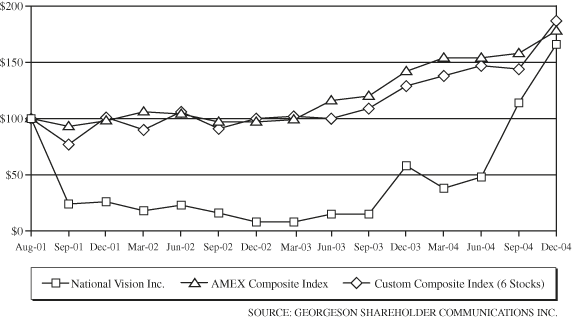
| Aug-01 | Sep-01 | Dec-01 | Mar-02 | Jun-02 | Sep-02 | Dec-02 | Mar-03 | Jun-03 | Sep-03 | Dec-03 | Mar-04 | Jun-04 | Sep-04 | Dec-04 | ||||||||||||||||||||||||||||||||||||||||||||||||||||||||||||||
|
National Vision, Inc.
|
$ | 100 | $ | 24 | $ | 26 | $ | 18 | $ | 23 | $ | 16 | $ | 8 | $ | 8 | $ | 15 | $ | 15 | $ | 58 | $ | 38 | $ | 48 | $ | 114 | $ | 166 | ||||||||||||||||||||||||||||||||||||||||||||||
|
Amex Composite Index
|
$ | 100 | $ | 93 | $ | 98 | $ | 106 | $ | 104 | $ | 97 | $ | 97 | $ | 99 | $ | 116 | $ | 120 | $ | 142 | $ | 154 | $ | 154 | $ | 158 | $ | 178 | ||||||||||||||||||||||||||||||||||||||||||||||
|
Custom Composite Index (Stocks)
|
$ | 100 | $ | 77 | $ | 101 | $ | 90 | $ | 106 | $ | 91 | $ | 100 | $ | 102 | $ | 100 | $ | 109 | $ | 129 | $ | 138 | $ | 147 | $ | 144 | $ | 187 | ||||||||||||||||||||||||||||||||||||||||||||||
The Custom Composite Index consists of the following companies
with SIC code 5900 (Misc. Retail) that trade on the American
Stock Exchange: Blair Corp., Collegiate Pacific, Inc., Glacier
Water Services, Inc., iParty Corp., Mayor’s Jewelers, Inc.,
and National Vision, Inc.
A-16
Table of Contents
ANNEX B
July 25,
2005
Special Committee of the Board of Directors
National Vision, Inc.
296 Grayson Highway
Lawrenceville, GA 30045
Gentlemen:
We understand that Vision Acquisition Corp. (the
“Acquiror”), a wholly-owned affiliate of Vision
Holding Corp. (“Parent”), each affiliates of Berkshire
Partners, LLC (“Berkshire”), intends to make a tender
offer (the “Offer”) for all of the issued and
outstanding shares of common stock, par value $0.01 per
share, and the associated shareholder rights (collectively, the
“Shares”), of National Vision, Inc. (the
“Company”) at a cash price of $7.25 per Share
pursuant to an Agreement and Plan of Merger (the “NVI
Merger Agreement”) among the Company, Parent and the
Acquiror, dated as of July 25, 2005 which provides that
following completion of the Offer and at the effective time of
the Merger (as defined below) the Acquiror shall merge with and
into the Company and each Share not owned by the Company,
Parent, Acquiror, or if applicable, shareholders who perfect
dissenters rights, shall be converted into the right to receive
consideration equal to that paid per Share in the Offer (the
“Merger”). We further understand that the Company has
entered into a Share Purchase Agreement (the “CVG
Acquisition Agreement”), dated as of July 25, 2005,
providing for the acquisition (the “Acquisition”) by
the Company of Consolidated Vision Group, Inc.
(“CVG”), and that the Offer is contingent upon, among
other things, the completion of the Acquisition.
You have asked us whether or not, in our opinion, the proposed
cash consideration to be received by the shareholders of the
Company pursuant to the Offer and the Merger is fair to the
shareholders of the Company from a financial point of view.
In arriving at the opinion set forth below, we have, among other
things:
| (1) reviewed the Company’s Annual Reports on Form 10-K and related financial information for the years ended December 29, 2001, December 28, 2002, January 3, 2004 and January 1, 2005, the Company’s Quarterly Report on Form 10-Q and the related unaudited financial information for the three months ended April 2, 2005 and the Company’s Proxy Statement for the Annual Meeting of Shareholders held on June 29, 2004; | |
| (2) reviewed certain information, including financial forecasts, relating to the business, earnings, cash flow, assets and prospects of the Company, furnished to us by the Company; | |
| (3) reviewed audited financial statements for CVG for the years ended December 31, 2003 and 2004, together with unaudited financial information for CVG; |
B-1
Table of Contents
Special Committee of the Board of Directors
National Vision, Inc.
Page 2 of 3
| (4) reviewed financial forecasts prepared by the Company regarding a pro forma combination of the Company with CVG; | |
| (5) conducted discussions with members of senior management of the Company concerning its businesses and prospects and visited the headquarters and certain store locations of the Company and CVG; | |
| (6) reviewed the historical market prices and trading activity for the Shares and compared them with that of certain publicly traded companies which we deemed to be relevant; | |
| (7) compared certain financial information for the Company with that of certain publicly traded companies which we deemed to be relevant; | |
| (8) compared the proposed financial terms of the Offer and Merger with the financial terms of certain other mergers and acquisitions which we deemed to be relevant; | |
| (9) reviewed the NVI Merger Agreement and the CVG Acquisition Agreement; | |
| (10) reviewed the strategic and financial alternatives pursued by TM Capital and the Company since our retention as NVI’s financial advisor; and | |
| (11) reviewed such other financial studies and analyses and performed such other investigations and took into account such other matters as we deemed necessary, including our assessment of general economic, market and monetary conditions. |
In preparing our opinion, we have relied on the accuracy and
completeness of all information supplied or otherwise made
available to us by the Company, and we have not assumed any
responsibility to independently verify such information. With
respect to the financial forecasts examined by us, we have
assumed that they were reasonably prepared and reflect the best
currently available estimates and good faith judgments of the
management of the Company as to the future performance of the
Company and we have not assumed any responsibility to
independently verify such information. We have also relied upon
assurances of the management of the Company that they are
unaware of any facts that would make the information or
financial forecasts provided to us incomplete or misleading.
We have not made any independent evaluation or appraisal of the
assets or liabilities (contingent or otherwise) of the Company
nor have we been furnished with any such evaluations or
appraisals. We have also assumed with your consent that any
material liabilities (contingent or otherwise, known or unknown)
of the Company are as set forth in the consolidated financial
statements of the Company or the forecasted financial
information referred to above.
We have assumed that the Merger and Acquisition will each be
consummated in a timely manner and in accordance with the terms
of the NVI Merger Agreement and CVG Acquisition Agreement,
respectively, without any limitations, restrictions, conditions,
amendments or modifications, regulatory or otherwise, that
collectively would have a material effect on the Company.
This opinion is directed to the Special Committee of the Board
of Directors of the Company and does not constitute a
recommendation to any shareholder of the Company as to whether
any such shareholder should or should not tender shares pursuant
to the Offer nor whether any shareholder should seek to perfect
such shareholder’s dissenter’s rights in connection
with the Merger. This opinion does not address the relative
merits of the Offer and any other transactions or business
strategies discussed by the Board of Directors of the Company as
alternatives to the Offer or the decision of the Board of
Directors of the Company with respect to the Offer. Our opinion
is based on economic, monetary and market conditions existing on
the date hereof. We assume no responsibility for updating or
revising our opinion based on circumstances or events occurring
after the date hereof.
B-2
Table of Contents
Special Committee of the Board of Directors
National Vision, Inc.
Page 3 of 3
TM Capital Corp. is currently acting as financial advisor to the
Company in connection with the Offer and will be receiving a fee
in connection with the rendering of this opinion. In addition,
TM Capital Corp. will receive a fee in connection with the
consummation of the Merger and the Acquisition. A Managing
Director of TM Capital is an investor in an investment
partnership which is an investor in Berkshire Fund VI, L.P.
This Managing Director did not participate in the negotiation of
the terms of the Offer and Merger and did not participate in the
preparation of this opinion.
On the basis of, and subject to the foregoing, we are of the
opinion that the proposed cash consideration to be received by
the shareholders of the Company pursuant to the Offer and Merger
is fair to the shareholders of the Company from a financial
point of view.
This opinion has been prepared for the information of the
Special Committee of the Board of Directors of the Company in
connection with the Offer and shall not be reproduced,
summarized, described or referred to, provided to any person or
otherwise made public or used for any other purpose without the
prior written consent of TM Capital Corp., provided, however,
that this letter may be reproduced in full in a
Schedule 14D-9 filed by the Company related to the Offer
and in any solicitation materials regarding the Merger.
| Very truly yours, | |
| TM Capital Corp. | |
|
/s/ Michael S. Goldman ________________________ |
| By: |
Michael S. Goldman Managing Director |
B-3
Exhibit 99.1(a)(5)(A)

Peter T. Socha
Chairman
July 28, 2005
Dear Fellow Shareholder:
I am pleased to inform you that as of July 25, 2005
National Vision, Inc. (“NVI”) entered into an
Agreement and Plan of Merger (the “Merger Agreement”)
with Vision Holding Corp. (“Parent”) and Vision
Acquisition Corp. (“Acquisition Corp.”), each of which
are affiliates of Berkshire Partners LLC
(“Berkshire”). Pursuant to the Merger Agreement,
Acquisition Corp. is today commencing a tender offer (the
“Offer”) to purchase all outstanding shares of NVI
common stock, par value $0.01 per share, including the
associated rights (the “Rights”) to purchase
Series A Participating Cumulative Preferred Stock, par
value $0.01 per share, issued pursuant to the Rights Plan
dated as of January 27, 1997 (as amended from time to time,
the “Company Rights Agreement”), between the Company
and American Stock Transfer & Trust Company (together, the
“Shares”), at a price of $7.25 per Share. The
Offer is subject to several conditions that are described in the
accompanying documents. The $7.25 per Share being offered
by Parent and Acquisition Corp. represents approximately a 42%
premium to the closing stock price on July 25, 2005, the
day the Merger Agreement was executed.
The Merger Agreement provides that, if the Offer is completed,
Acquisition Corp. will merge with and into NVI (the
“Merger”), and NVI will become a wholly-owned
subsidiary of Parent. In the Merger, each Share not acquired by
Acquisition Corp. in the Offer will be converted into the right
to receive the same consideration paid pursuant to the Offer.
Your Board of Directors has unanimously approved the Merger
Agreement and determined that the Offer and the Merger are fair
to, and in the best interests of, the shareholders of NVI.
Accordingly, your Board of Directors recommends that you accept
the Offer and tender your Shares pursuant to the Offer.
In arriving at its recommendation, the Board of Directors formed
a special committee of certain members of the Board of Directors
(the “Special Committee”) to carefully review the
Offer and the Merger. The Board of Directors gave careful
consideration to a number of factors which are described in the
enclosed Schedule 14D-9, which is being filed with the
Securities and Exchange Commission, including, among other
things, the evaluation performed by the Special Committee and
the opinion of TM Capital Corp. to the Special Committee (the
“Opinion”) that, as of July 25, 2005 and subject
to the assumptions made, matters considered and limitations on
the review undertaken set forth in the Opinion, the $7.25 in
cash per Share to be received by the shareholders of NVI in the
Offer and the Merger is fair, from a financial point of view, to
such shareholders. The full text of the Opinion is attached as
Annex B to the enclosed Schedule 14D-9, and the Board
of Directors urges you to read it carefully and in its entirety.
Additional information with respect to the transaction is
contained in the enclosed Schedule 14D-9, which the Board
of Directors urges you to read carefully.
Accompanying this letter, in addition to the
Schedule 14D-9, is Acquisition Corp.’s Offer to
Purchase, dated July 28, 2005, and related materials,
including a Letter of Transmittal to be used for tendering your
Shares. These documents set forth the terms and conditions of
the Offer and provide instructions as to how to tender your
Shares. On behalf of NVI, I urge you to read the enclosed
material and consider this information carefully, and I would
like to personally thank you for your time as a shareholder of
NVI.
| Sincerely, | |
 |
|
| Peter T. Socha | |
| Chairman |
296 Grayson Highway • Lawrenceville, GA
30045 • (770) 822-3600 • Fax:
(770) 822-3601
P.O.
Box 1000 • Lawrenceville,
GA 30046